
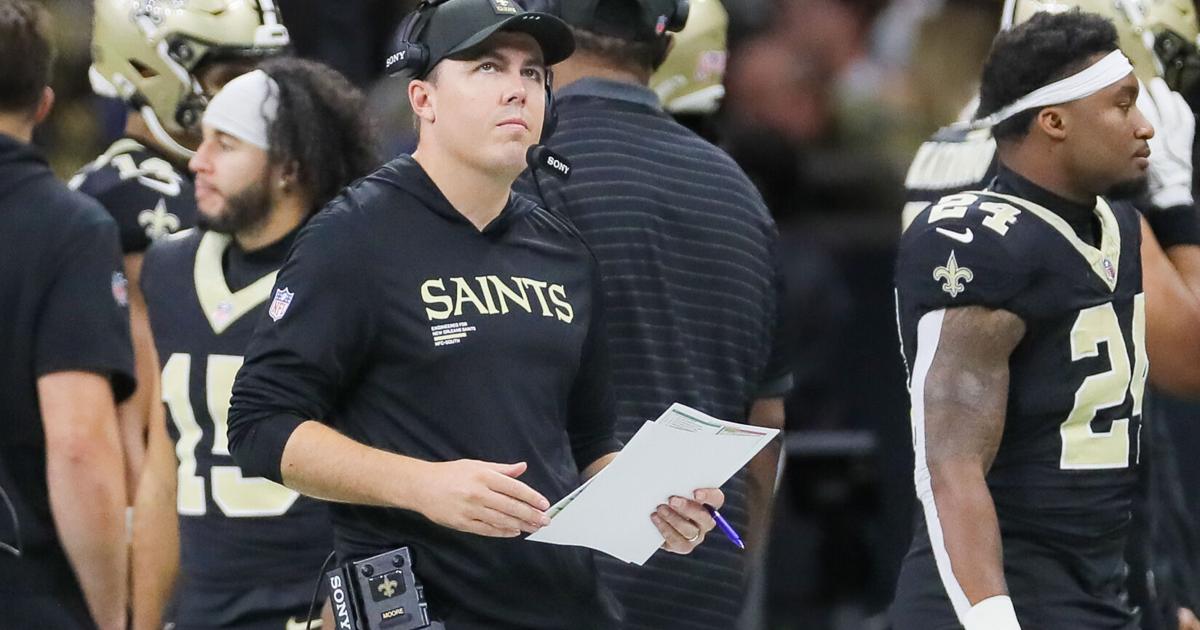
When the Los Angeles Chargers hired him to be offensive coordinator in 2023, Kellen Moore was determined not to be a wrecking ball, keeping some of the holdover concepts for a few reasons.
First, Moore knew predecessor Joe Lombardi’s scheme well after playing under him as a quarterback in Detroit. But more importantly, Moore recalled, Chargers quarterback Justin Herbert had already worked with “million” coordinators to start his promising career. So Moore wanted to maintain some semblance of continuity, even with his fresh approach.
Two years later, when he was hired to coach the New Orleans Saints, Moore brought out his axe.
“We just clean slated it for the most part here,” Moore said.
With the Saints, Moore installed his offense — tossing out what former offensive coordinator Klint Kubiak ran last year. And the differences aren’t just readily apparent — they’ll be on full display Sunday when the Saints face the Seattle Seahawks, the team that now employs Kubiak as its play-caller.
The clash in styles marks how different teams can go about attacking a defense. After all, Moore and Kubiak have both been lauded for their offensive prowess. But the way these men scheme up plays couldn’t be more glaring.
Kubiak emphasizes stretching the field with zone-based runs, mixing in a good dose of play-action and utilizing condensed formations to keep defenses off guard. Moore, by contrast, wants to spread it out, push the pace and mix in RPOs (run-pass options) to create a guessing game. The two, coincidentally, are each the son of coaches — those who grew up around the sport and carry a specific lens in which they learned the Xs and Os.
One idea isn’t automatically better than the other. They’re just distinct.
That’s football.
“That’s the beauty of it,” Moore said. “There’s a lot of different ways of approaching this. There’s no right way or a wrong way. … It’s the fun challenge of this. That’s what we all enjoy. This job is problem solving and helping the guys become the best versions of themself. And that’s what we get to do each week.”
Shotgun, shotgun, shotgun
Erik McCoy has rarely paid this much attention to how he snaps the ball.
Last year, the New Orleans Saints center was primarily focused on reading the opposing coverage before the play so that he could communicate any necessary adjustments to the protection. Kubiak, in particular, tasks the center to handle protection calls in his offense to help ease the burden on the quarterback. But when it was time to run the play, more often than not, McCoy would just hand it off to the quarterback under center.
This year, McCoy is still involved with protections — but he said he’s had to be on his “Ps and Qs” because of just how often the Saints are snapping out of the shotgun formation.
“You’ve got to get these things on the money,” McCoy said.
Moore has made the Saints a shotgun-first team.
In simple terms, the coach uses formations that spread out his receivers and keeps the quarterback standing several yards behind the center. And while there is still variety to how the Saints lineup within those looks, no team in the NFL has run more plays out of shotgun than New Orleans.
Through two games, according to Next Gen Stats, the Saints have run 113 shotgun snaps. For context, last year’s Saints didn’t reach that mark until Week 5.
Moore likes these looks because they allow the quarterback to see the field a “a little bit cleaner” — and that’s useful since starter Spencer Rattler, at only 6 feet, isn’t the tallest quarterback.
But there are deeper explanations. Moore said he’s “tied” the Saints’ run game around these formations to avoid being as one-dimensional. Out of the ‘gun, the Saints have had the seventh-highest rushing rate at 31%.
Under Moore, the Saints have put a heavy emphasis on RPO, which requires the quarterback to make a split-second decision whether to pass or run the ball based on how the defense reacts. In this setting, according to Pro Football Reference, the Saints’ 28 RPOs are also tied for a league high ahead of Week 3.
But because the Saints are still spread out wide, defenses aren’t stacking the box as much as they would in obvious run situations.
Alvin Kamara, for instance, has faced a light box (six or fewer defenders) on 73.1% of his rushing plays, the highest rate in the league, according to Next Gen Stats. He’s punished such looks, running for 113 yards on 24 carries.
Kubiak, meanwhile, wasn’t allergic to the shotgun last year — but the Saints ranked 27th on total shotgun plays.
3s and layups
The Seattle Seahawks haven’t exactly lit the league on fire as the Saints did through the first two weeks of last season.
But Kubiak’s fingerprints are still all over the offense.
To start the year, the Seahawks have run the fifth-most snaps under center — one spot above where the Saints finished in 2024. They have a pass-run ratio of 52-48, closer to what Kubiak likely wanted to run in New Orleans before consistently trailing skewed that split (57-43). And it wouldn’t be a Kubiak offense without an overload of pre-snap motion, doing so on 59.6% of Seattle’s plays, even a slight uptick from last year’s 57.8%.
“Yeah, it’s similar,” cornerback Alontae Taylor said, noting Seahawks wide receiver Jaxon Smith-Njigba is “basically” playing Chris Olave’s role from last year.
If there is one overlap between Moore and Kubiak, they seem to share a love of motion. Moore not only has the Saints running motion on 69.1% of their snaps, but he also ran it at a similar rate (57.5%) as Kubiak when he was with the Philadelphia Eagles last season.
Most of the parallels end there.
Philosophically, Kubiak and Moore attack defenses in different ways. In the passing game, quarterback Jake Haener said Kubiak really tries to emphasize the middle of the field by “layering things on top of each other.” Moore, at least to start the season, has worked the perimeter more of late, Haener said. Nearly half (37 of 80) of Rattler’s attempts have come on out-routes or hitches.
Moore, too, loves a good basketball analogy. In the offseason, he showed his players the Indiana Pacers as an example of how fast he wants the Saints to play — and it should be no surprise that New Orleans’ 38 no-huddle snaps rank second this season. But beyond that, the coach also harps on his quarterbacks to stick to “3-pointers and layups” — either passes that result in big gains or easy completions.
“If the 3-pointer is there, take it,” Rattler said. “If not, get your layup.”
Part of that, of course, is fundamental football — Kubiak also stressed taking shots when available, Haener said.
But, to borrow another basketball term for a second, Moore is also cognizant of the mid-range shot — which has been largely fazed out in the NBA because of its ineffectiveness. Mid-range shots, these days, are reserved for superstars or specialists, such as Kevin Durant or DeMar DeRozan — who shoot well-above average on those looks.
So what’s the NFL equivalent of a mid-range jumper? Defensive coordinator Brandon Staley said they’re the plays that are “first-down oriented” — a 6-to-12-yard play, he said — rather than being designed to be explosive.
Or, to cite “Moneyball,” the goal shouldn’t be to get first downs. The goal should be to get touchdowns.
“Threes add up quicker than 2s,” Staley said, noting that checking it down can still pick up the same amount of yardage as first-down oriented plays. “It’s just that simplicity to it, as well. But I also think there’s an efficiency aspect to it for offenses. … It’s less risky.
“Sometimes in that first-oriented area, there’s a lot of people in the way. And so if there’s a lot of people in the way, more risk.”
Moore understands that trade off, even though the Saints haven’t yet consistently hit on those explosives. New Orleans has just nine explosives to start the season, the NFL’s fifth-fewest. Only three of those nine have gone for at least 20 yards.
But the logic is there. Staley said the “simple” approach is how every great offense throughout history has functioned, adding it also helps players play fast.
“It’s a sign of who Kellen is and what makes him such an effective coach,” Staley said.
This week, Moore said he has a “ton of respect” for Kubiak. He said he recognized there was a “lot of good stuff” that Kubiak brought to the Saints. But the franchise ultimately made a change after a disappointing 5-12 season. The offense, hamstrung by a litany of injuries, wasn’t as effective as it needed to be.
So, Moore brought his own system — one that was unlike anything the Saints had seen before.