
My sons, two snot-nosed little middle schoolers who think they know everything, do this thing when I start scolding them with some story about not having a smartphone in high school, or waiting in line to buy “In Utero.” (You know, those things you do when you get older and realize you’re talking far more about things that have already happened rather than things that someday will — when there is more in your life to look back at than forward to.)
My kids, these little punks, they hike up their shorts, they push imaginary spectacles up their nose and they say, with a nasal pinch, “Back in my day …”
It’s iconic tween behavior and instantly devastating. There’s really no way to respond other than sputtering, “Well, someday you’ll be old!” and slinking away in shame.
Last week, Clemson coach Dabo Swinney did a classic middle-aged guy move: He began to lecture us about the old days.
“If they want me gone, they’re tired of winning, they can send me on their way because that’s all we’ve done is win,” Swinney said at some point during a 12-minute rant, another classic Gen-X move. We’re all Lloyd Dobler; we love our emotional soliloquies.
“So if they’re tired of winning — we’ve won this league eight out of the last 10 years, is that not good? I’m just asking. Is that good?”
The whole press conference had what The Solid Verbal’s Dan Rubenstein amusingly called, “Well, I guess I’m the worst mom ever!” energy.
Swinney then promptly went out and got shelled, at home, by Syracuse, dropping his team to 1-3 and making the illusion that he was going to figure all this out go poof. Swinney, a former walk-on at Alabama who in many ways is the manifestation of what college football once was, famously has eschewed, even lambasted, the transfer portal, NIL and the world of college football we all now swim in.
He’s a true believer, a man who has succeeded his way in the past and firmly believes, in the face of mounting evidence, he will do so again. He shares this kinship with Oklahoma State coach Mike Gundy, the best coach Stillwater has ever seen, who, as the sport has changed, has watched his program dissolve around him.
Thus, they have another thing they share: Their fan bases, the ones who once lifted them to the near-deified status they have enjoyed for a decade-plus, now want them gone. Both Swinney and Gundy have to remind their fans of their past because the present for both of them is so unsatisfying. But those past glories have already happened. We’re all watching sports now.
The thing about aging is that there is inevitably a moment when all that wisdom and experience you’ve been accruing over the decades begins to curdle, when what you’ve been through before blinds you to what’s happening right now. You can go from a captain of industry to a yeller at clouds in an instant. True wisdom is recognizing that when the world changes, you have to change too — or else get out of the way so someone without all your baggage can take their turn.
This is the lesson both Swinney and Gundy have failed to absorb: Just because it worked before doesn’t mean it’s going to work now. And their failure to absorb that lesson has been an entirely conscious choice.
Only two active coaches, Kirby Smart and Ryan Day, have won a national championship since Swinney last won his in January 2019, and both of them currently have teams in the AP poll’s top five; they are not talking about the old days at their news conferences because they’re too busy winning right now. These men are of the same era, in the same general age range (Gundy is 58; Swinney 55; Smart 49; Day 46) and they’ve all been involved in the sport of college football for more than a decade, all successful and firmly ensconced in this world long before the seismic changes of the last half-decade.
Smart and Day (and plenty others) saw the direction college football was going and steered into the skid; Swinney and Gundy decided to plow ahead, sticking to what had worked before. They liked the way college football was before.
You know, “back in my day!”
Not changing when the sport did was a life decision. It’s a decision I understand, and it’s not an entirely uncommon one; leaving college coaching because you don’t like what the job has become its own trope, from Jay Wright and Tony Bennett in basketball to Coastal Carolina’s Gary Gilmore in baseball to Dirk Koetter and even Nick Saban in football. Swinney and Gundy didn’t leave — one suspects the money might have something to do with it — but they haven’t altered their fundamental ethos.
And, thus, they’re losing. And, thus, their fans want them gone.
Here’s the thing, though: I suspect, deep down, many fans agree with Swinney and Gundy. College football has changed too fast, and it does feel fundamentally different from the sport we all fell in love with. Most college football fans I know do wish it were the same sport as when Swinney and Gundy were successful, or at least when fans felt like they had a more emotional connection to it — when rosters were less static, when the Pac-12 existed, when not every offseason was a non-stop bidding war.
An argument could be made that Swinney and Gundy, by not overhauling their teams, by not altering who they are, by sticking to the old way, are being more fundamentally true to what people love about college football. When fans talk about what they love about college football, they’re talking about exactly what Swinney and Gundy have been trying to protect — exactly what they’re complaining about.
But the job of Swinney and Gundy is not to protect college football. It is not to complain. It is not to tell stories about how things used to be. It is to win.
The problem is not that fans think Swinney and Gundy are wrong to prefer the way college football used to be. The problem is that it’s just nostalgia — and nostalgia wins you nothing.
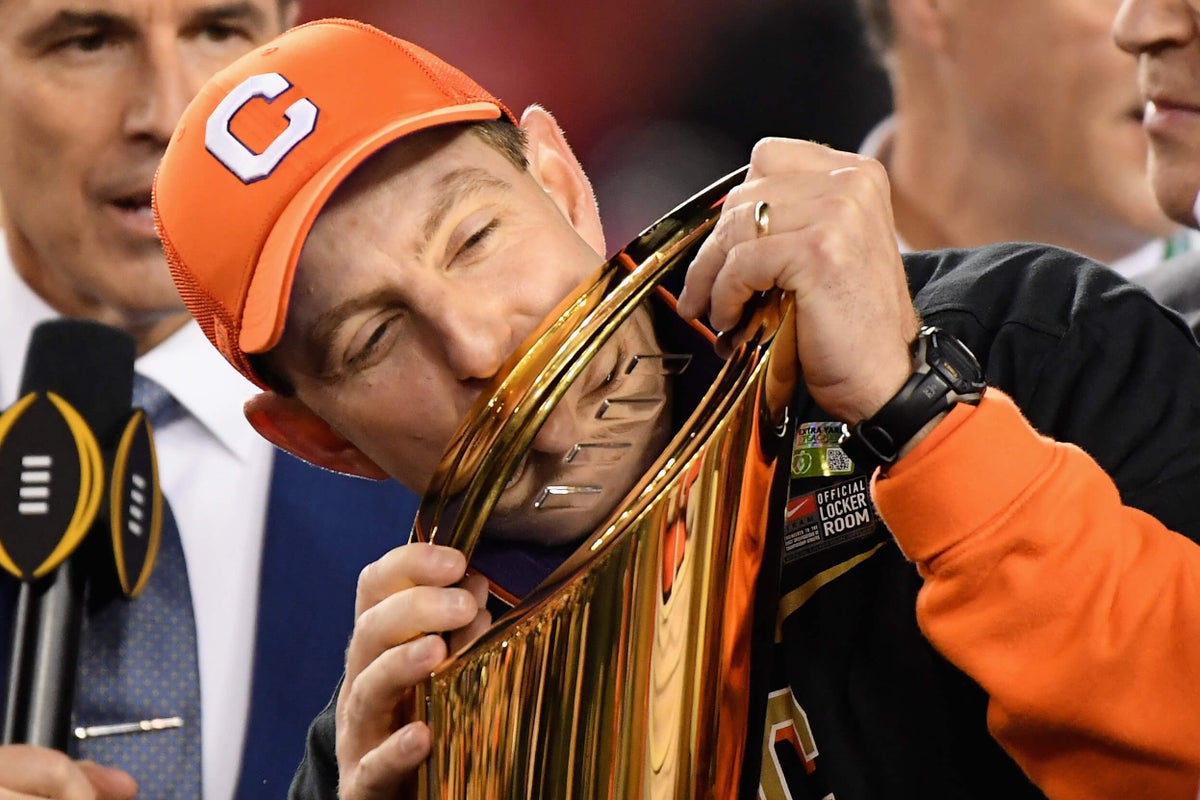
(Photo of Swinney after winning the 2019 national championship: Harry How / Getty Images)