
In 2013, Texas A&M quarterback and reigning Heisman Trophy winner Johnny Manziel was suspended by the NCAA for the first half of the Aggies season opener after an investigation into whether he accepted payment to sign autographs.
A dozen years later, Texas quarterback Arch Manning was featured in multiple nationally televised commercials during his first game as the team’s full-time starter.
The connection, aside from being SEC QBs in the Lone Star State, is that Manning is the biggest celebrity college football quarterback since Johnny Football burst onto the scene more than a decade ago, and Tim Tebow before that.
Unlike those two, Manning can profit off of his name, image and likeness as a college athlete — and he’s cashing in. Details are hard to come by, but a valuation from the recruiting website On3 suggests his current NIL value is $5.5 million. Yet in a landscape shaped by lavish NIL payments from booster-funded collectives and the onset of direct revenue sharing between athletes and athletic departments, Manning is making fresh tracks, raking in millions via endorsement dollars as a pitchman for prominent eyewear and ride share companies. His No. 16 Longhorns jersey is popular on Austin’s Forty Acres and beyond.
“He’s QB1 at Texas,” said Steve Denton, CEO of Opendorse, an NIL digital platform and marketplace. “Great name, football royalty, and the most valuable position in college sports.”
Others have attained varying levels of fame since Tebow and Manziel — Jameis Winston, Joe Burrow, Shedeur Sanders, to name a few — but none fully broke through to casual sports fans. Manning has joined that rarified air, and in his own distinct way. The others rose to prominence due to on-field success, but Manning has been famous since he was in high school. He’s the First Nephew of Quarterbacks, with Uncles Peyton and Eli, not to mention Grandpa Archie. The combination of his last name, five-star recruiting hype, and a blue blood like Texas meant the fame came first, and only intensified during his first two seasons as a college backup.
It’s built to full-scale Arch Mania in 2025, during which Manning was dubbed the Heisman favorite, next No. 1 NFL Draft pick and best college football quarterback “since Tebow,” all before he took the field as the Longhorns official starter.
However you quantify it, Arch Manning is alone at the top — the biggest celebrity college quarterback of the NIL era.
And he’s navigating his first PR crisis.
Manning’s passing numbers through the first three games of 2025 were pedestrian, to put it kindly: 55.3 percent completion rate, 6.8 yards per completion, six touchdowns, three interceptions. Entering last weekend, his completion rate ranked 119th among qualified FBS passers, and during an uninspiring Week 3 win over UTEP, he was booed by the home crowd.
He finally padded the stat line on Saturday, completing 18 of his 21 throws for 309 yards and three touchdowns, plus another two scores on the ground in a 55-0 skunking of Sam Houston. It was by far the best (and most emotional) Manning has looked all year, albeit against a winless Group of 5 opponent with one of the worst defenses in college football.
“I felt good. I wish I could have done that the past four weeks, but I’m glad we did it tonight,” Manning said after the game.
The off-field financial aspect is less cut and dried than a box score, but it still factors heavily into Manning’s outsized expectations — and the early disappointment.
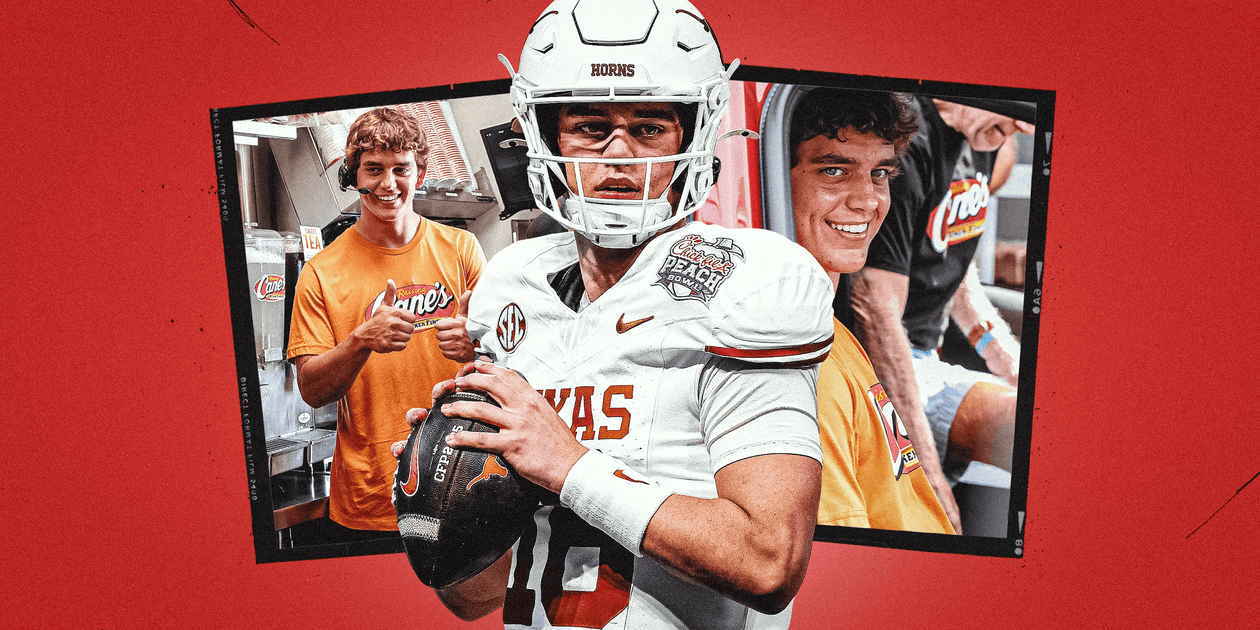
Manning, who is represented by Excel Sports Management, has a handful of national endorsement contracts, including Red Bull (a multiyear deal believed to be the most substantial), Uber, Warby Parker glasses, Raising Cane’s restaurant chain, Vuori clothing brand,and Panini America trading cards and memorabilia. Many of his commercials are a family affair, leaning into Arch’s aww-shucks, self-deprecating disposition. The Warby Parker spot features Arch’s dad, Cooper, needling his son for having “more of an accountant look” than a traditional quarterback. A Raising Cane’s ad features Cooper and Archie, along with LSU quarterback Garrett Nussmeier. In a commercial for Waymo, Uber’s driverless taxis, Arch, Archie and Cooper all cram into the backseat as dad and grandpa chide Arch for his dodgy driving ability.
Last year, Manning also appeared in a commercial for EA Sports with his uncle Eli Manning to promote the return of the college football video game. Arch, a redshirt freshman backing up Quinn Ewers at the time, initially opted out of having his likeness in the game before reversing course.
I’m IN the game 🤘 #CFB25 @EASportsCollege #EAAthlete pic.twitter.com/mgndu7Khuz
— Arch Manning (@ArchManning) July 9, 2024
Players who opted into the video game received $600 and a copy of the game, but On3’s Pete Nakos reported in July 2024 that Manning was paid an additional $50,000-$60,000 for the commercial. That’s as detailed as it gets in terms of money. Manning is highly visible, but his business profile is carefully curated — and guarded. Outside of SEC media days, Manning did only a few interviews this offseason, and most of them had a promotional tie-in. The Athletic reached out to multiple business representatives and partners, as well as the Texas athletic department, for comment on the financial impact of Manning. None would talk specifics, and most declined to discuss it at all.
The hesitancy extends beyond endorsement deals with outside companies. There’s also revenue sharing and the maybe-fleeting “pay for play” dollars from NIL collectives, with plenty of it funneled to starting quarterbacks. Reports vary, but Miami’s Carson Beck, Penn State’s Drew Allar, Duke’s Darian Mensah, Oklahoma’s John Mateer and Michigan freshman Bryce Underwood are all believed to be earning in the ballpark of $3 million this season, with some endorsements sprinkled in.
Manning likely surpasses each of them in endorsements alone, regardless of what he may or may not receive on top of that. In a Houston Chronicle article this spring, Kirk Bohls wrote Manning is “by far the highest-paid Texas player” but doesn’t take any money from the school. A Texas program source declined to comment on the matter, even when speaking anonymously in exchange for candor, and Manning himself has been similarly cagey.
“I don’t really know how it’s going to work,” Manning told The Athletic this summer when asked about revenue sharing. “I’m just here to play football.”
While college football is an increasingly professionalized sport, contracts are rarely reported, unlike the NFL, where most deals are made public. Neither Manning nor anyone in his orbit has an obligation to publicly talk about money. But that won’t stop everyone else. Fair or not, “pocket watching” comes with the territory in today’s attention economy.
With the caveat that mileage varies within the industry on how accurate these valuations are, Manning tops the On3 list of all college athletes, and is the only athlete above the $5 million mark; Beck is second at $4.9 million. On3 uses a proprietary algorithm, so it’s unclear how the company arrives at its estimates or how close $5.5 million is to Manning’s actual earnings — for example, just a week ago, the site listed Manning at $6.3 million. But with Manning, anything in that ballpark is on the table.
“For most athletes, those valuations, where the hell are you getting those from?” said one NIL industry source, granted anonymity in exchange for their candor. “But Arch is one of one. I don’t think that number is outside the realm of possibility if you’re factoring in what he could demand within the market from a rev-share standpoint, third-party deals. That could be legitimate. There are a lot of things aligning there.”
His family name is chief among them, amassing a wealth of opportunities while also affording the security to be selective. Manning made headlines as a freshman when his grandfather, Archie, stated that his grandson wouldn’t sign any NIL deals until he became the starter.
There ended up being exceptions. Panini was Manning’s first NIL deal as a freshman, and he was the first college freshman Panini had ever signed. In 2023, the company produced a one-of-one Manning autographed card that sold at auction for $102,500. The proceeds were donated to Ronald McDonald House Charities of Central Texas.
“We had conversations with him early on because we felt like Arch was the right kid to jump into that space in a big way,” said Jason Howarth, senior vice president of marketing and athlete relations for Panini America. “(Arch and his family) were a little bit hesitant at first, but we explained to them that he is the product. This is the way NIL was meant to work.”
Panini expanded its multiyear deal with Manning this past spring.
Excited to announce I have signed an exclusive autograph memorabilia deal with @PaniniAmerica! #HookEm https://t.co/SZN12t3FRY pic.twitter.com/Isnh7Bjhgc
— Arch Manning (@ArchManning) April 16, 2025
“I want to do deals with companies that I would represent well and they would represent me well,” said Manning. “I have a lot of people in my life to lean on, whether it’s friends or family when deciding this stuff. I try not to do much.”
The endorsement arsenal is also noteworthy considering Manning’s limited use of social media. He has 74,000 followers on X and just five total posts, starting with his Texas commitment announcement in 2022. He’s more active on Instagram, where he has 542,000 followers, but has still made just 22 total posts, many of which are simply re-posting commercials of his brand deals. Former LSU gymnast Livvy Dunne, on the other hand, has 5.4 million Instagram followers and nearly 600 posts. Former Iowa women’s basketball player Caitlin Clark has 3.6 million. Former Colorado two-way star and Heisman winner Travis Hunter has 2.2 million, and Sanders, his former teammate, has 2.5 million.
The best comp for Manning is probably former Duke men’s basketball player Cooper Flagg, who had a deal with New Balance while he was in school. But none of them, even Sanders, have a name that resonates like Manning’s.
“I’m not minimizing 500k followers, but it’s not like Livvy Dunne. That’s not his thing,” said Denton. “His earnings are not coming because he’s blowing up his social media. That’s what’s rare.”
There are other ways to gauge Manning’s value. The University Co-op in Austin, Texas, is the official course-material provider for the University of Texas and a not-for-profit retailer of Longhorns merchandise. It has felt the Arch effect.
“We’re referring to it as our Arch Manning Era,” said Olivia Biagi, the Co-op’s vice president of merchandising.
In 2024, Manning made a pair of spot starts in September for an injured Ewers and appeared sparingly in eight other games. Yet Biagi said the Co-op sold more than 7,200 units of Manning-branded merchandise in fiscal year 2024-25, and total adult jersey sales increased by 68 percent year over year, fueled by Manning’s No. 16 uniform. That doesn’t include Panini buying 500 Manning jerseys through the Co-op for Manning to sign.
Like many college athletes, Manning receives a portion of his merchandise royalties via NIL. At the Co-op that includes jerseys, T-shirts and, starting this month, a line of mugs and footballs with his name and number. Those sales also fund hundreds of course-material scholarships for Texas students, and they hadn’t let up entering the 2025 season. The week of the opener against Ohio State — which was a road game for Texas — the Co-op surpassed budgeted sales by 25 percent. The shop has pressed nearly 300 Manning jerseys since Aug. 1.
“It’s a completely different animal with Arch,” said Biagi. “I worked in Baton Rouge when Joe Burrow won a national championship at LSU. NIL wasn’t allowed then, so we couldn’t sell anything specific to Joe Burrow. But as big as that was, the excitement for Arch at Texas is two times bigger. At least.”
It’s not just in Austin. A spokesperson for OneTeam Partners, which has an NIL partnership with Fanatics, said Manning was among the top-selling jerseys nationally his first two college seasons — before he was named the full-time starter.
By all accounts, Manning has handled the fame and attention incredibly well, exhibiting a keen sense of maturity and self-awareness for someone who’s been in the spotlight since he was a teenager. Those who work with him won’t talk money, yet they don’t hesitate to rave about his character. But with great interest comes great scrutiny, and Manning’s early struggles have shifted the on-field narrative.
The Longhorns have dropped from preseason No. 1 to No. 10 in the AP Top 25. Manning’s Heisman odds plummeted from season-opening favorite to +2,500. ESPN’s Paul Finebaum has mea culpa-ed his “Arch = Tebow” preseason take. Fans remain wary, even after Saturday’s performance. The haters remain plentiful.
And, as is often the case in sports, the money puts a price tag on those perspectives.
It’s too soon to write Manning off, this season or long term. The Longhorns are idle this weekend before SEC play begins with a road trip to Florida. Maybe his showing against Sam Houston was the slump-buster he needed to turn things around. Those first three games could be a hazy, distant memory by Halloween.
Until that happens, it’s also fair to wonder what the future of the Arch Manning Era looks like, on and off the field, if his play fails to match the hype.
“I’m not really worried about what anyone thinks or the narratives,” Manning said after Saturday’s win, surrounded by a horde of reporters.
But that won’t stop everyone else.
— The Athletic’s Grace Raynor and Larry Holder contributed to this report.
(Illustration: Will Tullos / The Athletic; Photos: Kaitlyn Morris, Todd Kirkland / Getty Images)