
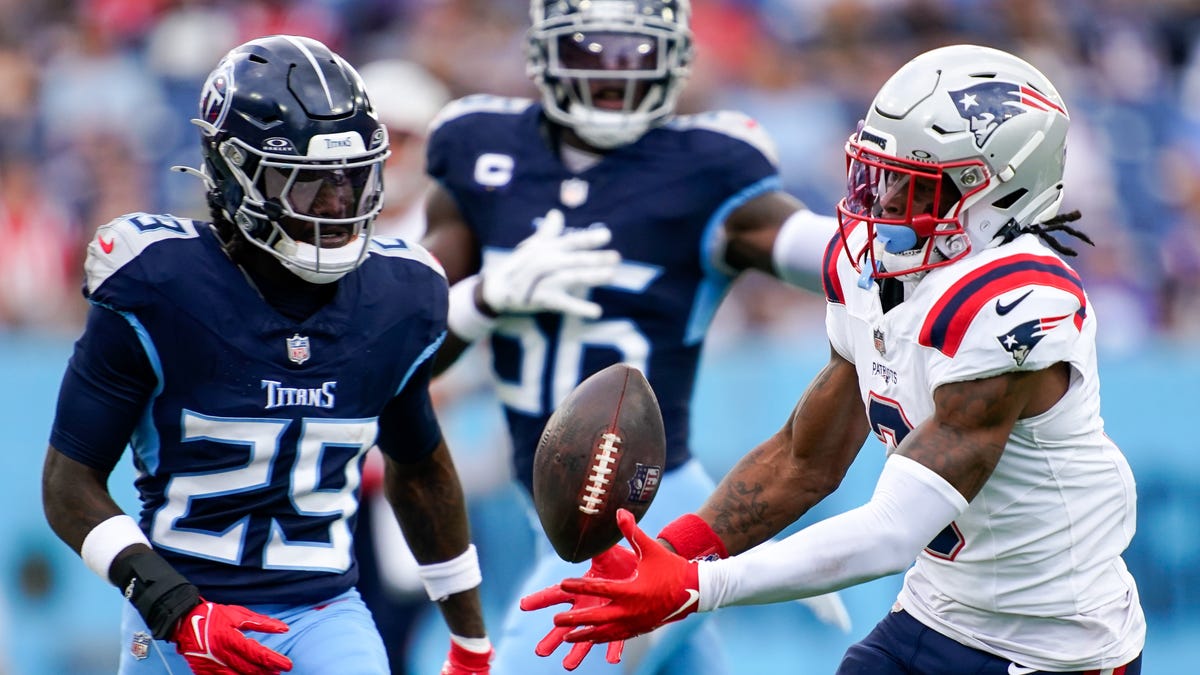
This is a perplexing one.
The Tennessee Titans traded second-year cornerback Jarvis Brownlee Jr. to the New York Jets on Sept. 23, getting a sixth-round pick in the 2026 NFL Draft in exchange for Brownlee and a seventh-rounder. The trade is a noteworthy surprise; Brownlee started 14 games as a rookie after the Titans drafted him in the fifth round in 2024, then entered the 2025 season as an unquestioned starter in a cornerback room already hurting for depth.
Now, in an era that has been defined by GM Mike Borgonzi and president of football operations Chad Brinker’s “draft, develop, retain” credo, the Titans are parting ways with a homegrown starter plucked out of the late rounds barely two years into his career. And in exchange for the former fifth-round pick, the Titans are getting a sixth-round pick. It’s hard to feel too enthusiastic about this return on investment, especially not when compared against the potential that Brownlee seemingly possesses.
Jarvis Brownlee stats: Breaking down who Titans are trading
To some extent, the excitement around Brownlee had more to do with his proving core competency as a rookie than it did with him putting up Pro Bowl-caliber performances. He allowed a passer rating north of 100 when thrown at last season to go along with nine penalties. In two games to start 2025, he allowed eight completions on 10 targets and got called for three penalties.
Pro Football Focus grades are hardly the end-all, be-all for evaluating players, but Brownlee graded out 87th among the 107 cornerbacks who played 250 or more coverage snaps in 2024. If the average team starts three cornerbacks, that means there are 96 jobs available, and Brownlee graded on the low end of that range. He also ranked low in the sample in passer rating against (82nd) and coverage snaps per target (85th) while ranking 11th in most penalties and in the bottom 30 in completion percentage against when targeted.
But again, those are numbers Brownlee put up as a rookie picked in the fifth round. And the promise was obvious. Despite the penalties, his aggressive nature led to eight forced incompletions, more than standouts from his draft class including Kool-Aid McKinstry, Cooper DeJean and Kamari Lassiter.
Let’s put it this way: Brownlee was the 21st cornerback drafted in 2024. He started more games than all but three of the players picked ahead of him, with the eighth-most coverage snaps of rookie cornerbacks. And the Titans are getting a pick in the Jets trade that is one round below where they drafted him.
Jarvis Brownlee trade: Why did Titans make deal?
Put any off-field considerations, injury questions or developments of other players aside for a second and view the trade from that lens, and it’s hard to believe Brownlee’s value has decreased in a year and a half in Tennessee. And because of the nature of the pick swap, it’s not as if the Titans are getting a full pick in return for Brownlee. They’re just improving a pick they already owned by giving up on a recent Day 3 selection.
But there is plausible logic here that the team can improve through subtraction. Jalyn Armour-Davis, who the Titans added via waivers in August, was a higher draft pick in 2022 than Brownlee was in 2024. Samuel Womack III, another waiver add, has just as much of a ball-hawking reputation, minus the penalty concerns. Marcus Harris, a sixth-round pick in 2025, now will have the chance to develop under the same coaches who developed Brownlee so quickly.
Those are just bets, though. Armour-Davis has played just 19 defensive snaps this year, and he has a long injury history. Harris has played only two defensive snaps. Womack hasn’t been active yet. Darrell Baker Jr., the Titans’ most-used backup cornerback, has yet to force an incompletion this season. And none of this mentions the looming L’Jarius Sneed question. The Titans’ No. 1 cornerback has been on the injury report since he arrived in Nashville; Sneed’s health concerns are a big reason why Brownlee had to play so much as a rookie.
The 2024 Titans held off on trading prominent assets DeAndre Hopkins and Ernest Jones IV until Week 8. Those moves allowed the Titans to pick tight end Gunnar Helm and guard Jackson Slater. There’s obviously upside and value in adding late-round picks. But there’s also upside and value in retaining a young, homegrown starter on a cheap contract at one of the five most important positions on the field.
It’s no secret Brinker and Borgonzi believe in amassing draft capital, and it’s hardly a surprise when a GM moves on from a player picked by his predecessor, in this case Ran Carthon. But it’s still a puzzling move for a team that has publicly and blatantly decreed that its best path forward is building around young, productive players who can develop into stars.
Nick Suss is the Titans beat writer for The Tennessean. Contact Nick at nsuss@gannett.com. Follow Nick on X @nicksuss. Subscribe to the Talkin’ Titans newsletter for updates sent directly to your inbox.