
The most dangerous part of NFL data is that it can be easily manipulated to tell any story you want. That’s the risk of small sample sizes.
In this column, I flag potential trends that might matter. It could be a hidden tight end climbing a depth chart. Maybe a veteran receiver proving he’s still got it. And after three weeks, I’ll review how I did.
This week, I want to talk about why we shouldn’t be surprised by the lack of production from highly drafted rookie running backs, and the cheapest rookie you should be acquiring moving forward.
Unless otherwise noted, all stats are tailored to redraft, PPR, 1-QB leagues.
Let’s talk rookie running backs, specifically, what their slow starts means for the rest of the season and the only running back I’m comfortable buying at cost.
Running backs travel in packs, or so it seems. Since 2000, we’ve seen two historically strong classes leave their imprints on the NFL:
The 2008 class, led by Chris Johnson, Matt Forte and Jamaal Charles; and the 2017 class, headlined by Christian McCaffrey, Alvin Kamara, Dalvin Cook and Leonard Fournette.
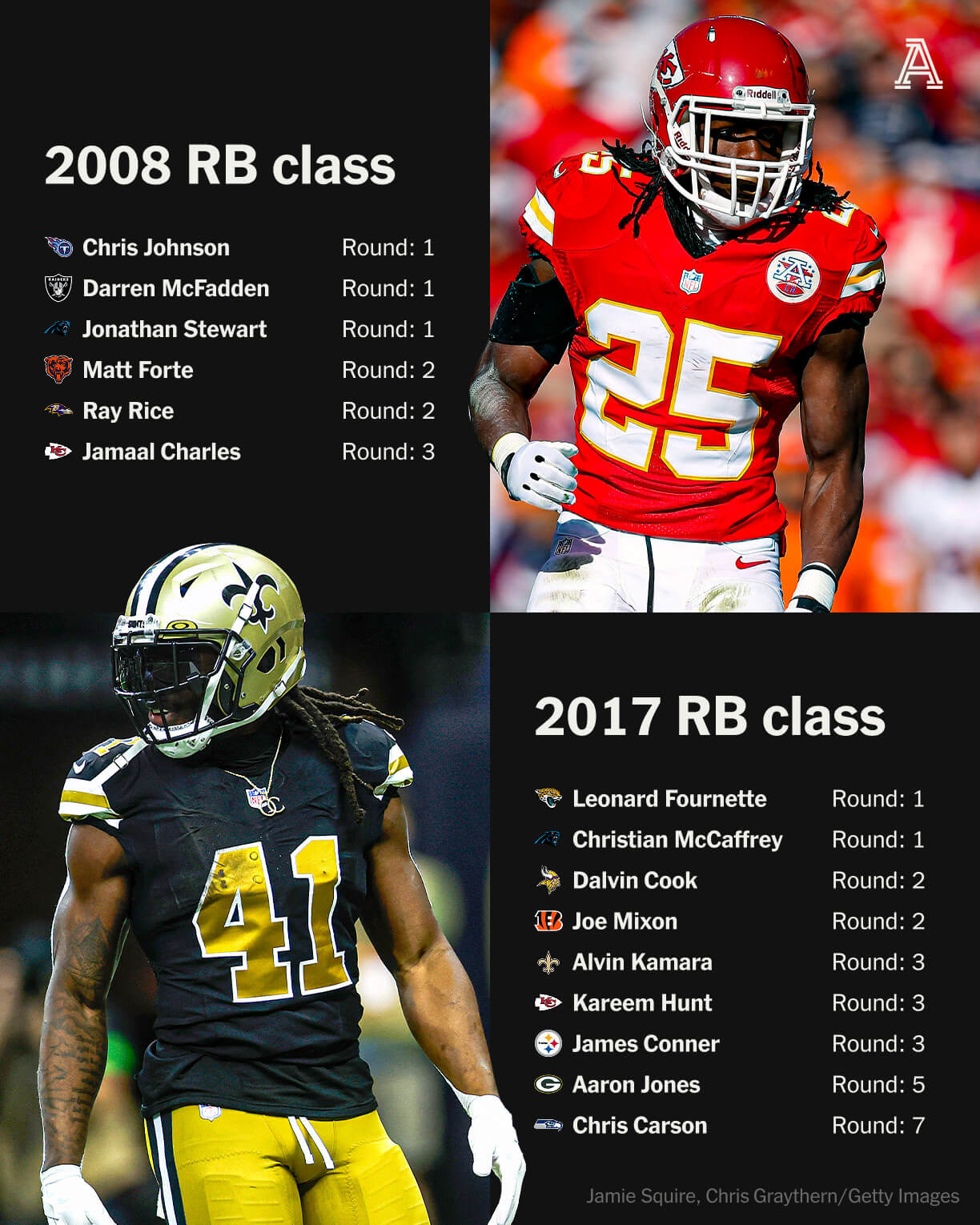
This year’s class of rookies has the talent and depth to join those groups, but early returns haven’t been too promising.
Should we have seen this coming? Definitely. I avoided Ashton Jeanty, Omarion Hampton, TreVeyon Henderson and Kaleb Johnson in almost all of my leagues.
They all had their flaws:
1. Jeanty was playing behind the league’s worst run-blocking group, with Las Vegas runners averaging 1.08 yards before contact (32nd) while their blockers ranked 21st in win rate (71%, per ESPN) in 2024.
2. Hampton was likely to split touches with former first-round pick RB Najee Harris, one of the league’s most durable backs (dang), while playing with a quarterback who rarely targeted his running backs.
3. Quinshon Judkins missed all of training camp with legal troubles, while TreVeyon Henderson was playing behind a below-average line for an offensive coordinator with a well-known history of splitting touches between situational backs.
4. Incumbent Jaylen Warren was no slouch, though I’ll admit Kaleb Johnson’s fit was strong in Pittsburgh. There were early warning signs in his preseason struggles, however.
5. Sean Payton was always going to have a 1A beside RJ Harvey, and it’s no surprise the talented but oft-injured J.K. Dobbins is performing well behind one of the league’s top offensive lines.
6. Cam Skattebo missed preseason time and seemed primed for the 1B role in New York (behind another poor offensive line), while Bhayshul Tuten was maybe the 1C behind Travis Etienne and Tank Bigsby (now with the Eagles) in Jacksonville.
Here’s how the fantasy-relevant runners in this class have performed through three weeks:
Not great, but does it matter? Absolutely. And that’s an important note, since this might be the last week your fellow fantasy football managers are still tied to the draft capital spent on these players, rather than their current value.
To explain why this matters, let’s travel back in time. Here’s how the 2014 class performed through three weeks:
As you may have noticed, any running back who finished among the top-20 scorers at the position was already among the top-20 scorers at the position through three weeks. This was true for the 2017 class, with one exception:
Again, any running back among the top-20 scorers at the position was already among the top-20 scorers at the position through three weeks.
That bodes poorly for any of the slow starters, who are likely to fail to live up to their lofty ADP. Except for that one highlighted player, Alvin Kamara. And that’s really what I want to talk about today.
Who is the Alvin Kamara of this year’s rookie class?
The answer is no one, obviously. Kamara was special.
It’s seemed overstated all summer, by myself included, that this year’s Kamara was RJ Harvey, the Broncos’ rookie runner. The comparisons were uncanny. They both left college with ball security concerns. Scouts thought both were too quick to bounce runs outside the tackles, rather than wait for a hole and hit it.
Then Harvey was drafted to a Sean Payton offense, and his stock skyrocketed. At No. 60, he was the third-highest running back drafted by Payton, joining an impressive top four that includes Reggie Bush (No. 2), Mark Ingram (No. 28) and Kamara (No. 67).
I was excited because Harvey could play a similar role to Kamara in Sean Payton’s offense, one that doesn’t require a boatload of touches to succeed and that sets up explosive ballcarriers in space, via draws, screens and routes to the flat. Most importantly, Kamara’s penchant to bounce runs outside was fixed by Payton’s staff in New Orleans, as were his ball security concerns.
ESPN’s run-block rankings graded Denver as the NFL’s best, while FTNFantasy’s offensive line rankings had Denver second. There was no question that Harvey landed with the best line among rookie runners.
The upside seemed too obvious.
But then Harvey started slow, and we’ve forgotten why we drafted him in the first place. Kamara was a top-10 RB as a rookie, after all, so shouldn’t Harvey have shown us something by now?
He has, of course — Harvey is one of just six runners with a carry of 50 or more yards, and the only rookie to hit that mark so far. The problem is that outside that run, Harvey hasn’t done much.
The good news? Neither did Kamara, at least through three weeks.
Since Kamara was the RB4 from Weeks 4-17, we tend to forget how slowly his career started. Here’s Kamara’s stat lines for each of the first three weeks, compared to Harvey’s:
Not much worse than Kamara’s start. At least from a rushing volume perspective, Harvey’s actually seen more carries than Kamara.
And while Harvey lacks certain skills that Kamara possesses — he has All-World balance and a 95th percentile wingspan that helps him in the receiving game — Harvey could improve his flaws in the NFL in a similar way.
My offseason outlook grade for Harvey’s rookie year (76%) ranked behind only Jeanty. Harvey suits Sean Payton’s preferred committee style as the Reggie Bush/Alvin Kamara archetype that raises his ceiling significantly.
Just because he’s not there yet is no reason to panic. Harvey still needs to clean up some things, like cutting and bouncing runs on gap plays and pass protection.
More good news: I went back and watched every Harvey touch this season and preseason. In his first preseason game, Harvey bounced all seven of his handoffs outside. It was rough, but his speed let him get away with it.
His improvement was obvious during the second preseason game: Harvey ran between the tackles and followed his lead blocker on every run. That carried over to his final preseason game, when he followed the lead blocker and stayed inside on three of his four carries.
That translated to the season, when in Week 1, he only bounced one of his six carries outside, breaking a field-turning 50-yard rush on a carry when he ran straight up the gut.
The rook breaks free! 💨
📺: FOX | @rjharvey07 pic.twitter.com/FBJEim1x47
— Denver Broncos (@Broncos) September 7, 2025
His stats have suffered due to the limited opportunities and poor blocking from his offensive line and tight ends, as the team still seems to be figuring out its run blocking.
Who cares? He might be dropped in some leagues with another slow performance, and you’ll want to pick him up.
Harvey could be this year’s Alvin Kamara, but he needs more targets — the one difference between his start and Kamara’s is the pass-game involvement. By Week 4, Kamara had seen 18 targets, which ranked seventh among all running backs. New Orleans, and Sean Payton, made an obvious push to get him the ball.
Harvey’s seen just six targets total, suggesting that he’s not the immediate All-Pro receiving threat of Kamara. But that can quickly change for the rookie running back, who is cheaper than those drafted multiple rounds later (like Cam Skattebo). If he’s half the receiving threat of Kamara for a Broncos team needing more explosives from their backfield, Harvey will be a value. Now’s the time to buy low.
The first three editions of this column had a few misses and some hits:
De’Von Achane’s first-round ADP will drop ✅
Overdraft Emeka Egbuka. ✅ ✅
Cooper Kupp could surprise. 🤷
Keenan Allen is still an elite receiver. ✅
Braelon Allen could be the Jets’ top runner. ❌❌❌
Harold Fannin: A top late-round TE target after flashing as the Browns’ No. 2 option. ✅ ✅ ✅
Acquire Chase Brown ❌ (I’m still a believer, as he’s seen some of the league’s best volume, but is lacking the production needed to justify the cost — add Tahj Brooks for now)
Stash Jalen Coker ✅ (Xavier Leggette has done nothing to secure the WR2 role)
Mason Taylor could surprise ❌ (Mostly irrelevant)
Remember the name AJ Barner 🤷 (Mostly irrelevant)
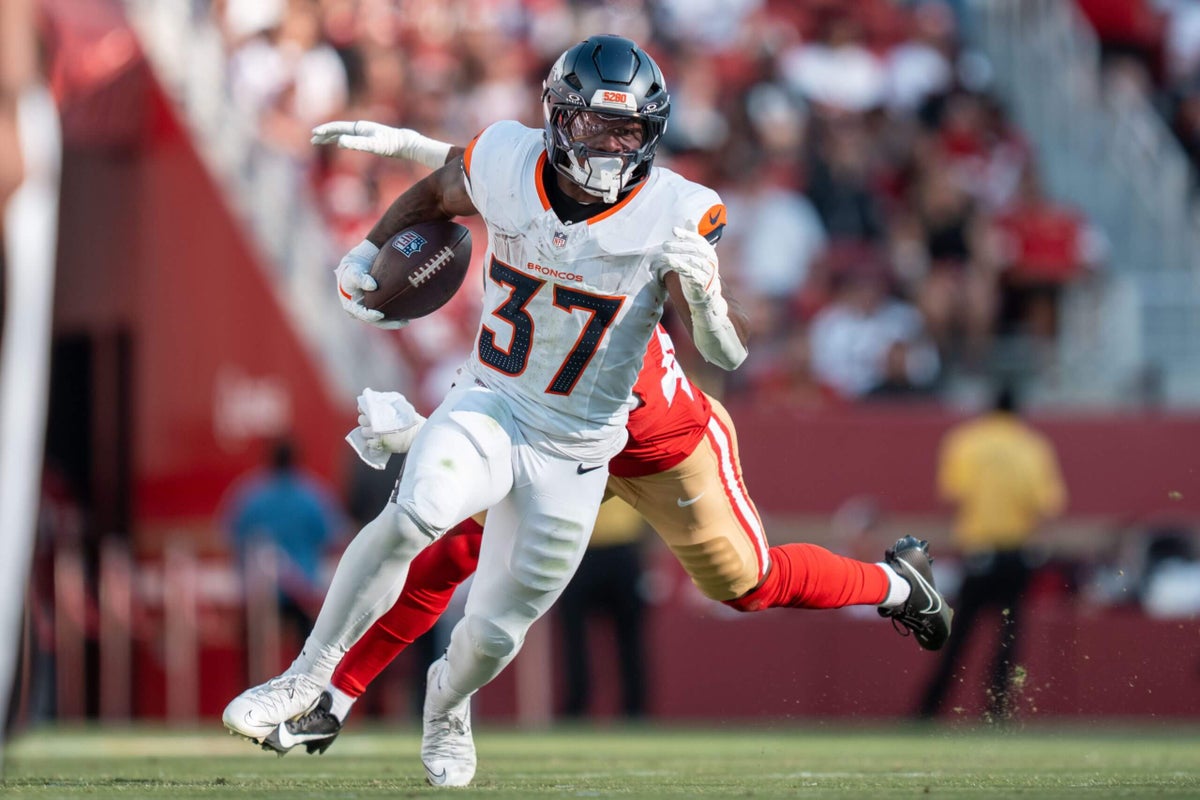
(Photo of RJ Harvey: Kyle Terada / Imagn Images)