
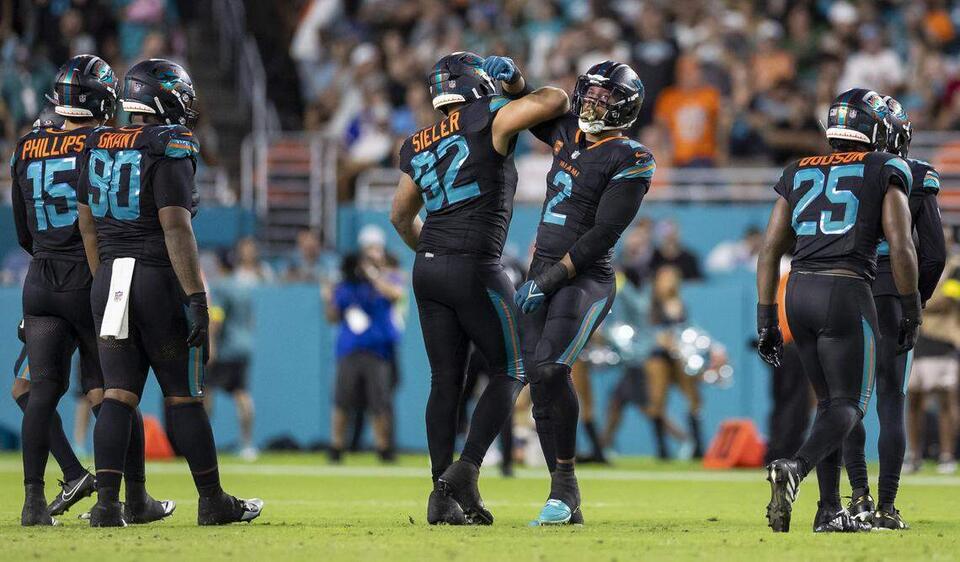
The Miami Dolphins’ run defense has been nothing short of disappointing.
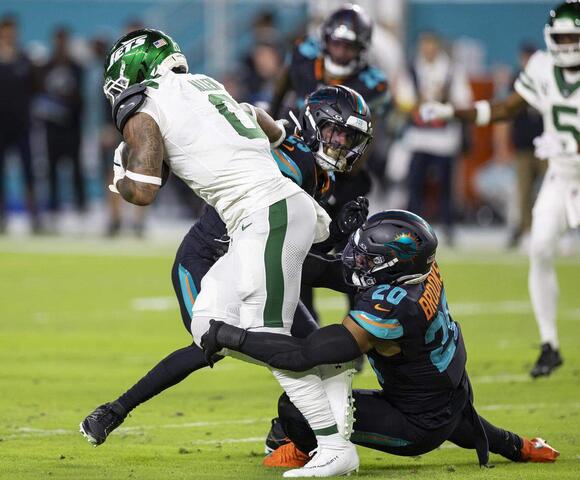
One year removed from being the ninth-ranked unit, the defense has fallen to 30th against the run after the New York Jets posted 197 yards during Monday’s loss to the Dolphins. Even worse: Miami has allowed opposing offenses more than half the distance to a first down — 5.1 yards per carry — with every rush.
There could be a plethora of reasons for it — replacing a 19-year veteran defensive lineman with a 22-year-old rookie, the defensive tackles’ overall lack of push or an excess of blitzing — yet defensive coordinator Anthony Weaver chalked it up to something much simpler.
“It all starts up front,” Weaver said. “There’s just been technique and fundamental lapses at different times for multiple things.”
Four weeks into the NFL season, the Dolphins now have a problem. The league, of course, is full of copycats, meaning that opposing offenses will clearly try to capitalize on the Miami’s inability to stop the run. And with several of the top rushing offenses including the Buffalo Bills, Washington Commanders and Atlanta Falcons still on their schedule, this issue has to be solved sooner rather than later.
“Most coordinators look at you statistically to see how people try to attack you,” Weaver said, explaining that “until we stop it, that’s what we’re going to see.”
To be frank, there’s not a single reason why the Dolphins’ defense has struggled against the run. An absence of technique and fundamentals, to borrow Weaver’s phrasing, can account for some of the issues, including a plethora of missed tackles and edge rushers’ lack of contain.
“Doing the little thing betters” will help, rookie defensive tackle Jordan Phillips said. “I got to always continue to pay attention to the little details.”
On the interior, the Dolphins defensive line has sometimes struggled with shedding blocks. The result: opposing offensive lines can move defensive tackles at will. Kenneth Grant, the 22-year-old rookie tasked with replacing Calais Campbell, somewhat admitted to this.
“I need to be better with my hands,” Grant told the Miami Herald’s Barry Jackson. “I’ve got all the power in the world. But without hands, it kind of makes taking those blocks on hard. I’m just focusing on my hands and hips.”
That’s part of the reason why linebackers Jordyn Brooks and Tyrel Dodson currently rank first and second in tackles; too many runs make it to the second level.
“We got to do better in the first line of defense,” Weaver said, explaining that he needs for players to be “more violent with their hand usage” at the line of scrimmage.
The poor run defense has put the Dolphins in a never-ending cycle where the team tries to make up for it by blitzing, something that automatically puts the unit at a disadvantage. At 37.7%, the Dolphins have the highest blitzing rate in the NFL, yet rank in the bottom third in tackles for loss, according to Pro Football Reference, which shows the team struggles to make plays in the backfield despite the extra defenders sent.
How the Dolphins can improve their run defense remains a bit of a mystery. Time could help as the defensive front continues to gel. Just look at how the secondary has improved, now owning the ninth-best passing defense. The biggest difference, however, is that unlike the secondary, the defensive tackle unit has a lot more younger players in Phillips and Grant.
That Zach Sieler found a way to snag his first two tackles for loss against the Jets showcases some growth in that area. As Sieler said prior to the first Bills game, the chemistry needs to improve. And while it would be inaccurate to say the star defensive tackle bears sole responsibility for failure to consistently stop the run, he understands that the good — and the bad – starts and ends with him.
“We got to get back there more,” Sieler said. “I think we are either being too conservative or not being sound enough up front where we need to work together as a unit better. I’ll take the ownership of that, and I feel like me, as a leader in the unit up front there, we got to do better.”