
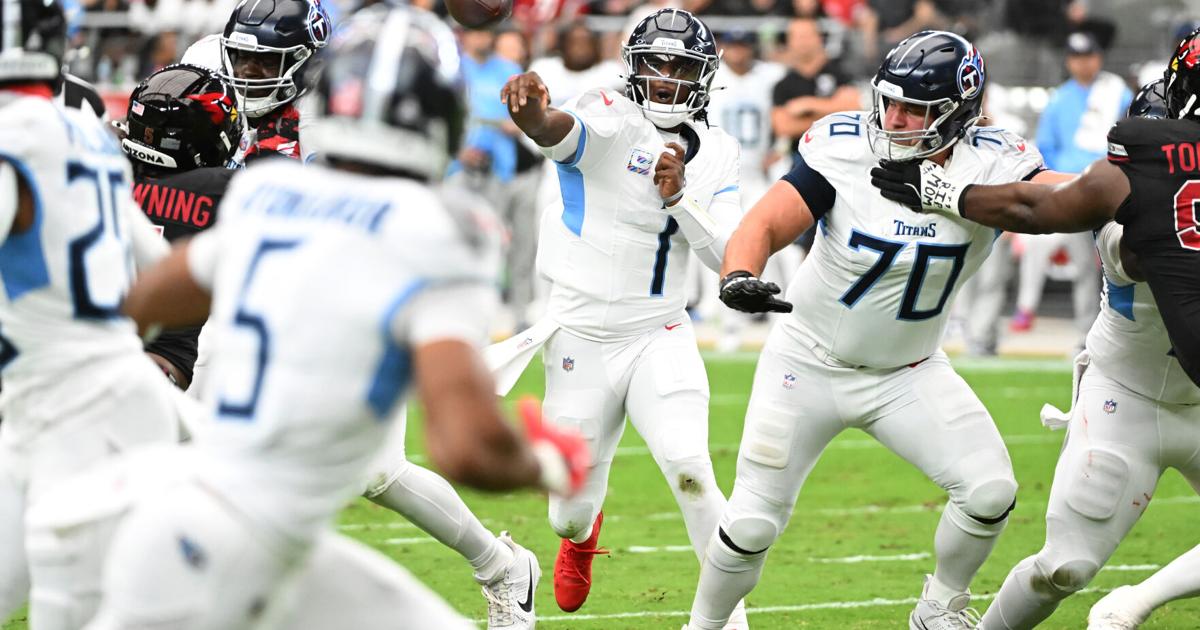
Cam Ward’s wow moment in last Sunday’s win over Arizona came late in the fourth quarter, when he dropped a 38-yard dime to Calvin Ridley down the right sideline, setting the Titans up for a game-winning field goal.
But the rookie quarterback also soaked in valuable knowledge on three previous completions during that drive, and none of those throws made the highlight reels.
Specifically, Ward was patient and efficient on the drive’s first three plays, connecting with Tony Pollard for gains of three and four yards, and then hitting tight end Gunnar Helm for six yards on a manageable third-and-three situation.
All of a sudden, the Titans had a fresh set of downs as well as momentum on their side, and Ward’s short-range completions helped open up the field for the downfield dagger strike to Ridley less than a minute later.
“I think that’s a great lesson for him,” Titans coach Brian Callahan said. “That’s what we needed from him early in the game, too. We had some opportunities to complete some balls that were easy throws.
“Some of those throws he made at the end of the game were high-level difficulty throws and really good catches. But [we’re] trying to make those be the throws that have to happen [only] a couple of times a game and the rest of it be as easy as possible. He’s figuring that part out as we go.”
Some of Ward’s stats through five games paint the picture of a young quarterback hungry to make big plays in the mid-range to deep portions of the field, at the expense of throwing shorter passes that are more likely to be completed.
• One set of NextGen numbers in particular stands out: Ward’s average intended air yardage on passes is 8.6 yards down the field, which ranks sixth highest in the league. But his average completed air yardage is only 5.7 yards, which ranks 13th.
That -2.9 differential between the two figures — what Ward wanted with his pass attempts versus what he has gained — is sixth worst in among NFL quarterbacks.
• Another sign that Ward may not be taking enough advantage of easier, shorter passes is his 51.8 percent completion rate, last among qualifying quarterbacks and more than 14 percentage points below the NFL average of 66.0 percent.
“I think he had some opportunities [for shorter completions] early in the game, and I think he really calmed down in the second half and just focused on … throwing the ball where it’s supposed to go, and not trying to do anything other than that,” Titans Offensive Coordinator Nick Holz said.
“That’s the one emphasis for him all this week [is] we’ve got to complete the ball at a higher rate. Not all that’s on him, obviously. But there’s a part of that that does fall on his shoulders, and we got to continue to do what we did in the fourth quarter [against Arizona].”
More offensive efficiency will mean more first downs for a Titans team that sits last in the league in that department (15.2 per game) and last in third-down conversions at 28.9 percent as well.
The last thing the Titans want to do is completely dissuade Ward from taking downfield shots, as the No. 1 overall pick in 2025 proved in college — and at times in his short NFL career — that he’s a gifted gunslinger with a very strong arm.
It’s just that coaches want to see a little more balance in his game, a willingness to take what the defense allows at times — in addition to trying the occasional deep haymakers.
Holz last Friday showed Ward a clip of Los Angeles Rams quarterback Matt Stafford’s performance in the Thursday night contest against San Francisco, hoping to illustrate the offensive coordinator’s point.
“We said, ‘Hey, here is [Stafford] looking for [a pass downfield at first], and then, boom, [completing a shorter pass],’” Holz said. “All of a sudden, Matthew Stafford is 20-for-28 or whatever, and he’s a gunslinger, too.
“So just because you don’t always get to throw it down the field doesn’t mean you can’t play efficiently. You can have the best of both worlds, and [Ward] sees that.”