
WARE, UK — When NFL teams fly overseas for international games, they bring flags.
As part of their public outreach overseas, franchises host flag football clinics — often featuring former players — for local youth.
The accessible, fast-growing sport — flag football will debut in the Olympics in 2028 — is a logical entry point for franchises when they visit overseas. This week, the Denver Broncos sent a team, including Hall of Fame safety Steve Atwater and Super Bowl 50 champion Bennie Fowler, to a London-area middle school ahead of Sunday’s game against the New York Jets at Tottenham Hotspur Stadium. The organization has invested significantly in flag football initiatives since Greg Penner and Carrie Walton Penner took over as the team’s owners in 2022, including helping girls’ flag football become a sanctioned high school sport in Colorado last year.
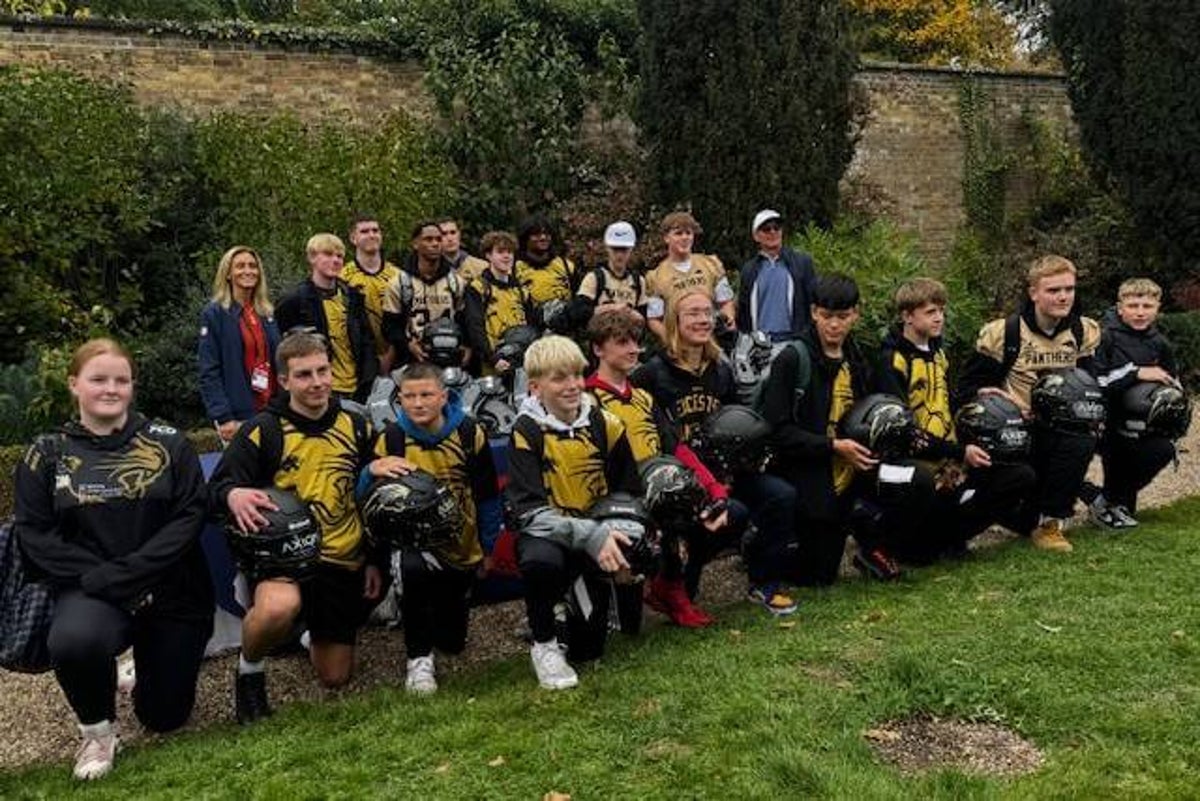
As the Broncos began planning their organization’s trip to the United Kingdom earlier this year, they also sought an opportunity to impact the game in another way. It’s why a youth American football program, the Leicester Panthers, was on hand Friday as the Broncos completed their final practice ahead of Sunday’s game. Broncos head coach Sean Payton played for the semi-pro Panthers as a quarterback in 1988, the final chapter of his playing career before he vaulted into coaching. The players in the Panthers’ youth program believed they were there simply to observe an NFL practice, having driven about two hours from Leicester to this quiet country enclave outside London.
Before they hit the sidelines, though, the young players — all 17 years old and younger — were greeted with a massive surprise: brand new helmets and shoulder pads, donated by the Broncos through their partnership with Riddell and Football America UK. The jaw-dropping reactions as the team’s owners handed out the helmets told the story.
“This is insane!” one player shouted as he was handed one of the new helmets.
“Very few teams do much with tackle football. We wanted to be really respectful and mindful of the things we were doing. So we said, ‘How do we marry those to be authentic to who we are and what they are?’” said Allie Engelken, the team’s vice president of community impact and executive director of the Denver Broncos Foundation. “… There were so many connection points that were too unique to ignore.”
The Broncos announced in January the largest philanthropic investment in franchise history, unveiling its “All In, All Covered” initiative. This initiative aims to distribute Riddell Axiom smart helmets to every high school football program in the state of Colorado at no cost. The schools received 25 percent of the donated helmets ahead of the current fall season, with an additional 25 percent phased in during each of the remaining three years of the program. The helmets, the same model worn by a number of NFL players, use TRU-FIT technology to create a custom fit for each player. The investment covers programs from six-man football through the highest classifications of the sport in Colorado. The idea of the program: eliminating some of the barriers of entry for high school programs — cost and safety among them — to sustainably grow the sport.
“This is unprecedented around the country,” said Mike Krueger, the state’s high school athletics commissioner, when the program was announced earlier this year.
“This is insane!” pic.twitter.com/mW1YtJFYRy
— Nick Kosmider (@NickKosmider) October 10, 2025
It’s what made outfitting a youth team in England, where clubs have little access to top-of-the-line equipment, so appealing for Engelken and her team when they started planning their community outreach for the trip back in the spring. It is a common challenge faced by many schools across Colorado, Engelken said.
“The players who get enthusiastic about the sport in the UK buy their own equipment,” said David Hagger, a director at Football America UK, which works as Riddell’s distributor in the country. “The clubs hardly have any team equipment. So that’s why the sport, internationally, these guys who play the sport play it for the love of it. They are always scratching and clawing to find equipment.”
Hagger did the same when he played with the Panthers back in 1988. He was a quarterback before Payton arrived, following his season as a replacement player with the Chicago Bears. Hagger gleefully moved to tight end, eager to learn from the American who would later become a Super Bowl-winning coach.
“Realistically, looking back, that would have been his first coaching job,” Hagger said. “He made it simpler for us to understand. We were still learning coverages. He was really good for that. He taught me a load about reading zone defenses.”
Then as now, top-tier equipment can be challenging to procure for clubs in the United Kingdom, where most games are played 5-on-5 on 50-yard fields. Players NFL Academy, a football training ground for top players in the UK, Germany and Africa headquartered not far from Leicester, have access to the same top gear as their counterparts at top American high schools and colleges. Still, it’s not the same for the small clubs around the country that are largely self-funded.
“There’s not a lot of money in the UK for our sport at the moment,” said Dean Holmes, the club’s youth director. “This will help the kids phenomenally. It will always be the case of, ‘Mum, can you buy me some new pads or some new boots (cleats).’ The starting rate on boots is about 100 pounds, really. Helmets can range from 300 to 1,000 pounds. For the love of the game, they purchase it. You don’t get these things given to you like this. … It was a massive surprise for the kids.”
After receiving their new helmets and shoulder pads, the Panthers were invited to watch the Broncos practice. They then met Payton, who wasn’t all that much older than they were when he wore the Panthers’ black-and-gold colors. His connection to the club, Engelken said, was such a perfect opportunity, “that it was one of those things where you’re waiting for the other shoe to drop.”
“He’s like an NFL superstar and he used to play for us,” Holmes said. “It’s bringing that heritage back to the club and makes sure everyone knows who they are and what they’re about.”
Penner updates stadium project
In September, the Broncos announced a preferred site for their new stadium, the kind of news that triggers a never-ending stream of questions about what’s next.
Penner, the Broncos CEO and owner, addressed some of those Friday while speaking to reporters for the first time since the organization pegged Burnham Yard, a defunct railyard just a few miles from Empower Field at Mile High, as the planned site of a new stadium. The venue is currently targeted for an opening in 2031, but Penner stressed, “We’ve still got a long way to go.”
“The next step is really engaging with community leaders, working on a small-area plan,” Penner said. “We’ve had a lot of outreach to (Denver) City Council members. We’ve talked to them on the phone. Carrie has met with a number of them. We’re going to keep that going. Our goal is to be very open with the process and transparent. We think we have a real opportunity to create something special, not just with the stadium but with the development around it for the city of Denver and all of our fans.”
Penner said the design plans for both the stadium and the mixed-use entertainment accompanying it will be presented to the mayor, city council and community leaders on the same timeline, but the development of both projects will be “staged somewhat differently.”
“Obviously, the stadium has a hard date where you want to get it open, (so) we can play games,” Penner said. “Some of the development will be tied to that, but it will be a much longer timeframe for that all to get done.”
The Broncos are still in the “early phases of design,” Penner said, and are working with several consultants, but they have not yet selected a contractor for the project.
“We’ve got world-class architects we are talking to,” Penner said. “No hard date yet on when we’re going to hire those folks.”