
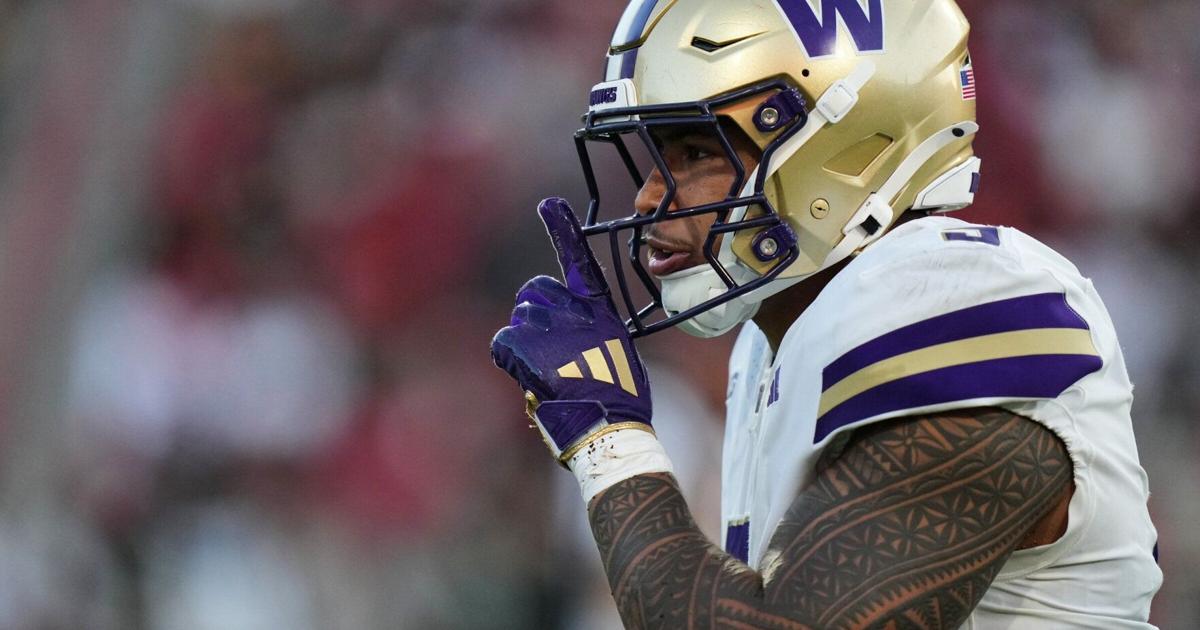
Jacob Manu, a linebacker at the University of Washington, filed an antitrust lawsuit against the NCAA on Wednesday, challenging the association’s “unreasonable restrictions that arbitrarily cut short his ability to compete as a college athlete,” according to the suit acquired by The Seattle Times.
Manu’s suit, filed by attorneys Christopher A. Wright and Mark Rosencrantz of Seattle law firm Carney Badley Spellman, adds the Husky linebacker’s name to the rising chorus of student-athletes arguing that the NCAA’s eligibility rules, which allow them five years to compete during four seasons, unfairly limits their ability to make money in the new era of revenue sharing in college athletics.
“There’s (Name, Image and Likeness) opportunities that they didn’t have,” Washington football coach Jedd Fisch said Sept. 29 when asked why he felt student-athletes such as Manu deserve to play five years instead of four. “That’s really what it comes down to for a lot of these kids.”
Manu’s lawsuit, which seeks an injunctive relief, compensatory and punitive damages and attorney’s fees, is one of several new legal challenges to the NCAA’s eligibility rules. On Sept. 2, a group of 10 student-athletes, including Vanderbilt linebacker Langston Patterson and defensive lineman Issa Ouattara, filed a class-action lawsuit against the NCAA about the same issue.
Patterson and Ouattara’s suit follows Vanderbilt quarterback Diego Pavia’s lawsuit, which received a preliminary injunction allowing him to play for the Commodores this season. Pavia’s suit argued that his years spent at a New Mexico Military Institute, a junior college, should not count toward his NCAA eligibility. The NCAA recently had an appeal dismissed by a federal panel Oct. 1.
“It just doesn’t feel right to me,” Fisch said, “when we’re letting guys who went to junior college come back and be able to play five or six years.”
Student-athletes are allowed to participate in four seasons of competition, as dictated by Rule 12.6 of the 2025-26 NCAA Division I Manual. Rule 12.6.1, dubbed the five-year rule, clarifies that those four seasons of competition can be spread out across a time frame of five years.
The Division I Manual states: “A student-athlete shall complete the student-athlete’s seasons of participation within five calendar years from the beginning of the semester or quarter in which the student-athlete first registered for a minimum program of studies in a college institution.”
Manu’s lawsuit argued that the NCAA already has shown its eligibility rules are flexible. The redshirt rule, it states, was initially introduced so players who were forced to sit out a year after transferring didn’t lose a season of eligibility. But the NCAA changed its transfer rules in 2023 to grant immediate eligibility to transfers.
The suit also stated that the NCAA’s granting of a sixth year of eligibility because of the COVID-19 pandemic was another example that the organization’s limits are artificial.
However, the antitrust nature of the lawsuit revolves around the potential for Manu to earn money as a student-athlete. Starting this season, NCAA institutions have been allowed to share revenue directly with student-athletes — around $20.5 million per school in 2025 — after settling three antitrust lawsuits known collectively as the House settlement.
Manu, specifically, is in an interesting position. The 5-foot-11, 225-pound linebacker played 12 games as a true freshman at Arizona under Fisch in 2022. He enjoyed a breakout 2023 campaign as a sophomore, earning first-team All-Pac-12 honors while playing 13 games for Fisch’s 10-win Wildcat squad.
Fisch departed for Washington after the season, but Manu stayed at Arizona for incoming coach Brent Brennan. He was named a captain before the season but suffered a season-ending ACL injury against Colorado on Oct. 19, 2024. However, Manu had already played seven games, surpassing the four-game limit that might’ve made eligible to use his available redshirt and save another season of eligibility.
Manu transferred to Washington before the 2025 season, and missed the first three games of the campaign before making his return against No. 1 Ohio State on Sept. 27. He still has a redshirt to use but can play in only four games this season, not counting playoffs or bowl games, if he wants to preserve his eligibility for 2026 under the NCAA’s current rules.
That decision became even more complicated because of UW’s specific situation. Washington lost starting linebacker Taariq “Buddah” Al-Uqdah to a season-ending knee injury during the Apple Cup against Washington State on Sept. 20, and Manu has started all three games since returning in Al-Uqdah’s place. Manu said he was uncertain how he and the coaching staff planned to approach his eligibility following UW’s 24-20 win against Maryland on Oct. 4.
“That’s something I’ve got to talk to coach Fisch about,” he said. “But I’m here if the team needs me.”
Fisch vehemently argued that Manu — and other student-athletes — deserve a fifth year. Manu missed a total of eight games across two seasons, five as a junior at Arizona and three as a senior at Washington. If all those games had occurred in one campaign, he would’ve played in four games, qualifying for a redshirt and an extra year of eligibility.
“To say this is the only year he can play isn’t right,” Fisch said. “It’s not right to do to the team. And then you have an injury at his position, so now you’re kind of forcing him to make a decision that could directly impact financially his career. Because if he does go play these nine games, then this is it. If he doesn’t and he plays four games, then he has a whole another year.
“He’ll be — probably — a team captain for us. He’ll probably be able to have an incredible amount of outside NIL opportunities because of his personality and because of what he means for the team. He’ll be able to receive revenue share dollars, and none of those things will be available to him if his time is expired.”