
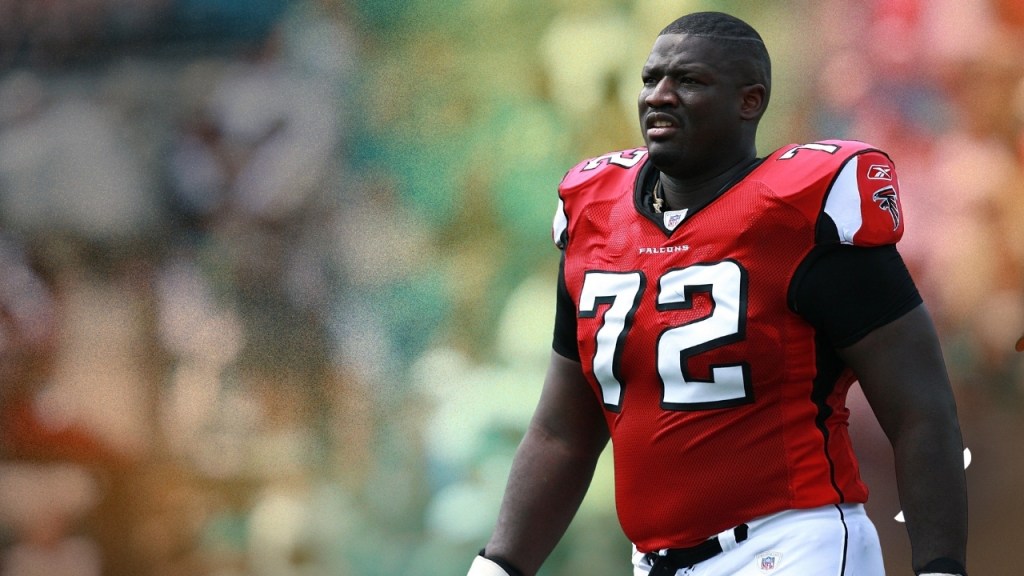
The Atlanta Falcons are exempt from California workers’ compensation law for a claim filed by retired offensive tackle Wayne Gandy, a California appellate court ruled last week.
Gandy, a first-round pick by the Los Angeles Rams in the 1994 NFL draft, played 15 seasons in the NFL. He served as a captain for the Falcons in 2007, during which he tore his left anterior cruciate ligament in a game against the Tennessee Titans. Gandy finished his NFL career with the Falcons in 2008.
In 2015, Gandy filed a claim for workers’ comp in California, with the five teams he played for in his NFL career—the Los Angeles Rams, the St. Louis Rams, the Pittsburgh Steelers, the New Orleans Saints and the Falcons—listed as his employers. Gandy asserted a cumulative injury to multiple body parts, with the idea that wear and tear over his 15 seasons gradually worsened his health. Although every workers’ comp claim is unique and every state’s workers’ comp has different payout and eligibility levels, California is considered a relatively favorable state for NFL players seeking compensation for injuries that occurred through their occupation.
The Falcons insist they are exempt from Gandy’s claim since they aren’t based in California. While Gandy played twice in the state of California during his three seasons with the Falcons, there’s an insufficient linkage between the Falcons and California for purposes of workers’ comp coverage. The Falcons’ interpretation has yielded conflicting decisions from a workers’ compensation judge and the California Workers’ Compensation Appeals Board, and the team has petitioned the Court of Appeal for California to review the matter.
In siding with the Falcons, Justice Martha K. Gooding explained that while California workers’ comp coverage is extensive, it generally does not extend to employees “hired outside of California who do not regularly work in California.”
California law on workers’ comp changed in 2013 when language was added to specifically address cumulative injury claims by pro athletes. The revised law was a response to athletes with only minimal ties to the state filing for workers’ comp there, and it added restrictions on residency, number of games played and other metrics. Under the law, an out-of-state team is exempt when a player was hired outside of California, provided the team offers workers’ comp or its equivalent under the laws of another state, and the athlete is only “temporarily” within California to perform services for their team.
California law clarifies that a pro athlete is “temporarily within” California if the athlete performs less than 20 percent of their duty days in California during the year preceding the last day of work. Under this test, Gooding noted, Gandy was temporarily within California during the last year of his work for the Falcons.
But Gooding cautioned that conclusion “is not the end of the inquiry.” Gandy’s situation is complicated by the fact that he was hired as a pro football player in California when the Rams signed him in 1994. His claim for monetary recovery is based on injuries that accumulated while he played for five teams—including the Rams, which moved to St. Louis in 1995.
Gooding reasoned that the law provides an answer to this twist. Gandy’s career is not governed by California’s workers comp law unless he establishes two factors. First, he must have spent two or more seasons, or 20 percent of his NFL career, working in California or for a California-based team. Second, Gandy must show he spent fewer than seven seasons working for a non-California team.
Gandy’s career doesn’t meet this test. He played 15 seasons in the NFL, 14 of which were for teams located outside of California. During those 14 seasons with non-California teams, Gandy played in 203 games (207 if playoffs are included) and only 15 of those games—about 7%—were in California.
Gooding noted that the Workers’ Compensation Appeals Board reached a different interpretation of law, namely that because Gandy was hired by at least one team in California, his cumulative trauma injury period is covered by California law. The judge reasoned that interpretation “ignores” the statutory language addressing pro athletes “who ultimately suffer a cumulative injury after having been hired by one or more California-based teams at some point in their career.”