
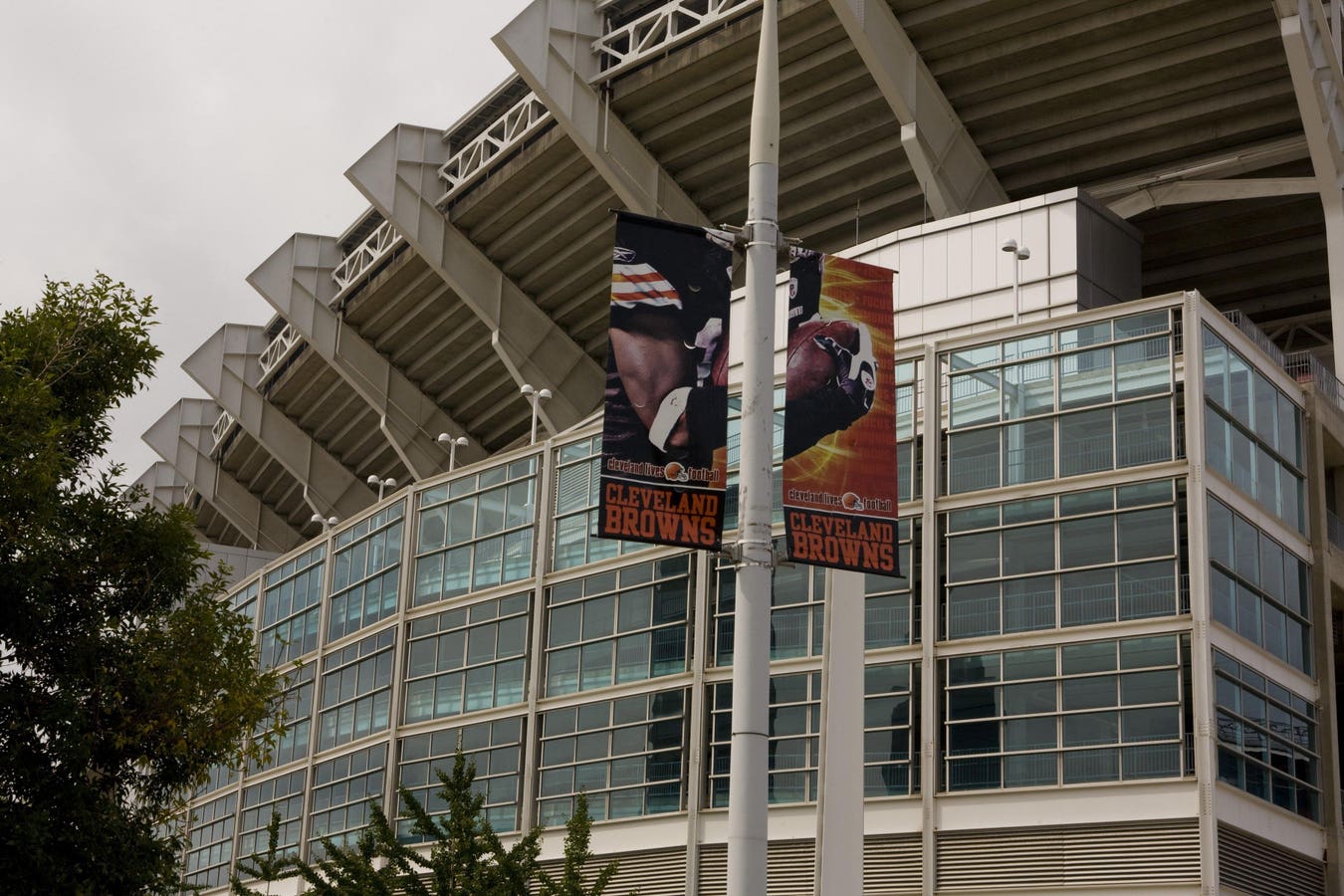
An exterior potion of Huntington Bank Field, home of the Cleveland Browns NFL club, in Cleveland, Ohio. (Photo by George Rose/Getty Images)
Getty Images
Moves to sort out the Cleveland Browns’ quarterback corps have been stirring chatter across the NFL, among fans, and in the media. But a different deal the club struck is more of a game-changer for shaping its future. As part of the new agreement, the Browns’ Haslam Sports Group ownership will commit $100 million to the City of Cleveland.
Browns owners Dee and Jimmy Haslam recently joined Cleveland Mayor Justin Bibb in announcing the agreement, which paves the team’s path to a new stadium-anchored mixed-use district in suburban Brook Park and puts in motion plans to redevelop the current downtown lakefront stadium site. The agreement would also settle a series of lawsuits, countersuits, and legal wranglings that had the club and the city at odds in city, state, and federal courts.
This investment from Haslam Sports Group begins with a $25 million payment to the city by December 1 of this year. The Browns will also cover the estimated $30 million expense of demolishing its current home stadium, Huntington Bank Field, and preparing the remaining pad at the lakefront site for new development. Starting on New Year’s Day 2029, the Browns will make annual $5 million payments to the city through 2033, a total of $25 million over five years. Then, beginning in 2034 and continuing for the next decade, the club will contribute $2 million per year toward mutually agreed-upon community benefits projects. The Browns and the city will also collaborate on transportation infrastructure to improve links between the city proper, Brook Park, and nearby Cleveland Hopkins International Airport.
At the press conference announcing the deal, Bibb said the agreement was reached during a meeting in the Haslams’ home, where they talked things through and found common ground over glasses of soft drinks. In a press release announcing the partnership, Bibb said, “This $100M investment continues our lakefront momentum and economic resurgence” and that the agreement is “the right solution for the City and the region” for the benefit of residents and attracting new people, organizations, and businesses. Cleveland City Council still has to approve the arrangement.
Meanwhile, Cuyahoga County Executive Chris Ronayne takes a different view. Opposed to public financing for the Brook Park domed stadium and “resigned” to the team’s move, he said in a recent television interview that considering the stadium as economic development doesn’t hold and that the regional infrastructure project can advance without county funds.
Against that backdrop, Cleveland’s new $100 million agreement is an example of a changed—and changing—part of the landscape in sports facility infrastructure deals. “Community benefits” are no longer secondary or symbolic. They are meaningful, measurable outcomes around which sports-led public-private partnerships are being structured.
As the sports industry has grown and become more sophisticated over the past seventy-five years, the value of sports infrastructure projects has been traditionally measured primarily in economic terms. Job creation, revenue generation, tax collection, and the like were viewed as the key drivers. The operating assumption was that getting the economic factors right would set the social factors in good shape. That left social impacts and community benefits to be treated as either secondary considerations or “nice to have” add-ons. In more than a few instances, they were dismissed as too abstract to be anything more than printed lines on the final page of an agreement.
But that equation has been increasingly recalculated since the early part of this century. By now, social outcomes are as visible and measurable as the financial ones. And they have proven to be at least as significant as economic outcomes. The difference is in knowing what results to look for. When social impacts and community benefits are prioritized, they get defined. And when they get defined, they can be measured. The intangible become tangible.
Social impacts and community benefits becoming defined, funded, and contractual deliverables on the level they are now signal the arrival of a new era in stadium and surrounding district development in the United States. The first can be called the Economic Performance Era of the 1990s and 2000s. The next was the Mixed-Use and Neighborhood Revitalization Era of the 2010s and early 2020s. The current phase—the Social Impact Era—builds on and fulfills those that came before.
The elements and factors have always been present—access to facilities, opportunities for programs, quality of life for residents and visitors, civic pride, and so on. What distinguishes the current period is that decision-makers now recognize social outcomes as indispensable to—not side effects of—the project itself. Social impacts and community benefits are being built into plans from the start, measured alongside financial returns, and treated as shared responsibilities within the public-private partnership.
Examples of this approach exist across sports and cities. They range, to mention just a small handful, from Fenway Sports Group’s long-term revitalization of Fenway Park in Boston to New York City FC’s under-construction Etihad Park in Queens; from the downtown developments surrounding the Tampa Bay Lightning’s home arena in Tampa and the Orlando Magic’s in Orlando to the Dallas Cowboys and Texas Rangers venues within the entertainment district in Arlington, Texas; from Nationals Park, Capital One Arena, and the RFK Stadium redevelopment in Washington, D.C., to Titletown at Lambeau Field in Green Bay, and to SoFi Stadium’s integration into Hollywood Park in Los Angeles.
The agreement between the Cleveland Browns and the City of Cleveland announced this week could add to that list.
Even though the Browns are lining up to play their home games in a new stadium in the suburbs, it will remain Cleveland’s NFL team. The club’s future will still be tied to the city. The Browns’ commitments to lakefront redevelopment, community benefits projects, and other public-private partnership initiatives will keep the organization, the city, and the community connected to one another. In that way, this latest agreement between the Browns and Cleveland expands their relationship rather than ends it.