
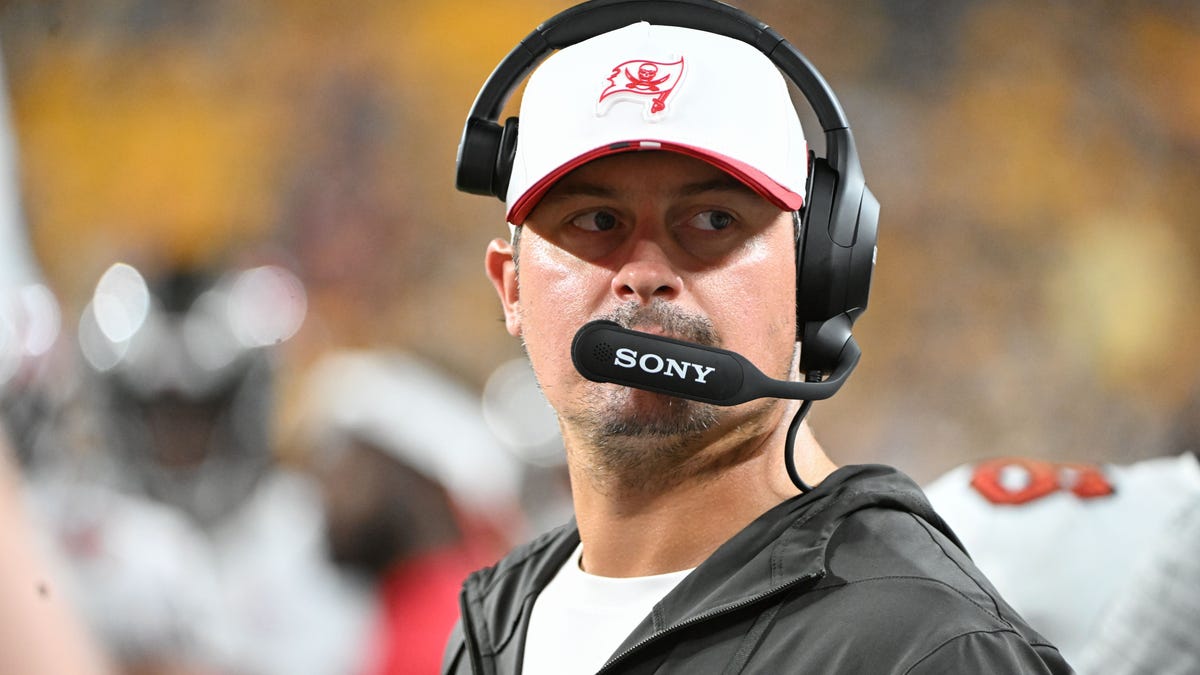
The Tampa Bay Buccaneers secured a 23–3 victory over the New Orleans Saints on Sunday, but the shine of the win is dimmed by troubling signs in the offense and particularly the play-calling of offensive coordinator Josh Grizzard.Tampa Bay’s defense carried the game by forcing four turnovers, including a pick-six by Anthony Nelson that made it 7–0 in the second quarter.
Offensively, quarterback Baker Mayfield completed 15-of-24 passes for 152 yards, yet the unit struggled to convert in critical situations.
Second Quarter Playcalling
The Bucs drove into goal-to-go multiple times and were stopped four straight times from the 1-yard line before Nelson’s defensive touchdown. Grizzard’s stubbornness with the run cost the Buccaneers points. It wasn’t just the four straight runs; it was running straight at the teeth of the Saints’ defense and subbing out a hot Sean Tucker for Rachaad White.
Third Quarter Playcalling
After halftime, Tampa Bay finally broke through with a 1-yard touchdown run by Sean Tucker on fourth-and-goal. Gizzard’s playcalling once again left fans puzzled, by starting with a fade route to 5’10 Sterling Shepard against a much larger Kool-Aid McKinstry. This was followed up by another run straight at the teeth of the Saints’ defensive front, and then another fade route to Emeka Egbuka, on the same side against McKinstry. Luckily, Tucker converted on 4th down.
While the offense then followed with long field goals all of 50+ yards, the team failed to convert any additional touchdowns. Across those drives, the offense managed only one offensive touchdown, despite reaching prime red-zone position multiple times. Defenses were stiff on short yardage, while the play-calling remained heavy on inside runs and lacked misdirection.
Grizzard, in his first full season as play-caller, has shown a reluctance to deviate from the plan, especially in short-yardage and goal-line situations. The drive chart exposed a predictable sequence of calls up the middle, often when they had already been stopped multiple times. That stagnation may go unnoticed in a comfortable win, but it will not against stiffer competition—like they’ll face after their BYE against the Patriots, Bills, and Rams. Suppose Tampa Bay wants to sustain a deep playoff run. In that case, the offense must improve its red-zone creativity, vary its approach behind the line, and execute third-down strategies with better protection and movement. The defense can win you games, but the offense has to deliver when it matters.