
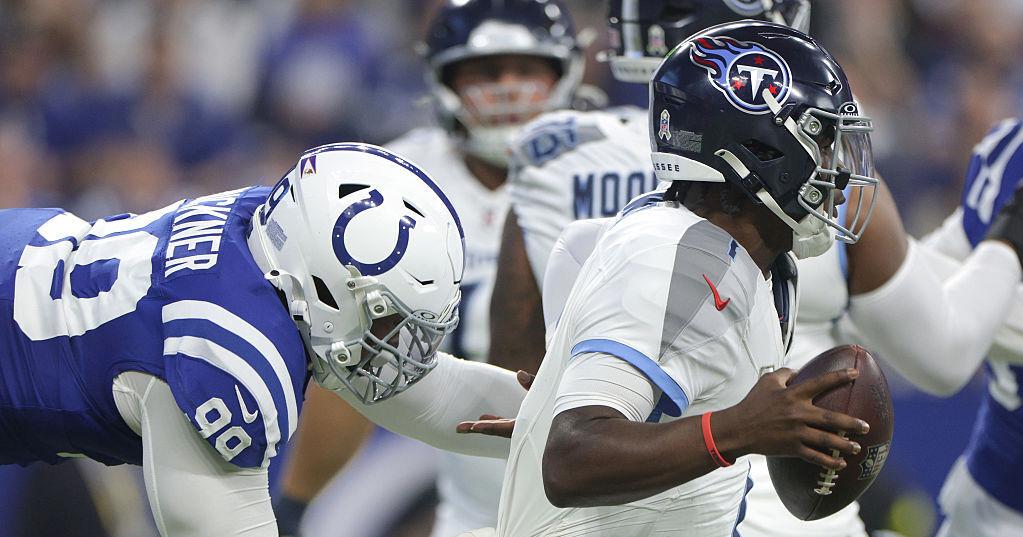
Titans quarterback Cam Ward has spent a fair amount of the 2025 season on his backside.
The No. 1 overall pick in the 2025 NFL Draft has been sacked a league-high 34 times through eight games, putting him on pace for 72 this season, which would be just short of the NFL record (76) set by Houston’s David Carr in 2002.
But even as the sacks continue to pile up — Ward has been taken down 15 times in the last three games alone — an interesting phenomenon is also occurring: The Titans’ offensive line seems to be doing an increasingly better job in pass protection, as judged by multiple analytical sites.
That gives rise to an obvious question: How much blame should Ward himself shoulder in terms of the Titans’ sacks allowed?
Probably a fair amount, given the rookie’s struggles when facing pressure, his reluctance to scramble and his penchant — at times — for holding onto the football too long.
Those habits aren’t necessarily uncommon for a rookie quarterback, but the resulting sacks have clouded what appears to be improvement in the offensive line’s pass protection this season.
ESPN, for instance, ranks the Titans as 12th-best in the NFL in pass-block win rate, while Pro Football Focus ranks the team 12th-best in pass protection.
NFL analyst Sam Hoppen, using a formula that combines stats from nflfastR, Trumedia and ESPN, ranks the Titans as 13th-best in pass-block win rate.
Those complimentary pass-protection numbers don’t necessarily point a singular incriminating finger at Ward for the team’s significant number of sacks.
After all, Titans receivers have to get open for Ward as well.
But here are three ways Ward is indeed hurting his own cause in the pocket:
Inviting too much pressure
Whether it’s due to holding the football for excessive time or drifting into the pass rush, Ward is inviting more pressure upon himself than necessary.
PFF attributes responsibility to Ward for eight of his own sacks, which is tied for fifth-most in the league, as well as for 19 of his own pressures, which ranks fourth in the NFL. Three of the four sacks the Titans allowed last Sunday against Indianapolis were attributed to Ward, according to the analytics website, and only one to the offensive line.
Part of the issue is that Ward’s average time before throwing this season has been 3.0 seconds, which is ninth slowest among NFL starters, per PFF.
When Ward has been pressured — whether it’s because of himself or others — he’s had problems dealing with it.
His average time to throw under pressure is 3.92 seconds — almost a full second higher than when he’s not pressured — which is the seventh slowest among NFL starters.
In addition, Ward’s pressure-to-sack ratio — which measures the amount of time that pressure turns into sacks — is 28.2 percent, second highest among NFL starters, trailing only Baltimore’s Lamar Jackson (28.8 percent).
Ward is no speedster, but he used his legs when necessary in college. Despite sack yardage factoring into his totals last year at Miami, Ward still carried 60 times for 204 yards and four touchdowns.
But for whatever reason, Ward has scrambled this year only as a very last resort. On average, his scrambles have started 6.2 seconds after the snap, a time exceeded among NFL starters only by Las Vegas’ Geno Smith (6.7).
Ward has scrambled on just 3.1 percent of his dropbacks this season, per SumerSports, which ranks 29th among NFL starters.
He has gained just 40 yards on scrambles and designed runs this season, which is just 10 yards more than notably immobile Joe Flacco of Cincinnati — a 40-year-old who has played one fewer game than Ward.
On third-and-8 from the Indianapolis 8-yard line late in the contest, Ward dropped back to pass.
Feeling some pressure, he scrambled to his left and then turned his back completely to the line of scrimmage, running backward to the 24-yard line. Ward eventually turned back around and once again moved left. But instead of throwing the ball away and returning to the 8-yard line, Ward allowed himself to be sacked at the 16.
One play later, facing a fourth-and-16 instead of a fourth-and-8, Ward was intercepted in the end zone.
It was a teachable moment in terms of how to better deal with pressure — and how to better avoid yet another sack.
“Yeah, he learned from that one for sure,” Titans coach Mike McCoy said Wednesday. “That’s one of those that is going to happen from time to time. But you just got to understand, throw the ball away, live for another down.
“Don’t make a bad play worse or make a situation worse. It’s a lot easier as a play caller to call it to where the ball was [compared] to where it went to.”
Ward says he’s learning to release the ball quicker in the NFL than he did in college, realizing that means his offensive linemen don’t have to hold blocks as long, and his playmakers get more time with the ball in their hands.
“It’s not really a big adjustment,” Ward said. “It’s about [knowing] the times when you can hold the ball in certain situations, where you need to extend [the play]. But the majority of the game, you just have to continue to try to play on schedule.”