
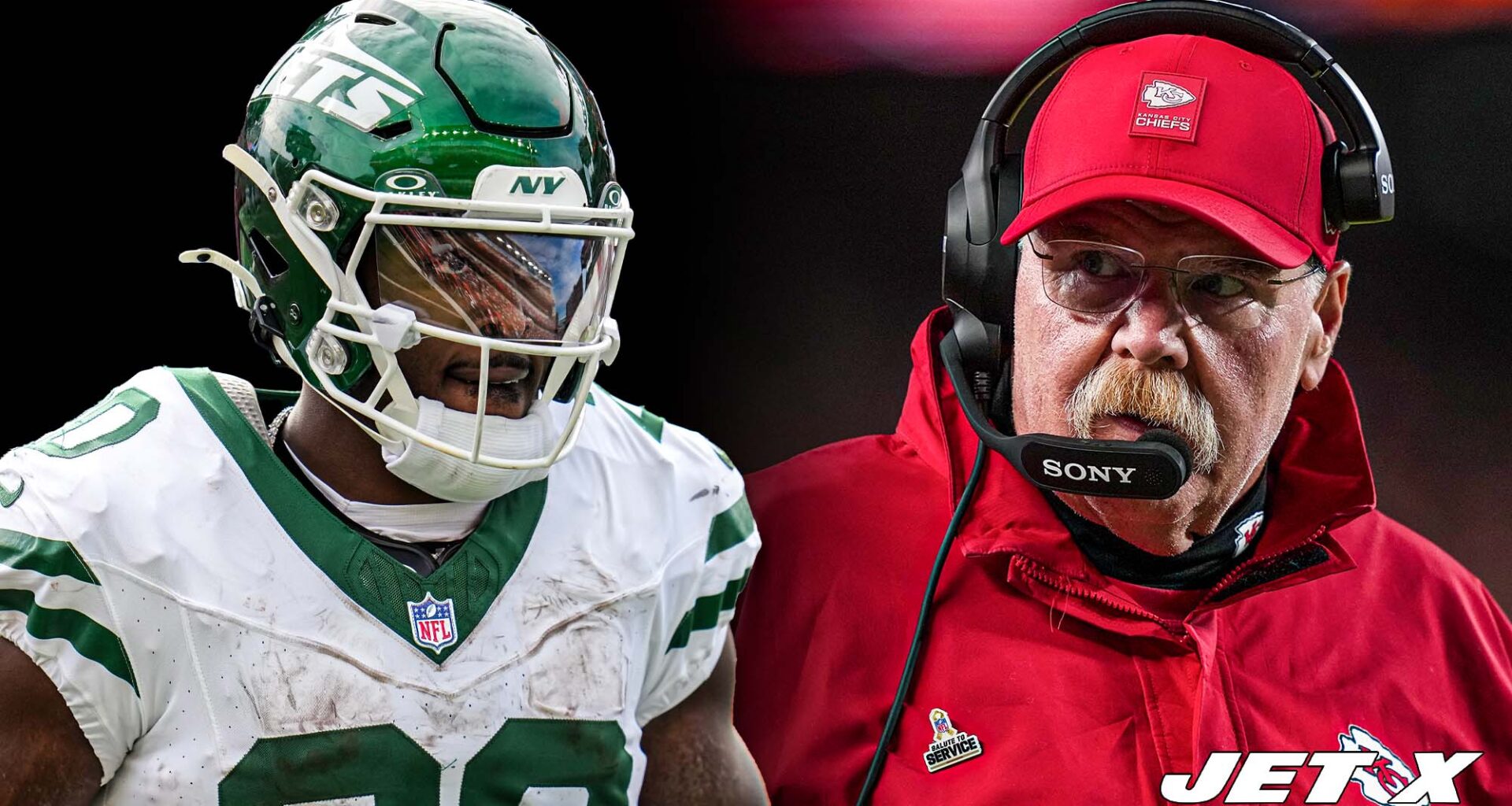
Sitting ugly at 1-7, the New York Jets are widely expected to be sellers at the NFL trade deadline (Nov. 4). They’ve already begun with their trade of cornerback Michael Carter II to the Philadelphia Eagles.
However, as head coach Aaron Glenn seeks to win games and establish a rejuvenated culture in his debut season, the Jets are unlikely to go full fire-sale mode and sabotage Glenn’s ability to win games in 2025.
With no chance of making the playoffs, the Jets will surely be all ears when teams come calling for their talent, but they won’t take a deal unless the offer blows them away. The Carter trade is a perfect example.
The Jets had little leverage with Carter on the trade market, as he had already lost his starting job and was fully expected to be released after the year. With a player like that, a team would be more than happy to land a late-round pick swap or a conditional pick.
New York landed that and then some, as the Eagles offered a surprisingly intriguing package for a player deemed expendable. In addition to a pick swap, Philadelphia threw in wide receiver John Metchie, a 25-year-old former second-round pick at a premium position where the Jets are weak.
That’s the type of offer New York simply won’t turn down in an uncompetitive season.
As the trade deadline inches closer, don’t be surprised if the Jets take another offer like this one—exploiting a desperate, contending team that is willing to overpay for a player because they are in a hurry to win games.
The Jets won’t ship off their good players for pennies. They care too much about winning games to do that; this team isn’t operating like the Tennessee Titans. That doesn’t mean they view their valuable players as untradable.
Fourth-year running back Breece Hall is one of the Jets players who has generated the most trade buzz in recent weeks. He’s a prime candidate to attract a trade offer the Jets would have no choice but to take.
What price would it take to trade Breece Hall?
Despite the popular chatter around Breece Hall as a trade target over the last few weeks, I would be surprised if the Jets were eager to trade him.
As Glenn seeks to win games with a run-first team over the rest of the year, it seems doubtful that he’d approve of dumping the team’s starting running back after already seeing his backup (Braelon Allen) go down with an 8-to-12-week injury. It would send a message to the locker room that winning is not the priority, especially after Hall just had a dominant performance to lead the Jets to their first win.
But with Hall being an impending free agent and one of the most valuable trade chips on a 1-7 team, general manager Darren Mougey wouldn’t be doing his job if he slammed the phone down when Hall’s name came up. Every player has a price, and when your team isn’t in contention for a championship, it’s always worth seeing if someone out there is willing to pay that price.
Hall’s odds of returning to the Jets next year feel slim. The Jets have too many needs at premium positions to allocate premium cap space toward a running back, especially one who suffered a serious injury early in his career and hasn’t reached the same heights since.
Mougey needs to address quarterback, wide receiver, guard, center, edge rusher, defensive tackle, linebacker, and safety before he starts worrying about who’s taking handoffs behind the Jets’ strong offensive line. Hall is a good running back, but he’s not a superstar, which makes it difficult to justify paying him big bucks when there are more pressing needs to address.
Plus, if the Jets allow Hall to walk in free agency, they probably won’t get a compensatory pick in return, as they will likely cancel out his exit by signing a plethora of free agents to fill out their porous roster. So, if they don’t trade Hall now, odds are they will lose him for nothing in 2026.
Still, this doesn’t mean the Jets should dump Hall for whatever they can get. There is value to keeping him around in pursuit of more wins over the next nine games, and there is a chance they could re-sign him after the year if he continues playing well and things work out cap-wise. We can’t rule out the possibility that New York wants him back and can get it done for a reasonable price.
If a great offer comes around, though, the Jets would be remiss not to take it.
One team to keep an eye on: The Kansas City Chiefs.
The 5-3 Chiefs are surging after a cold start, but they find themselves in a heated division race. The Denver Broncos are on top of the AFC West at 6-2, and the Los Angeles Chargers are tied with the Chiefs at 5-3 while owning a head-to-head win. Kansas City also has to leapfrog Indianapolis, Buffalo, and New England for the AFC’s No. 1 seed.
With Travis Kelce possibly retiring after the year and Andy Reid getting older, the Chiefs could be aggressive in bolstering their roster as they look to maximize their championship window with the current core. If they are looking for a spot on the roster with ample room for improvement, running back is near the top of the list.
Kansas City does not have a clear-cut RB1, as Isiah Pacheco (78 attempts) and Kareem Hunt (62 attempts) have alternated carries. Both players are below the NFL average of 4.4 yards per carry, and both rank outside the top 30 running backs (among 57 qualifiers) in yards after contact per carry. They are also unproductive in the passing game, combining for a measly 100 receiving yards on 26 targets (3.8 yards per target).
Enter Hall, who is averaging 5.0 yards per carry, 3.3 yards after contact per carry (19th of 57), and 5.9 yards per target. His 187 total receiving yards are nearly double Pacheco and Hunt combined.
It’s easy to picture the Chiefs viewing Hall as a piece who could put their offense back over the top as an unstoppable juggernaut.
Based on recent running back trades, it isn’t far-fetched to claim that Hall should demand a third-round pick. In September, the Eagles traded a fifth-round pick and a sixth-round pick for Jaguars running back Tank Bigsby, who only had 820 scrimmage yards in 16 games last year. Hall has 759 scrimmage yards in eight games this year, after posting 2,944 across the previous two seasons.
In 2021, the Rams traded a fourth-round pick and a sixth-round pick for Sony Michel, who was coming off a season with 563 scrimmage yards in nine games.
If a team like Kansas City calls the Jets with genuine interest in Hall, Mougey has the leverage to demand a third-rounder—and he shouldn’t budge if a team offers anything less.
Chiefs general manager Brett Veach has shown that he is not afraid to spend premium assets on a running back, as he drafted Clyde Edwards-Helaire in the first round of the 2020 draft. If it takes a third-rounder to land Hall, it would not be unprecedented for the Chiefs to make such an investment in a running back.
Furthermore, both Pacheco and Hunt are free agents after the 2025 season, which leaves the door wide open for Kansas City to sign Hall as their running back of the future. That would justify trading a premium asset to land him, as it would be more than just a half-season rental.
There are many reasons to believe that Kansas City could be strongly interested in Hall. If they give the Jets a call, New York will have plenty of leverage, given how appealing he is for Kansas City’s situation.
Whether it’s the Chiefs or another team in a similar spot, this is the only type of situation where the Jets should trade Hall. If they can entice a hungry team to deal a third rounder or more, the Jets have to take it for a player at a non-premium position with murky odds of staying on the team beyond this season.
If they cannot land such a package, keeping Hall is arguably the correct move. It wouldn’t be worth dumping Hall for a low price to send the wrong message to the locker room while erasing any and all chance of him returning on a fair contract next year.