
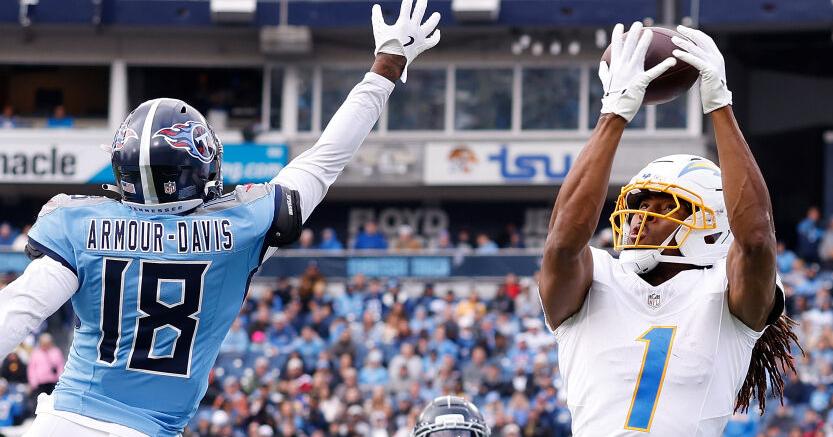
The offense had showed hardly a hint of life to that point, but here the Titans were nonetheless, just 36 inches away from taking the lead over the Los Angeles Chargers midway through the third quarter on Sunday.
The team had already converted a third-and-7 on a drive that had started at the Tennessee 28-yard-line, as Cam Ward had connected with Elic Ayomanor for a 29-yard pickup.
Surely they could find some way — on either of two tries — to find the end zone from a single yard out.
But in a game-changing sequence, the Chargers’ defense stuffed Tony Pollard on back-to-back attempts at the goal line and took over possession on downs, still leading 20-17.
The Chargers’ offense then put together a back-breaking 15-play, 99-yard touchdown drive that took 9:03 off the clock, giving the visitors all the points they needed in a 27-20 victory Sunday at Nissan Stadium.
The Titans lost for the fourth straight time overall, eighth straight time at home and 12th straight time against an AFC opponent.
On a day the team scored one touchdown on a punt return, another on an interception return and recorded six sacks, the Titans were left wondering what might have been if the offense had just been able to break through from inches away.
“It’s got to get in [in that kind of situation],” Titans left guard Peter Skoronski said. “You kind of have to win and you’ve got to be able to win in those phone-booth kind of situations.
“If we got in there, we might still be out there playing or we might have won the game. So, disappointing … But you have to score from the 1-yard line.”
On third-and-goal from the 1-yard line, the Titans used a direct snap to Pollard in the wildcat, something the team went to three times Sunday — without a great deal of success. He was smashed for no gain going up the middle.
“That’s all part of game planning,” Tennessee interim head coach Mike McCoy said of using the wildcat formation. “When the staff put the plan together, they had a lot of … they thought this was the best thing to do.”
On fourth-and-goal from the 1-yard line, the Titans tried the more traditional approach, as Cam Ward handed off to Pollard, only to see the veteran back smothered — stopped in part by former Chargers defensive back Elijah Molden.
Why, McCoy was asked, didn’t either of the plays work?
“The defense stopped them,” he said.
It was a discouraging moment for the Titans’ offensive line, which features three highly paid free agents — left tackle Dan Moore, center Lloyd Cushenberry and right guard Kevin Zeitler — in addition to two first-round picks, Skoronski and right tackle JC Latham.
“Yeah, that was a pivotal moment,” Moore said. “We knew as an offense we needed to capitalize on that moment, and that speaks to everybody.”
It might have been a less pivotal moment had the Titans’ defense been able to take advantage of a Chargers’ offense that began the following drive inside its own 1-yard line.
Had Tennessee been able to force a quick punt, the Titans’ offense would have been in good field position.
Instead, the Chargers used a play-action pass to gain 14 yards on first down, and just kept marching down the field after that.
Los Angeles converted three third-down attempts on that 99-yard drive, the last one giving the Chargers first-and-goal at the Titans’ 1-yard line. The visitors had no problem finishing their drive, as quarterback Justin Herbert trotted around end for a touchdown.
“The big turning point, obviously, is getting stopped on the 1-yard line and then letting the big drive go down there and score,” McCoy said. “That’s the difference. It’s frustrating.”