
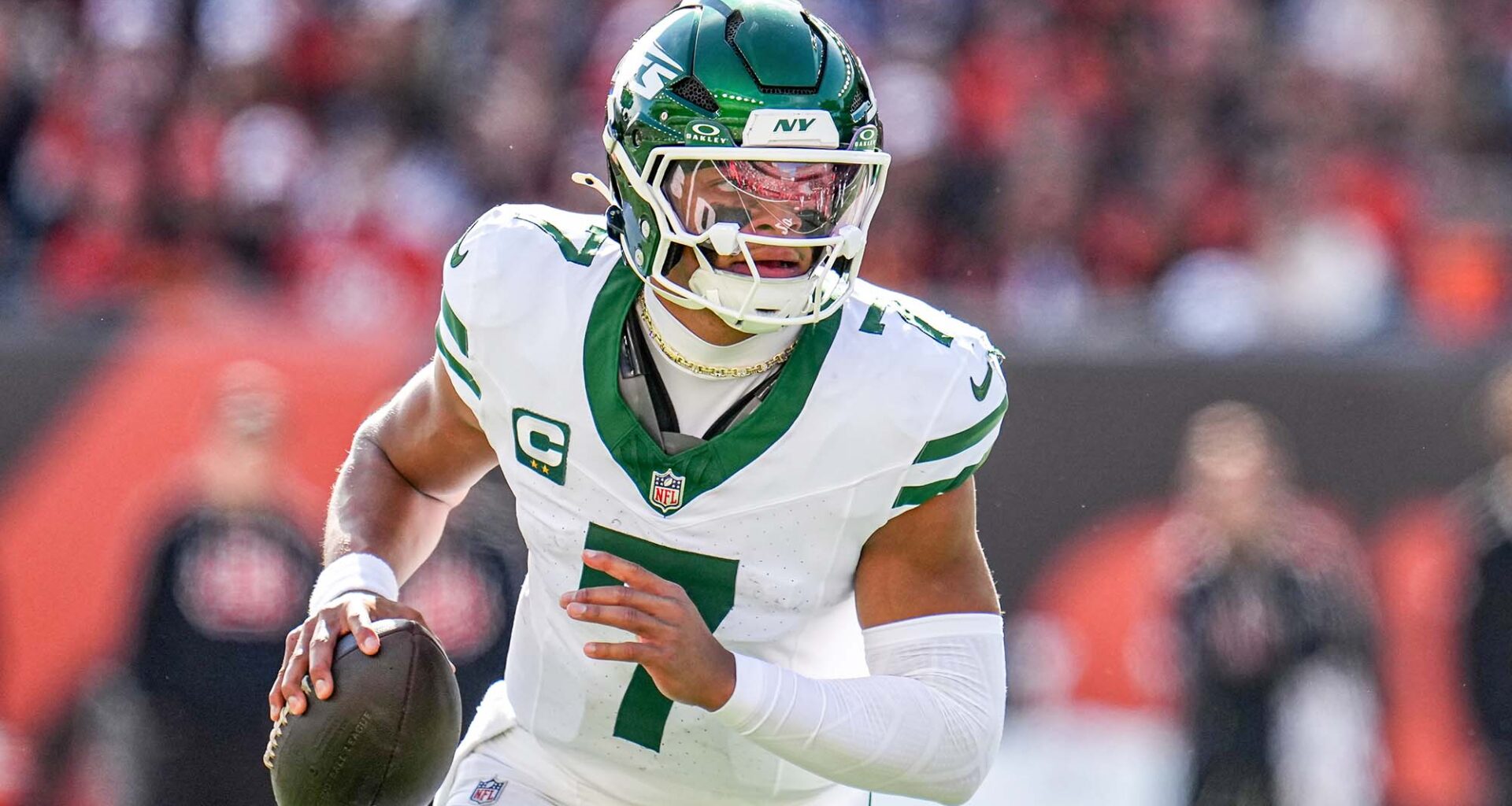
Aaron Glenn refused to name the New York Jets’ starting quarterback for their Week 10 game against the Cleveland Browns.
In all likelihood, though, Justin Fields will retain the job after playing well in his most recent outing, leading the Jets to their first win of the season.
Fields will be captaining a Jets team that has been completely overhauled since it last took the field in Cincinnati. Since their comeback win, the Jets have waved goodbye to three core defensive players, replacing them with a plethora of future draft picks and three young players with high draft pedigrees.
Among those incoming players are two 25-and-under wide receivers with second-round pedigrees: John Metchie and Adonai Mitchell.
In the wake of New York’s recent trades, the Jets need Fields to overhaul his play style just as much as the team overhauled its roster. From both a roster standpoint and an organizational vision standpoint, the Jets are a brand-new team compared to two weeks ago, and Fields’ approach must reflect those changes.
Although Fields will probably not be the Jets’ long-term franchise quarterback, it’s critical for the future of the franchise that he alters his play style over the next nine games.
New vision in Florham Park
The Jets’ deadline frenzy signaled two significant changes to their plans.
Firstly, the team is committed to building for 2026 and beyond, regardless of general manager Darren Mougey’s futile attempts to convince us otherwise.
That means their goal for the rest of the 2025 season is not to stockpile as many victories as possible, but to develop pieces that can be a part of the long-term plan. The Jets would obviously love for victories to come alongside that, but the top priority is to unearth gems that can fill 2026 roster holes ahead of time, creating more flexibility in the offseason.
The second overarching takeaway from New York’s moves is a philosophical shift in how the team wants to win games moving forward.
All three of the core players dealt by Mougey hail from the defensive side of the ball. He did not trade away any offensive players, notably electing to keep running back Breece Hall. Of the three players acquired in exchange for the defensive mainstays, two are wide receivers.
After decades of being a defense-first organization, these moves send the message that the Jets finally understand the modern NFL zeitgeist: Offense wins championships.
The 2025 post-bye-week Jets will operate much differently than the pre-bye-week version. Before the bye, the Jets were focused on establishing a gritty culture under Aaron Glenn by winning as many games as possible, particularly with a defensive-minded, ground-and-pound mindset.
Post-bye, the Jets want to develop young talent for the future and begin establishing their identity as an offensive-minded franchise.
It falls on the starting quarterback to facilitate that shift.
What the Jets need from Justin Fields moving forward
So far in 2025, Fields has played an incredibly safe style of football to support the Jets’ pre-bye goals of winning games behind their defense.
Fields has thrown zero interceptions in seven starts. That’s a great accomplishment in a vacuum, but Fields only achieved it because of his extremely conservative approach.
Among 30 quarterbacks with at least 180 dropbacks, Fields has the fifth-lowest average depth of target (7.1) and the second-highest sack rate (11.8%). He is the only quarterback ranked top-five in both categories.
Fields is interception-less because he rarely takes chances. Instead of forcing dangerous passes, he throws checkdowns and eats sacks. It helps him protect the ball, but it’s also caused him to have three games with under 50 passing yards. Fields is fourth-worst in the NFL with 4.9 net yards per pass attempt, a career low.
That approach failed to help the Jets win games; they’re 1-7, after all. The consequences of Fields’ ball security far outweigh the benefits.
With Sauce Gardner and Quinnen Williams gone, it will only become even more difficult for the Jets to win games with Fields playing that brand of football—dare we say impossible?
The Jets are already sixth-worst in the NFL with 27.6 points per game allowed. They allowed 38 points without Gardner last week. It’s a fair assumption that, moving forward, there is a realistic chance that New York will allow more than 30 points per game over the final nine weeks.
If the Jets are going to have any chance of winning games, Fields has to start taking risks—and lots of them.
Wins are not the Jets’ priority, but this isn’t even about winning. Rather, it’s the perfect opportunity for the Jets to plant the seeds of the offensive-minded identity that they are focused on growing over the long haul.
Prepare to cringe: We’re about to discuss the 2021 Detroit Lions again.
When Dan Campbell and the 2021 Lions inspired faith with a 3-3 finish following an 0-10-1 start, it had little to do with their defense. Across the final six games, Detroit allowed 29.7 points per game, even more than the 26.3 points per game they allowed during the winless 11-game start.
What shifted in Detroit was the offense.
Over the final six games, the Lions averaged 25.1 points per game, a monumental jump from their 15.8 points per game through 11 games.
Although the season was lost, Detroit’s late-season offensive surge set the tone for its evolution into one of the NFL’s premier offensive-minded franchises. The Lions have a 41-18 record since 2022, and it’s almost entirely because of the offense. Over that span, they are first in points (29.1 per game) and 19th in points allowed (22.7 per game).
That’s the formula New York is seeking to emulate.
By trading Gardner and Williams, the Jets sent the message that they’re ready to put their defense on the back burner and start embracing their offense as the nucleus of the team. They are not built to field an elite offense just yet, as they don’t have a franchise quarterback, but they can use these next nine games to begin the organizational shift to an offense-first mindset.
It can only happen if Fields starts to air it out, though.
Through Week 9, Fields has thrown just 12 deep passes (20+ air yards). That makes up 7.4% of his pass attempts, the third-lowest rate among qualifiers. He has thrown a league-leading 59% of his passes from 0-9 yards downfield.
If the Jets want to start embedding an offensive mindset within the fabric of the organization, they must strongly encourage Fields to start firing the rock downfield with unabashed confidence. It doesn’t matter if those shots are reckless; they have to be taken, because it’s the only way to give the Jets a high enough ceiling to rack up points with their current roster.
The Jets’ coaches should be honest with Fields about his interception number. He must understand that it will be okay if he throws one or even two interceptions per game as a byproduct of pushing the ball downfield. If they give him the green light to take shots with the knowledge that they won’t hold turnovers against him (unless they’re egregious), he will gain the necessary confidence to start airing it out.
This isn’t guaranteed to lead to success. Fields was highly aggressive early in his career and lost plenty of games.
It’s still the best approach, though, both for the sake of winning games now and establishing the franchise’s revamped philosophy.
With a gutted defense, the Jets aren’t going to win games if they play it safe. And with a long-term focus on offense, they need to give themselves the highest possible offensive ceiling over the next nine games. The goal is to begin building a culture in Florham Park where running up the score is the expectation—just like Campbell’s Lions did at the end of their 2021 season.
It’s also about evaluating the young receivers
Beyond winning games in the short term and supporting the franchise’s long-term vision, Fields’ aggressiveness is important for the sake of evaluating the Jets’ young receivers.
With the additions of John Metchie (25) and Adonai Mitchell (23), the Jets are loaded with youth at wide receiver. They will join up with fourth-round rookie Arian Smith (24) to give New York three 25-and-under receivers who are eager to prove themselves.
Youth is not the only thing these receivers have in common. As prospects, they all find themselves in a similar boat.
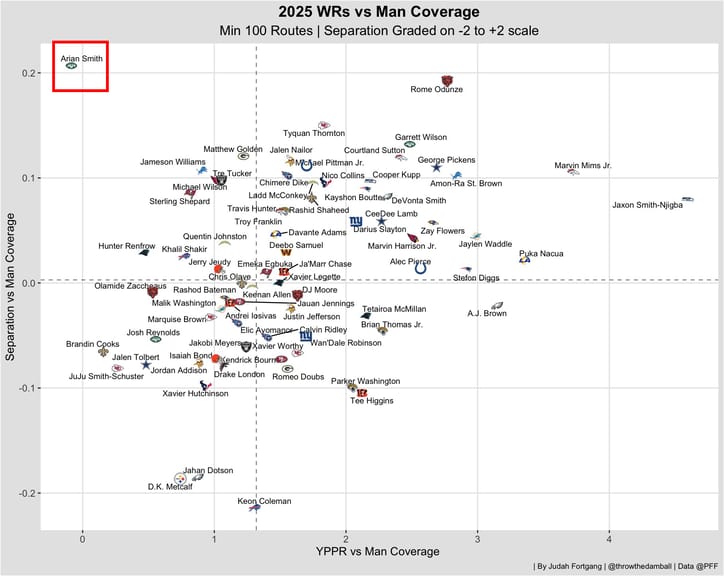
Metchie, Mitchell, and Smith have each built reputations as highly rated separators who have yet to translate their separation into production.
According to Pro Football Focus, Smith has the best separation grade against man coverage among wide receivers this year.
 via Twitter/X: @throwthedamball
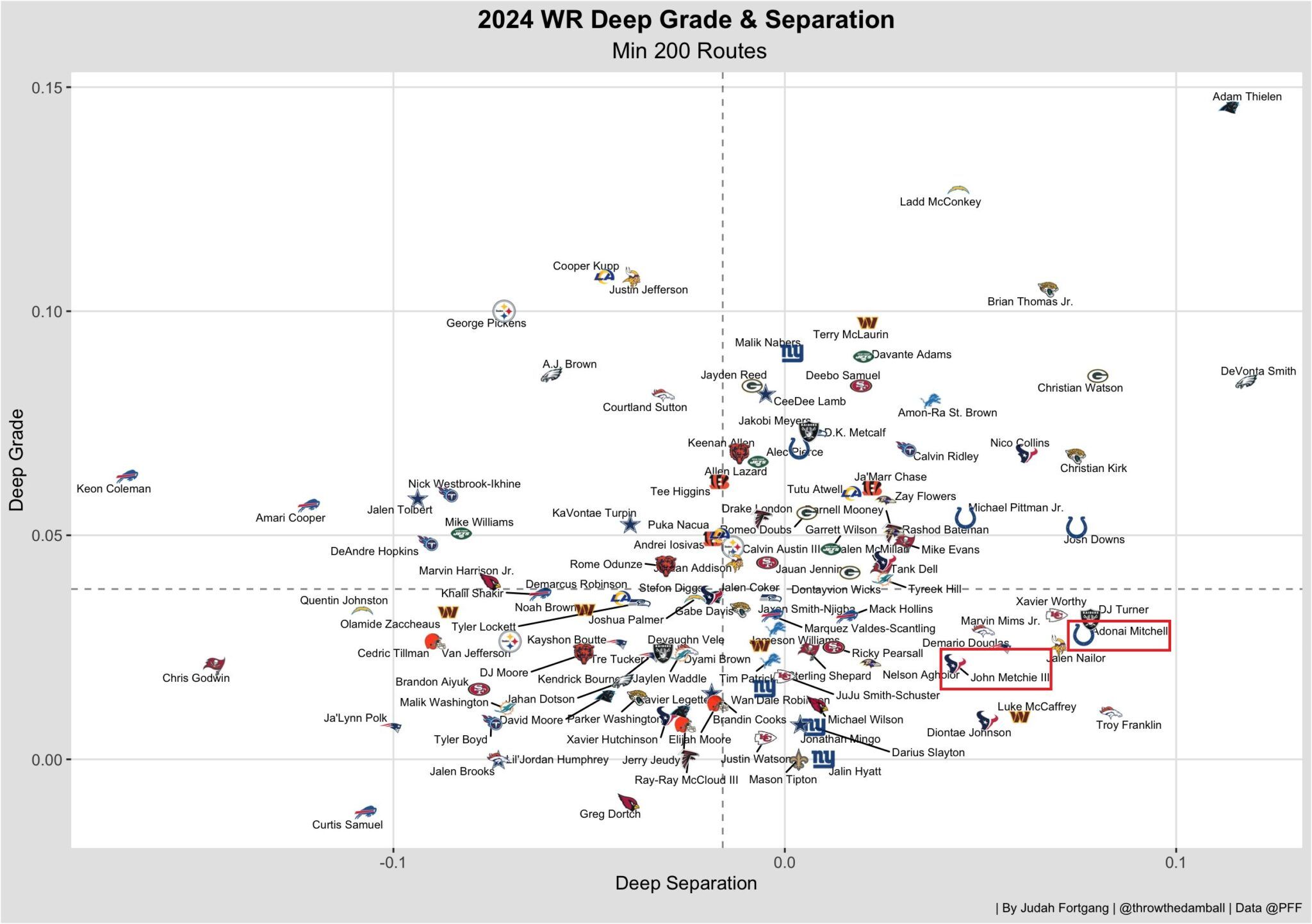
Mitchell and Metchie both ranked among the top receivers in deep separation during the 2024 season.
via Twitter/X: @throwthedamball
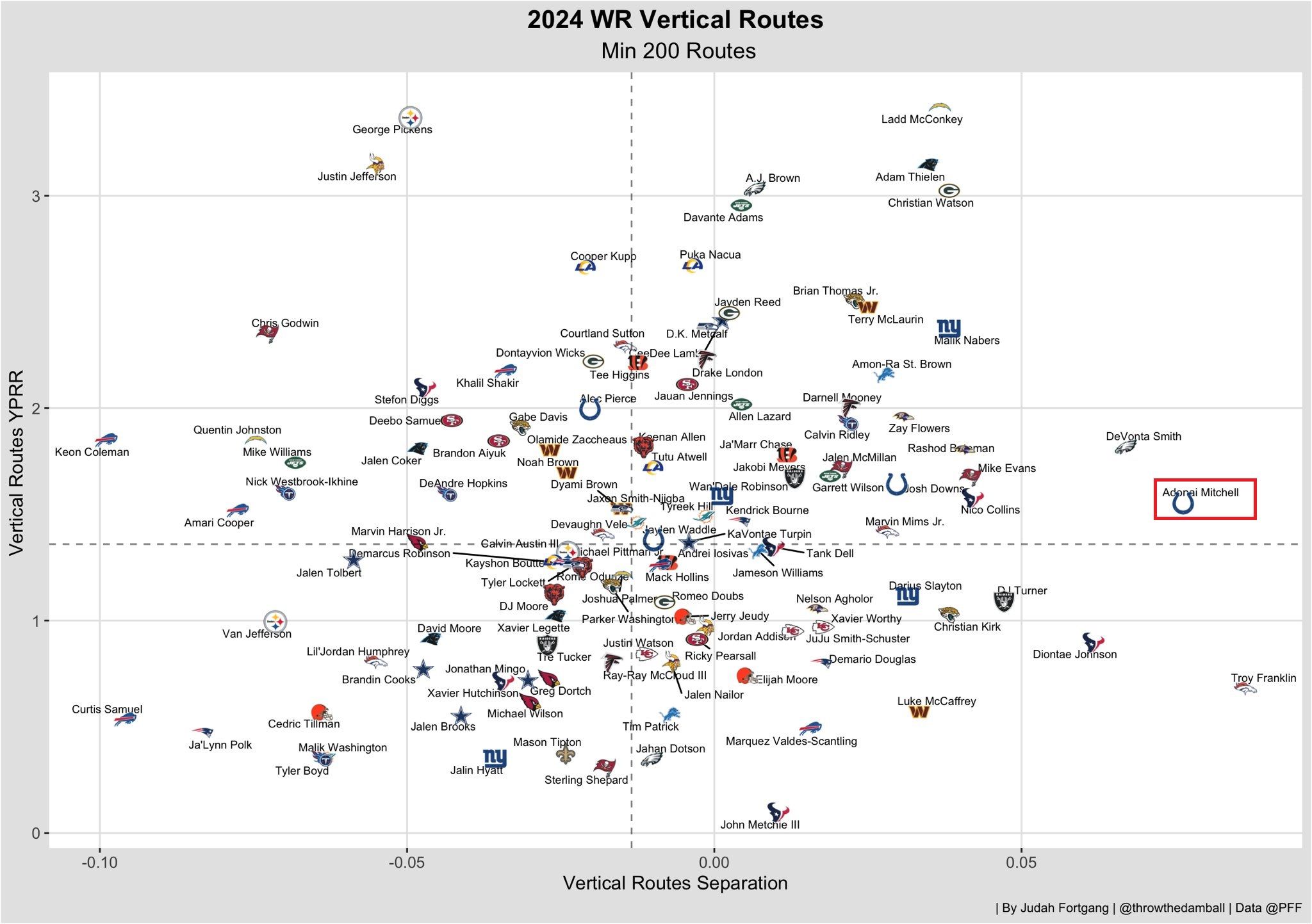
In 2024, Mitchell also had the position’s second-best separation grade on vertical routes. He was even third-best on in-breaking routes. Metchie was also comfortably above-average at separating on vertical routes, although his yardage production on those routes was league-worst.
via Twitter/X: @throwthedamball
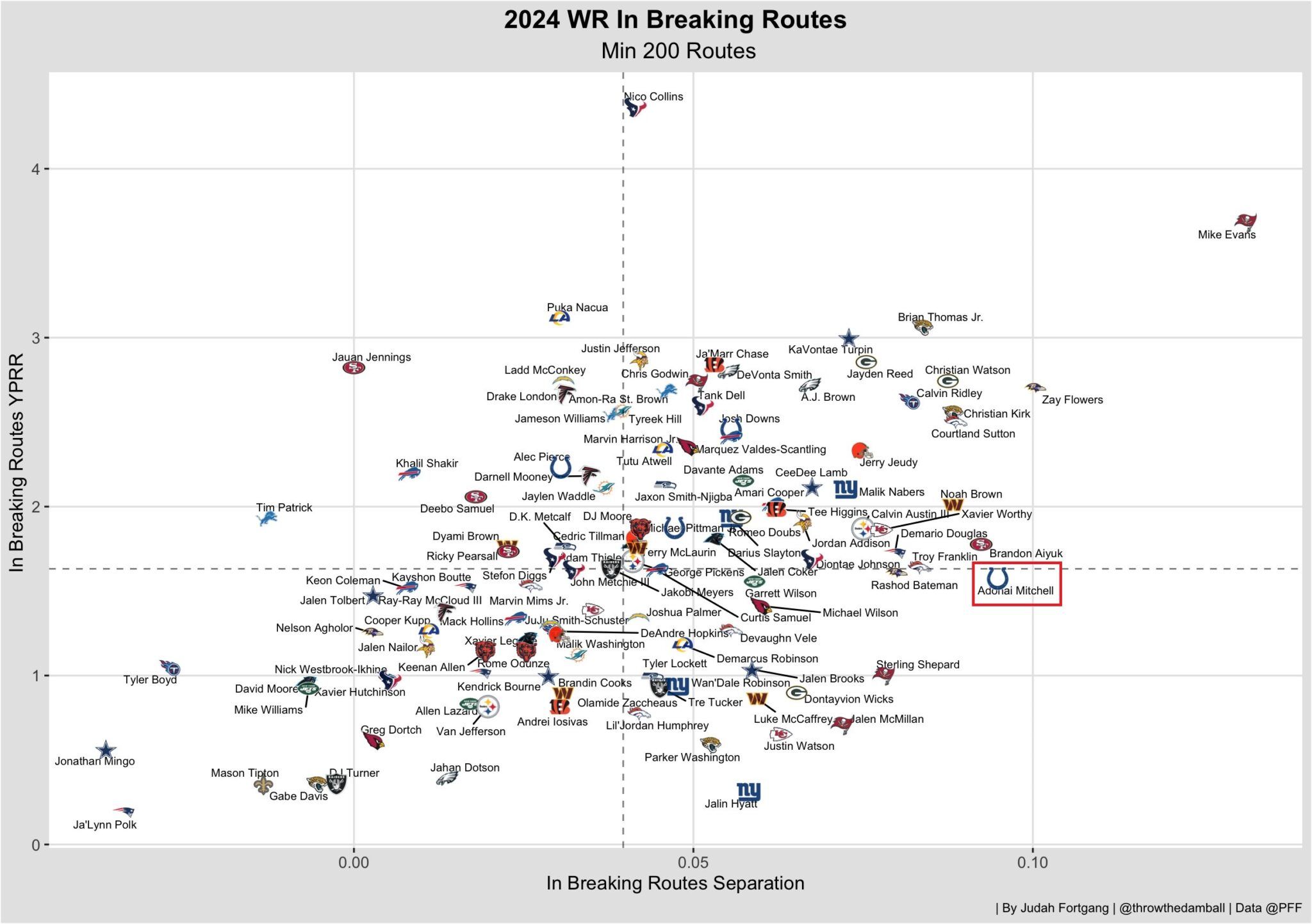
via Twitter/X: @throwthedamball
Despite these sparkling grades in the separation department, none of these three receivers have impressed from a production standpoint.
Smith has caught six of 10 targets for 47 yards and no touchdowns through his first eight NFL games.
Mitchell caught 32 of 71 targets for 464 yards and no touchdowns over 25 games in Indianapolis.
Metchie comes to New York with 44 catches on 71 targets for 430 yards and a touchdown in 36 career games.
None of these players looks tantalizing through their box-score production, but the underlying metrics suggest they are loaded with potential. The film backs it up, as all three players have put together long reels of reps in which they were open, but either were not targeted or received an inaccurate throw.
AD Mitchell (top) winning deep for a should be 71 yard TD
Out n up. Plays with the route pacing as he stems the CB with a slowed pace, accelerates hard outside for 3 steps selling the out
CB bites, Mitchell takes it vertically and wins for a should be TD catch but is overthrown pic.twitter.com/HQ49vXBbHD
— Joe Blewett (@Joerb31) November 5, 2025
For now, though, these receivers are who their numbers say they are. You don’t win games through hypothetical yards. Many receivers with similar profiles never translate their upside into production, for one reason or another (hello, Elijah Moore).
But if the Jets want to find out whether Smith, Mitchell, and Metchie can translate their separation skills into tangible results, they have to, well… throw them the ball.
While all three players have been victimized by a combination of poor quarterbacking and a lack of opportunities, they each have plenty of their own individual weaknesses to address, specifically at the catch point. Smith was extremely drop-prone in college. Mitchell has struggled with fumbles, drops, and alligator arms at the NFL level. Metchie is below-average with drops, contested catches, and YAC.
The only way to see if they’ve improved in these areas is to feed them targets on Sundays.
New York needs to come out of the 2025 season with solid evaluations on the development of these receivers, because there’s a chance they can fill one or even two holes in the 2026 depth chart. Each of these receivers is young, offers a high ceiling via their separation, and is under team control moving forward. That means if any of them impress the Jets enough over the next nine games, they can solidify a role for themselves in 2026, giving Mougey one less need to worry about.
That’s why it’s imperative for Fields to ensure that New York collects enough data on each wideout. Hypothetical upside via separation is great, and the Jets can evaluate each player in that area whether they are targeted or not, but all three have already excelled at separating. The next step is seeing whether they can convert at the catch point, and that can only happen if Fields targets them downfield.
If Fields spends the next nine games taking sacks and throwing dump-offs to Breece Hall, the Jets won’t get enough information to make definitive judgments on Smith, Mitchell, and Metchie going into the offseason. It could cause them to miss out on checking off a need, ultimately forcing them to spend assets on a receiver that could have been allocated to another position if one of the young receivers staked their claim to a role during the 2025 season.
Altering the offensive approach is how the Jets can prove they have a focused vision
Fields is not the Jets’ answer at quarterback. But he is their starting quarterback (presumably) entering the final nine weeks of the 2025 season, which means he still has a pivotal role to play in the organization’s future.
To recap, it is imperative for Fields to dial up his aggressiveness for three reasons:
It’s the best way for the Jets to win games in the short term with a gutted defense
It can help the Jets plant the seeds of the newfound offense-first vision they established by trading Gardner and Williams
It will allow the Jets to fully evaluate their three high-upside young wide receivers
Allowing Fields to continue playing Checkdown Charlie will help the Jets maximize their tanking efforts, but it will cost them dearly in multiple areas that are critical for their long-term prospects.
The Jets have spewed a deluge of messages over the last two days since their trades, both subtly through their actions and explicitly at the podium. If they meant what they said—wanting to continue winning games in 2025 and shift their focus toward building an elite offense over the long term—they will back it up by coaching Fields into leading a revamped gun-slinging offense over the next nine weeks, for better or worse.
Sticking with the same conservative offense over the next nine games would suggest that the Jets don’t truly know what direction they’re headed. Perhaps they impulsively dumped two franchise cornerstones without it being part of a larger plan. It is noteworthy that Aaron Glenn’s demeanor on Wednesday gave off the impression that he was stunned by Tuesday’s events; it would not be surprising if there is no overarching plan at play here, and Mougey just happened to suddenly receive two offers he couldn’t refuse.
That would be a concerning sign for the Jets’ future, as appealing as the trade returns were.
Revamping their offensive identity—by way of coaching Fields into playing with newfound aggressiveness—is the Jets’ best way to prove that these trades are indeed part of a focused vision, and not just a pair of impulsive “fire sale” deals.
If Fields doesn’t cut it, they will yank him for Tyrod Taylor (who went bombs-away in his latest appearance) and continue reinforcing their refreshed mission statement behind Taylor.
Whoever takes the snaps on Sunday and moving forward, the Jets need him to be aggressive to augment the franchise’s new direction following the trade deadline.