
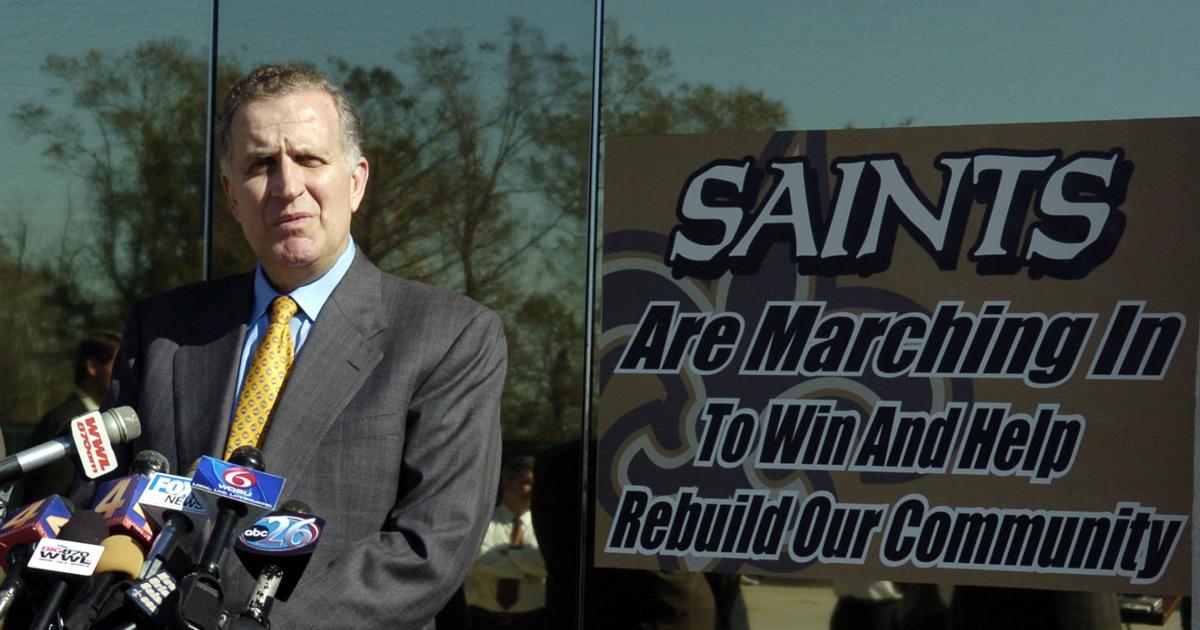
New Orleans lost a friend Sunday.
Former NFL commissioner Paul Tagliabue died at his home in Cape Cod, Massachusetts, at the age of 84. His health had been in decline for months as he battled Parkinson’s disease. The apparent cause of death was heart failure.
New Orleanians will forever owe a debt of gratitude to Tagliabue for his service to the city and the Gulf Coast region in the wake of Hurricane Katrina. In the final year of his 17-year tenure as commissioner, he deftly managed the crisis and spearheaded the New Orleans Saints’ return to the city.
It’s too simple to say the Saints wouldn’t have returned to New Orleans if it weren’t for Tagliabue. But it’s fair to say they wouldn’t have returned as successfully as they did without his shrewd leadership.
One of Tagliabue’s favorite sayings was “A friend in need is a friend indeed.” New Orleans learned that firsthand from Tagliabue when it needed it most.
It was Tagliabue who assuaged then-Saints owner Tom Benson’s fears in the wake of the storm and facilitated the club’s return to the city by fast-tracking resources to the club and cutting through red tape on Capitol Hill.
It was Tagliabue who rallied support for the team by arranging a series of meetings with local and regional business leaders, including a pivotal gathering at local businessman Tommy Coleman’s camp along the Mississippi River batture near the Orleans-Jefferson Parish line. The meeting featured some of the city’s richest and most powerful men and women — a who’s who of banking, energy, shipping, and real estate — and served as the catalyst for the Saints’ return.
And it was Tagliabue who showcased the city’s post-Katrina recovery on a global stage by putting the Saints’ return to the Superdome on Monday Night Football, the league’s premier platform.
“The whole thing turned around in remarkably quick time,” Tommy Coleman told me for a column I wrote in 2015. “Paul was really the inspiration behind it all. He’s really a phenomenal guy. He didn’t want to see anything happen to the franchise in New Orleans. He made it happen.”
Ever the diplomat, Tagliabue expertly handled the politically sensitive situation. Privately, he worked behind the scenes to steer the Saints back to New Orleans after the club’s relocation to San Antonio, Texas, after Katrina. Publicly, he defended Benson and had the owner’s back after fans in the city pilloried him for his post-Katrina flirtations with San Antonio.
“People like to fit others with black hats or white hats in life, he said in a meeting with the Times-Picayune editorial board in 2005. “I have found there are usually more shades of gray to everyone.”
Tagliabue later called the Saints’ successful post-Katrina return to New Orleans “probably the greatest community moment in the history of the NFL.”
“The Saints, the league and the city surviving Katrina and the league being such a huge part of saving an American city, it’s never happened before in any sport,” Tagliabue said at a 2015 charity event in New Orleans. “The Yankees won the World Series after 9/11, and the Red Sox won the World Series after the Boston Marathon. But never has a winning team saved a city after winning a championship.”
Tagliabue fell in love with New Orleans in the early 1960s when his Georgetown Hoyas basketball team played in the Sugar Bowl Classic basketball tournament. He grew to love the spirit, passion and culture of the city and South Louisiana. He developed an affinity for Cajun Zydeco music and returned to the area often after he retired as commissioner in 2006. He even took a tour of the Tabasco plant in Avery Island.
“Paul was a great friend, not only to me and my husband, Tom, but also to the city of New Orleans, hosting three Super Bowls during his tenure,” Saints owner Gayle Benson said in a statement.
On a visit to New Orleans years after Katrina, Tagliabue had dinner with Gary Solomon, the CEO of Crescent Bank and Trust, who was one of the power brokers in attendance at the 2006 summit meeting at Coleman’s camp. Solomon asked Tagliabue why it meant so much to him to ensure New Orleans’ recovery from Katrina.
“He told me, ‘My daddy taught me never turn a back on your friend,’” Solomon said.