
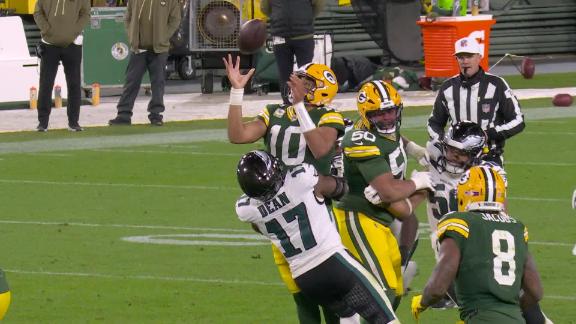
In the past two games played by the Green Bay Packers they have scored 20 total points and gone 0-2 against NFC opponents. Last night’s game against the Philadelphia Eagles was another example of the Packers’ offensive failure. On the morning after disaster, who or what is to blame for the loss against the Eagles?
Blocking
Even before Elgton Jenkins left the game with a fractured leg, the Packers offensive line was unable to create plays for their running backs. Josh Jacobs averaged 3.5 yards per carry, almost a whole yard below the NFL average of 4.4 yards. For a team that rushes the ball more often than 60% of the league, bad run blocking key cause for the Packers’ offensive failure.
Additionally, Jordan Love rarely had time to make throws to open receivers. According to Next Gen Stats, he was pressured on over 40% of his dropbacks and only completed 3 passes for 12 yards when under pressure. The Monday Night Football broadcast showcased multiple examples of open receivers that never had a chance to make a play due to their quarterback running from rushers or having to throw the ball away.
Lastly, although star pass rusher Jalen Carter did not get a sack, he did bat down two passes at the line. Football is won in the trenches, and Green Bay’s offensive trench players’ poor play was a massive piece of the Packers’ offensive failure.
Drops
To compound the difficulty in the passing game due to the Eagles constant pressure on Love, the Packers’ receivers had trouble catching the football. After a quick rewatch, I counted 2 drops by Romeo Doubs and 1 each by Dontayvion Wicks and Bo Melton. All but 1 of these drops were on 3rd or 4th down which killed the drive. Melton’s drop was particularly painful as he dropped a pass right to his chest on 4th down.
Christian Watson made a confusing choice on one of the few deep shots attempted by the Packers during the game. On a moonball near the goal line, Watson chose to play defense rather than attempt to use his height and physicality to grab the ball. Instead, he turned into the defender to prevent an interception. He said this was the wrong choice on social media after the game.
Although the Packers have been catching better than last year, drops on key plays were a big part of the team’s offensive failure.
Penalties
Penalties were momentum killers at multiple points during the game. The second drive of the game ended when Aaron Banks committed a false start on a 4th and 1 attempt. A 20 yard pass to Watson that would have been the Packers first entrance into the red zone was nullified by an illegal formation penalty. In a game where both defenses were defending every blade of grass, these penalties were a huge factor in the Packers’ offensive failure.
Conclusion
After my rewatch, I believe these factors were the biggest contributors to the Packers’ offensive failure on Monday night.
Jordan Love did not play his best game of the season. He fumbled before the end of the half which cost the Packers a scoring opportunity, and he missed several open receivers. Despite this, his line gave him little time to make good decisions and good throws.
Much criticism has been leveled at Matt Lafleur’s playcalling over the past few games. While I don’t think it is entirely fair to judge any playcaller whose offensive line has played as poorly as the Packers these past few weeks, I do criticize his ability as a head coach. Blocking, catching, and not getting penalties are mistakes of execution. When a team consistently fails to execute, the buck stops with the person in charge of team preparation: the head coach.
The Packers are now 3rd in the NFC North and 7th in the NFC. If they want to guarantee a spot in the playoffs or have the chance at winning the division, the offense needs to execute better and quickly.

Drew Jones
I am a Minnesotan born Packers fan and owner who decided to apply his excitement to writing about his favorite team. In between Packers games, I teach band to middle and high school students and work as a counselor at a summer camp in northern Minnesota.