
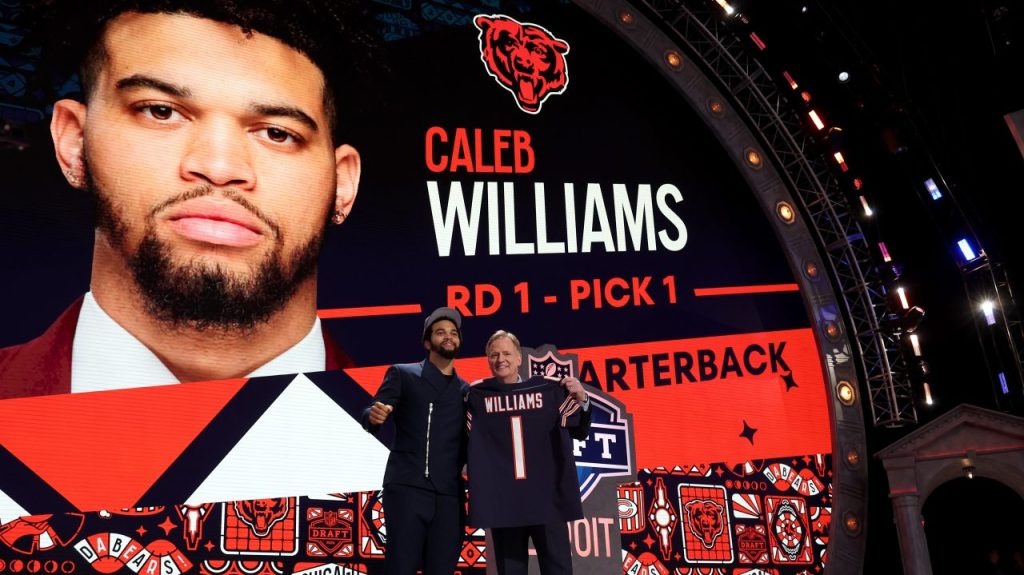
An upcoming book by ESPN’s Seth Wickersham on Caleb Williams details how the quarterback explored potential legal challenges to circumvent the 2024 NFL Draft.
The reality is that Williams would have lost any lawsuit.
According to Wickersham, Williams did not want to play for the Chicago Bears, which had the No. 1 pick and made it clear they intended to pick the USC star.
Like any drafted player, Williams was not compelled to play. He could have refused to sign and hoped the Bears traded him, as Eli Manning did with the San Diego Chargers in 2004. Williams could have waited a year and entered the 2025 NFL Draft. The Heisman winner could have also played in a different pro football league, including the United Football League. Wickersham says Williams considered that option.
It appears Williams and his father Carl Williams also contemplated a legal challenge against the draft or rookie employment conditions, including the rookie wage scale that slots entry-level players based on when they are drafted.
“The rookie cap is just unconstitutional,” Carl told Wickersham.
There are at least a couple of legal problems with that statement.
First, there is no constitutional issue with the rookie cap or any aspects of the NFL Draft. The NFL is a private entity. The league is not obligated to provide due process, equal protection, free speech and other constitutionally protected rights. The rights afforded to NFL players and prospective NFL players are based on contractual, not constitutional, rights.
Second, the rookie wage scale and the draft are legal. They are borne through collective bargaining between the NFL and the NFLPA. The fruits of collective bargaining are exempt from antitrust scrutiny through the non-statutory labor exemption. The exemption reflects U.S. Supreme Court rules that dictate when management and labor collectively bargain pay, wages and other employment conditions, those conditions are exempt from antitrust scrutiny. Courts have repeatedly upheld CBA terms, including drafts and their features, that are agreed to through bargaining.
Even when a player is excluded from a draft and a league, his exclusion has been found lawful. I know this from personal experience. I served on the legal team for Ohio State star running back Maurice Clarett in his antitrust challenge against the NFL and its eligibility rule requiring that players be three years out of high school. Even though the rule prevented Clarett from being part of the NFL or NFLPA, and even though the rule was not borne through formal collective bargaining, a federal appeals court still sided against Clarett.
The draft and rookie wage scale are unfair in some respects. They prevent a prospective player from signing with a preferred employer (team), deny the player a chance to use bargaining with multiple teams as leverage to extract more pay and better terms, and slot a player into a pay scale that, for some, underpays them based on what they could obtain in a less restrained market.
Those things can be true while the legality of the draft is also legitimate. The draft also has features that promote competition. It helps to ensure that unsuccessful teams have opportunities to improve themselves by acquiring the best new talent, which in turn makes the league more competitive overall.