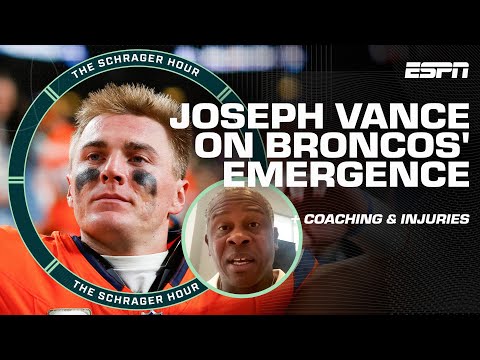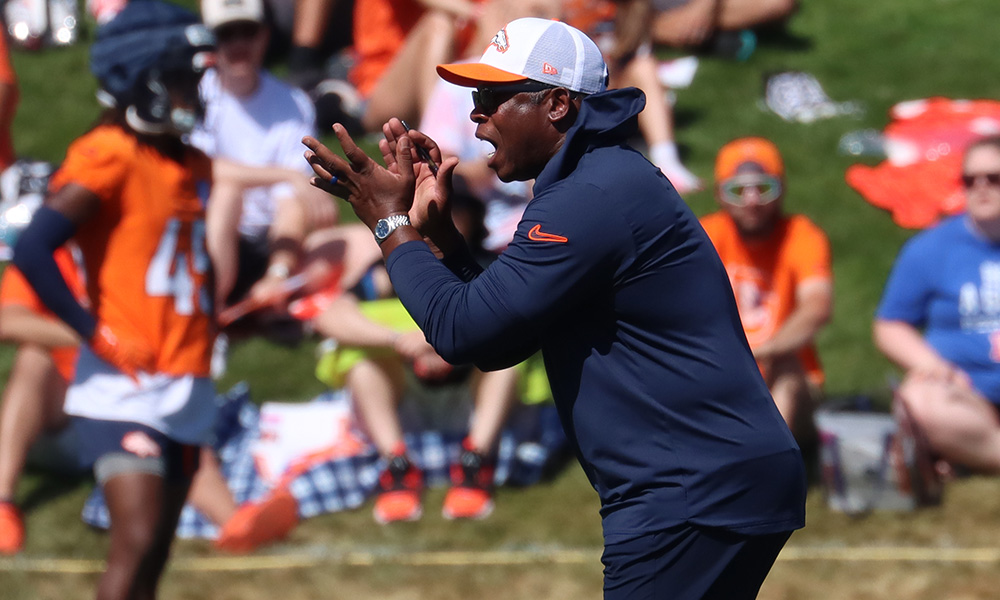
Vance Joseph knows what he would do differently if — and when — he gets a second chance to be an NFL head coach.
But what was most fascinating about the answer he gave when asked that question earlier this week was this: He actually had some of the right ideas all along.
“I think the overall philosophy of building a team, I was chasing the wrong thing,” the Broncos’ defensive coordinator told ESPN’s Peter Schrager this week on his The Schrager Hour podcast when queried as to he would handle a second chance.
What he was chasing at the time, he says, was a quarterback.
“I should have spent my time on … playing great defense, right? Building an offensive line, having a winning formula where I didn’t need a Peyton Manning or John Elway at the time because those things are hard to find. That’s unicorns, right? And you need obviously picks and lots of money and some misfortune to kind of pick those guys at the top five. And we weren’t there,” Joseph said.
“So to chase that, that, that unicorn, right, before I chased building the O-line, let’s run, or let’s take care of the football, let’s play defense. The defense was still top 10, but I thought I missed a mark on that, right?
“I was chasing something that was really hard to acquire versus fixing O-line, which was real. We could have fixed the O-line.”
Yet here’s what I recall about when Joseph’s first offseason as Broncos head coach: He actually DID try to repair the offensive line.
JOSEPH’S BRONCOS TARGETED O-LINE IN 2017
Perhaps Joseph wants to stick up for the players who came in on his watch — specifically a pair of free agents who did not live up to their contracts. But in the 2017 offseason, Joseph and the Broncos installed newcomers along 60 percent of the offensive line: two free-agent signees and first-round pick Garett Bolles.
So Joseph had the right general plan. Just the wrong guys — at least at two spots.
Ronald Leary struggled with injuries in his two seasons under Joseph, missing 15 of 32 games over the 2017 and 2018 seasons. He bounced back to play 12 games in 2019, but the Broncos released him in 2020 with one year left on his contract, opting to add free-agent Graham Glasgow from the Detroit Lions to bolster the interior of their line. Leary wasn’t a Ja’Wuan James-esque bust for the Broncos up front, but he came up short of being worth the $27,281,250 the Broncos paid him over his three years of service.
And then there was Menelik Watson, best remembered for proposing to his girlfriend from the bench area during a preseason game. He’d struggled with consistency and injuries and started just 17 games over four seasons with the then-Oakland Raiders. With many better and more proven options on the market, the Broncos rolled the dice and thought things would be different. They weren’t and he was gone after one season, yet another horse in the right-tackle carousel that spun for nearly a decade.
In the cases of Watson and Leary, the Broncos went for players who were more budget-friendly options than other free agents that year such as Kevin Zeitler, Andrew Whitworth, Ricky Wagner or Riley Reiff. They were top-50 free agents that year. Leary and Watson weren’t; Watson wasn’t even in the top 100.
Sometimes, you get what you pay for.
Bolles, the first-round pick in Joseph’s initial draft, eventually worked out well. But three years into his career — and one season after the Broncos sacked Joseph following a 6-10 finish in 2018 — Denver thought so little of Bolles’ progress that the team declined to pick up his fifth-year option.
A relatively inexperienced prospect who began playing football at a relatively late age, Bolles broke into the league as a raw prospect who required more developmental time than many players — including, for example, the offensive tackle New Orleans selected 12 choices after Bolles, Ryan Ramczyk.
Ramczyk became an All-Pro and has since retired, so he wouldn’t help the Broncos today, but he would have aided Joseph’s cause right then and there.
Then came the 2018 offseason, in which notions of a long-term plan were tossed. The quarterback solution was Case Keenum, a low-ceiling passer with analytics that revealed his miraculous 2017 season was potentially a fluke outlier. The Broncos had that top-5 pick of which Joseph spoke, but they didn’t take the quarterback; nor did they choose an offensive lineman.
The former could have been Josh Allen; the latter saw Quenton Nelson available; he’s merely on a Hall-of-Fame trajectory with three first-team All-Pro nods, two second-team All-Pro selections and seven Pro Bowl trips in seven NFL seasons.
Several years later, Joseph was left only to reflect.
“That’s what I could have gotten done and still had a great product and won games, which would have bought me time to find a quarterback, right?” Joseph told Schrager. “But I thought I missed a mark there and I regret that, but I learned from it.”
But Joseph’s regret appears misdirected.
He shouldn’t lament where his arrow pointed. The regret should be on the players picked. And remember, the final say landed elsewhere.
The Broncos shopped in the scratch-and-dent pile in 2017. They went looking for value. Six years later, when Joseph returned, they shopped for offensive linemen again, but they went upscale with big-ticket items Mike McGlinchey and Ben Powers.
Together, they ignited the line’s revival; the growth of Quinn Meinerz and the renaissance of Bolles helped complete the picture. And those additions helped put the Broncos near a playoff spot in 2023, even with Russell Wilson spinning his way into sacks despite excellent protection.
“Watching how Sean has built this team has been for me a masterclass on how to build a team around what you have and how to win each game differently until you acquire that player [at quarterback],” Joseph said. “Even before Bo Nix got here, we should have been a playoff team.
“And I watch how Sean would maneuver the game plans and strategically win each game differently before we had a Bo Nix. And that’s the key in this league, man, you have to find out your formula to win with what you have available.”
Had Joseph been able to pull that off in 2017 and 2018, the runway to get quarterback right would have come naturally.
“And that only just gives you time. It buys you time to fix the major problems, which for me was the quarterback,” he said. “But it was too much focus on that and not enough focus on winning around that issue until we had more time to kind of find it.”
So, perhaps the moral of the story for Vance Joseph, Head Coach Version 2.0 at his next stop is this: When you’re trying to fix the offensive line, don’t sign two potential replacements who aren’t top-50 free agents.
When it comes to the offensive line, you get what you pay for.
Unless it’s Ja’Wuan James. Which leads to another lesson: Don’t sign an offensive lineman with a track record of frequent injuries.