
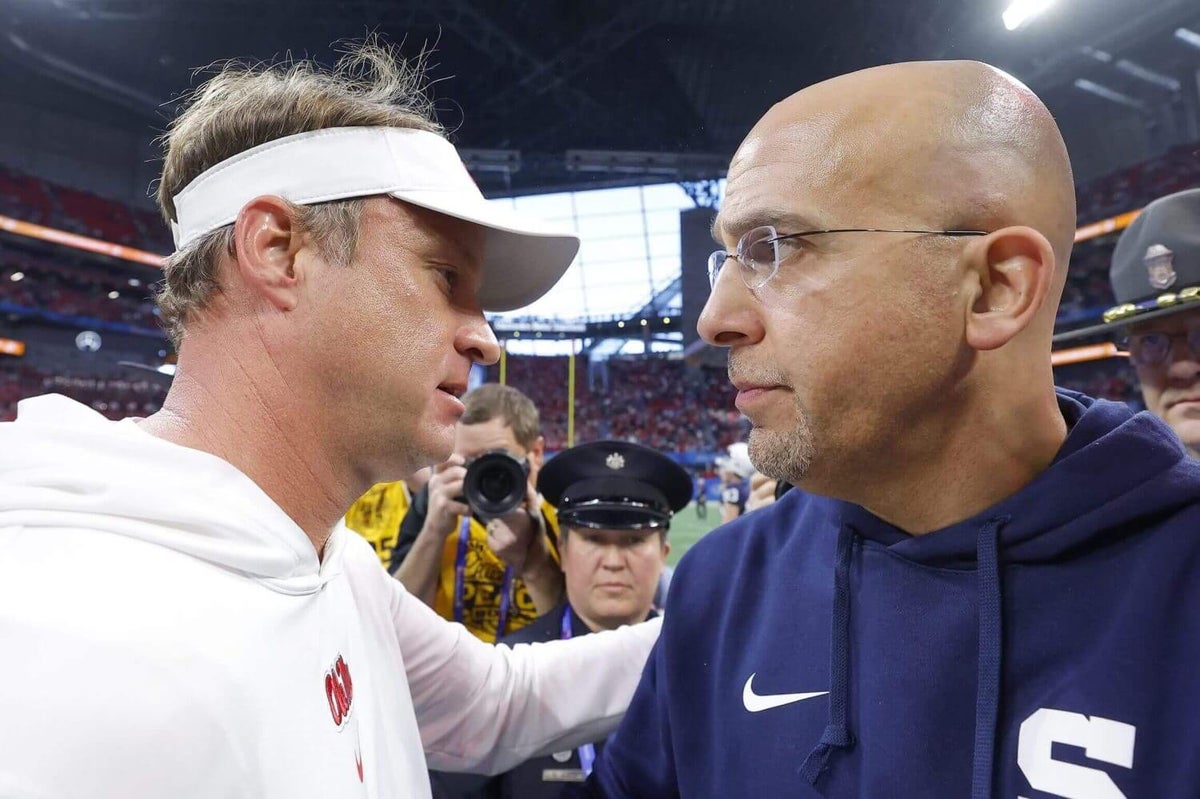
The coaching carousel is heating up as the end of the regular season approaches. Decisions are imminent, Zoom interviews are frequent and everyone is waiting for Lane Kiffin — for now.
Why Lane Kiffin has to make up his mind soon
It was only a matter of time before Kiffin’s balancing act spilled into the public and became a mess for everyone involved. From the moment South Florida upset Florida and made clear the Gators would move on from Billy Napier, this was always going to be the result. After all the work done to rehabilitate his image, Kiffin is now stringing people along and upsetting almost everyone in the process.
Kiffin’s family visited Gainesville, Fla., and Baton Rouge, La., over the weekend, while Ole Miss made clear to the coach this week that he has to make a decision soon. Politicians are expressing their frustration, too.
Couldn’t agree more. At some point, it’d be nice for our current coach (@Lane_Kiffin) to reciprocate the love and gratitude shown by our administration, players, fan base, and collective. It just shouldn’t be this hard. https://t.co/HHmBOxvaCP
— Secretary Michael Watson (@MichaelWatsonMS) November 16, 2025
Kiffin has done this dance before. Three years ago, he flirted with Auburn ahead of the season-ending Egg Bowl. Kiffin ultimately stayed, and Ole Miss boosters upped their name, image and likeness spending to help him, but the Rebels lost to Mississippi State to cap a stretch-run collapse.
The difference this time is that Ole Miss is nearing the end of one of the best seasons in school history, and Kiffin’s impending decision has put a shadow on that celebration. The Rebels’ Playoff odds sit at 96 percent per The Athletic’s model, yet Kiffin may cross the coaching carousel Rubicon of leaving a national championship contender for another job before the season ends.
“If a team wanted a Playoff coach, this was bound to happen,” Kiffin said Wednesday during a contentious SEC coaches teleconference. “Just looking from the outside, not talking about myself, there’s a systematical problem. It used to be players were in it, and they still are a bit with the portal timing, and look at the Penn State quarterback (Beau Pribula) a year ago. That’s a systematical issue, a calendar issue. The subject is probably, until something changes, going to be an issue for years.”
Kiffin can lament the calendar, but as industry sources have pointed out, he’s not a backup quarterback or a Group of 5 coach considering a career-altering move without a real chance at winning it all. Ole Miss does have that shot, and any school Kiffin would leave for would pay him relatively the same amount of money as Ole Miss can, with no guarantee he’ll get as far as he is right now.
The calendar is a real problem for Jon Sumrall at Tulane or Eric Morris at North Texas. But this one is mostly on Kiffin to make a decision.
So what if Kiffin doesn’t make a choice before or shortly after the Egg Bowl? What can Ole Miss actually do? They won’t fire him and deal with the costs of that, but the Rebels have a plan. If necessary, defensive coordinator Pete Golding or quarterbacks coach Joe Judge are the most likely interim head coaches, according to industry sources. Judge spent two years as the New York Giants coach (and, coincidentally, is a Mississippi State alum).
The situation is reminiscent of 1989, when Michigan athletic director Bo Schembechler told basketball coach Bill Frieder to resign after he’d accepted the Arizona State job on the eve of the NCAA Tournament. Steve Fisher became the interim coach and led the Wolverines to the national championship.
But along with a Playoff run, the Rebels must also be prepared for the coaching search process, which is why they need Kiffin to make up his mind. Sumrall is in the mix for other SEC jobs, but he’s also a former Ole Miss assistant and would be a top target for the Rebels if Kiffin moved on. Ole Miss can’t wait around too long and see its top options come off the board. The Rebels’ spending on the roster has dramatically improved the quality of the job.
It’s not lost on observers that, amid a coaching carousel headlined by enormous buyouts, a coach might leave a national championship contender on top of that. These are not things that happen in most sports, but if anyone was to be in the middle of all this, of course it would be Kiffin.
Coaching search updates
Here’s what I’m hearing around a few other searches.
Auburn continues to show a lot of interest in Sumrall, USF coach Alex Golesh, Missouri coach Eli Drinkwitz, Vanderbilt coach Clark Lea and Georgia Tech coach Brent Key, among others. Sumrall and Key are Alabama natives. There is a lot of overlap between the Auburn and Florida searches outside of the Gators’ Kiffin pursuit.
Oklahoma State’s long search to replace Mike Gundy has narrowed to a point where Morris, Golesh, Texas A&M offensive coordinator Collin Klein and Alabama defensive coordinator Kane Wommack are considered the strongest candidates, and a final decision could come soon. The potential opening at Baylor, which some view as a better job, could impact that search, but the departure of Bears athletic director Mack Rhoades has left a lot of people unsure who can or will make a decision on Dave Aranda’s future.
Names to watch at Penn State include James Madison coach Bob Chesney, Louisville coach Jeff Brohm, Drinkwitz, Key and Lea, among others. Chesney was an option for Virginia Tech before James Franklin took the job. Former New York Giants head coach Brian Daboll is an option, as is Ohio State offensive coordinator Brian Hartline. Former Northwestern head coach Pat Fitzgerald has spoken with almost every open school, including Penn State.
At UCLA, Chesney’s name continues to be mentioned. San Diego State’s Sean Lewis, whose Aztecs are off to an 8-2 start this season, is also on the radar, as are Morris and Memphis head coach Ryan Silverfield.
Arkansas continues to show interest in Golesh, Silverfield and Morris, among others.
Akron’s season ended on Tuesday with a win over Bowling Green to finish with a 5-7 record, and head coach Joe Moorhead could be a name to watch at a few places. That includes the offensive coordinator job at Virginia Tech under Franklin or the UConn head job if Jim Mora leaves. Moorhead was Franklin’s OC at Penn State from 2016 to ‘17, and he was the OC on the 2010 UConn team that reached the Fiesta Bowl. Mora himself has received interest from jobs out west, like Oregon State and Stanford.
Why James Franklin renegotiated his Penn State buyout
Not long after Franklin accepted the Virginia Tech job, The Athletic reported that Franklin and Penn State had renegotiated his buyout. Instead of the almost $49 million he was owed through 2031, the sides agreed to a $9 million guarantee paid out in installments. Many fans asked why Franklin would give up $40 million, but that’s not exactly how it works.
Most coaching contracts include a duty to mitigate, meaning the coach is required to try to get another similar job, and whatever he makes from that next gig is subtracted from the buyout that his previous school owes. Jimbo Fisher’s $77 million guarantee from Texas A&M was an exception, not the norm. Not all splashy buyout numbers are the same. That’s why LSU was also trying to negotiate something with Brian Kelly, according to a lawsuit Kelly filed alleging that the school was attempting to fire him for cause.
Franklin was set to receive around $8 million annually from Penn State. His Virginia Tech salary has not yet been made public (The Athletic has submitted an open records request for its details), but for the sake of this exercise, let’s pretend it’s $6 million annually. That means Franklin’s buyout from Penn State would drop to something like $2 million annually through 2031. A negotiated $9 million guarantee makes the split easier for both sides, avoids any contentious offset math and generally gets the coach the money he would’ve gotten anyway.
Penn State may have seen a benefit to firing Franklin early in the season by recognizing that Franklin wanted to keep coaching and would be highly sought-after. As a result, the sides have moved on smoothly.
Expand the Playoff … to keep your coach?
As College Football Playoff expansion discussions continue, whether toward 16 teams or 24 or something else, much of the focus is on postseason access or what it does to the regular season. But some coaches and administrators have another selling point: A larger field would help keep schools from firing their coaches.
With the high-profile firings at Penn State, LSU and Florida this year, perhaps with more to come, anything that helps lower the bar for meeting expectations is viewed as a solution to the big buyouts nobody wants to pay.
“Until the College Football Playoff expands, and I’m talking at least doubles in size, you’re going to see firings like what you’re seeing this year every couple of years,” said one staff member at a school that has already fired its coach. “Out of the Power 4 conferences, only 11 schools get in out of 60-plus. Somebody is getting left out. The expectations aren’t aligned.
“In the NFL, you’ve got 32 teams, at least 12 teams, a third of the NFL gets into the playoffs every year. You can lose six games and have a really good year. Here, if you lose three games, people are calling to fire you if you don’t get in the Playoff. The odds aren’t in your favor.”
That statement may seem self-serving (because it is), but there is a case to be made about what it means at schools from year to year. Dan Mullen reached three New Year’s Six bowls in his first three seasons at Florida (before the CFP expanded from four teams to 12), and he was fired before the end of Year 4 and replaced by Billy Napier, who came nowhere close to those expectations.
Missouri coach Eli Drinkwitz laid out a 30-team playoff idea this summer at SEC Media Days in part for this reason, and last week he lamented the “Playoff-or-bust” mentality he believes has taken over the sport. The Tigers have had a respectable season, still in the CFP top 25 despite two season-ending quarterback injuries, but with Missouri out of the CFP race, he sensed more negativity than there should be. Is that fair?
“Whoever takes over at Florida or at LSU, they are going to be expected to be in the Playoff, or they are going to get fired,” that staff member said. “I don’t know how you coach, how you create a safe environment for your coaches and your players with that type of pressure.
“The walls start to cave in and squeeze because of the murmur of the fans and the expectations. It’s just hard to do your best work when you are constantly being squeezed from all sides. I think you’ve got to be able to breathe, and you’ve got to have a place where coaches can coach and do their work.”
But, as Don Draper once said, that’s what the money is for.
Maryland keeps Mike Locksley
Maryland on Sunday became the second Big Ten school to announce its maligned coach would return next season, bringing back Mike Locksley, who joins Wisconsin’s Luke Fickell. At least one prominent board of regents member is fully behind the decision.
Tom McMillen, the former Maryland and NBA player and congressman, knows the land well. He was once the director of the Lead1 Association, a lobbying group for Division I athletic directors, and he agreed with Maryland’s athletic director on the decision.
“I admire Jim Smith for bucking the coaching carousel,” McMillen told The Athletic.
McMillen has frequently criticized the current college sports landscape and still meets with people in Washington, D.C. about various issues. But as a Maryland alum, he didn’t see the upside in starting over again. The Terps have lost six games in a row following a 4-0 start. But their young talent has shown promise, led by freshman quarterback Malik Washington, and the 2026 recruiting class includes top-five prospect Zion Elee, a five-star edge rusher from Baltimore.
Locksley’s buyout would’ve been around $13 million, with no offset and half of it due in 60 days.
Fan patience is shorter than ever, and McMillen believes Indiana’s rapid turnaround has further accelerated that loss of patience. In addition to hiring a good coach, Indiana dramatically increased its program investment. That’s what Maryland should do, rather than fire the coach, McMillen believes.
“It’s a systemic problem across college sports,” he said. “What’s happened now because of Curt Cignetti is that everyone thinks if you get a golden boy coach, you’re going to go undefeated. He’s a great coach, but the idea you (are guaranteed to) get these kinds of rewards for not succeeding are nuts.”