

The New York Jets are about to watch the NFL playoffs from their couches for the 15th year in a row.
There are many logical explanations for the drought. Whether it’s poor head coaching hires, whiffed quarterback selections, or shoddy ownership, it doesn’t take a football savant to figure out why the Jets have been one of the NFL’s least successful franchises.
But to be this bad, this consistently? It isn’t supposed to be possible in a parity-driven league.
READ MORE: The Jets’ Jeremy Ruckert situation demands attention
Let’s think for a second about just how unfathomable it is to miss the playoffs 15 (fifteen!) years in a row in the modern NFL.
This is a sport with a bizarrely shaped ball that can bounce whichever way it wants, and those bounces often dictate the outcome of a game. With the season being only 17 games long, a couple of bounces can be all a team needs to luck its way from a sad seven-win team to a playoff-bound nine-win team that makes a surprising run.
There aren’t enough games on an NFL schedule for luck to even itself out the way it does in leagues like the NBA or MLB. This also applies to the playoffs, where the NFL’s one-game format allows for substantially more upsets than five or seven-game series.
On top of the makeup of the sport itself, the NFL’s team-building structure is designed to facilitate parity from year to year. This is a league with no draft lottery; “tanking” is encouraged and rewarded, unlike the NBA. There is also a hard salary cap, unlike MLB. These functions help struggling franchises rise quickly, while making it challenging for great teams to stay great.
Additionally, for six seasons now, the playoff field has been expanded to include an all-time high of 14 teams, meaning that 44% of the league makes the playoffs each year. Making the playoffs is not far off from a coin flip.
Everything about football as a sport and the NFL as a league is designed to drive parity. The entire system is built to level the playing field. It is arguably the best-designed sports league in North America when it comes to giving every team an equal chance to compete for championships.
Sure, there is still a skill gap, which allows smart franchises to achieve sustained success, and, in turn, bumbling franchises to fall into stretches of misery. It’s not as if the NFL’s results are completely random each year.
Mathematically speaking, though, the ball is supposed to bounce a franchise’s way every once in a while, no matter how inept they are at managing a professional football team.
Here is what some of the other “worst” franchises in NFL history (based on win percentage since 1966) have achieved since the Jets last made the playoffs (2010).
32. Tampa Bay Buccaneers (.413): 5 playoff appearances, 5 division titles, 6 playoff wins, Super Bowl victory
31. Jacksonville Jaguars (.421): 2 playoff appearances, 2 division titles, 3 playoff wins, 1 AFC championship appearance
30. Arizona Cardinals (.429): 3 playoff appearances, 1 division title, 1 playoff win, 1 NFC championship appearance
29. Cleveland Browns (.430): 2 playoff appearances, 1 playoff win
28. Detroit Lions (.430): 5 playoff appearances, 2 division titles, 2 playoff wins, 1 NFC championship appearance
27. New York Jets (.436): 0 playoff appearances
26. Atlanta Falcons (.436): 4 playoff appearances, 2 division titles, 4 playoff wins, 2 NFC championship appearances, Super Bowl appearance
25. Houston Texans (.440): 8 playoff appearances, 8 division titles, 6 playoff wins
24. Cincinnati Bengals (.455): 7 playoff appearances, 4 division titles, 5 playoff wins, 2 AFC championship appearances, Super Bowl appearance
23. Carolina Panthers (.456): 4 playoff appearances, 3 division titles, 3 playoff wins, Super Bowl appearance
All of these organizations have been similarly woeful to the Jets throughout their history. Yet, even these notoriously star-crossed franchises have managed to enjoy multiple seasons of playoff-caliber success over a 15-year stretch in which the Jets haven’t done it a single time.
Consider this: The Atlanta Falcons and Carolina Panthers are currently tied for the NFL’s second-longest playoff drought behind the Jets at seven seasons, and yet, both teams have made one Super Bowl appearance and three divisional round trips since the Jets last even made the playoffs.
No fanbase can claim it has withstood the same amount of pain as New York Jets fans over the last decade and a half. Simply put, the Jets’ drought defies logic.
Meddling ownership, bad coaches, bad quarterbacks—it doesn’t matter. In a sport like football and a league like the NFL, every team should be able to luck its way into multiple memorable seasons over a 15-year span. The Jacksonville Jaguars did it. Even the Cleveland Browns did it.
Why haven’t the Jets?
When you dive deeper into the Jets’ struggles, searching for logical reasons that might explain how the Jets could possibly be this consistent at losing, things only start to become more inexplicable.
Nothing sums up the Jets’ incomprehensible misfortune more than their performance in an aspect of the sport that is entirely driven by luck: recovering fumbles.
When the “ball” is loose in a football game, there is little to no skill involved in determining who ends up with it. This is not a basketball or baseball, a perfectly round object that usually bounces in a predictable direction as a result of the way it was struck by the player(s) involved. This game is played with a prolate spheroid. Its destination is handpicked by the football gods.
And for whatever reason, the football gods don’t seem to like the New York Jets very much.
Through the Jets’ first 10 games of the 2025 season, there have been 20 fumbles: 11 by New York and nine by opponents. That’s 20 coin flips in which the ball has a relatively equal chance of going to either team, with the results of these coin flips being incredibly pivotal to deciding the outcomes of each game they occurred in.
How many of those 20 coin flips did the Jets win?
Four.
Yes, four.
The Jets have come up with possession on 20% of fumbles in their games this season. Not only is that the lowest rate in the NFL, but the gap between them and the 31st-ranked team (12%) is twice as large as the gap between any other two teams on the list.
Note: Fumbles that go out of bounds are marked as a recovery for the offense, despite no player receiving statistical credit for recovering it.
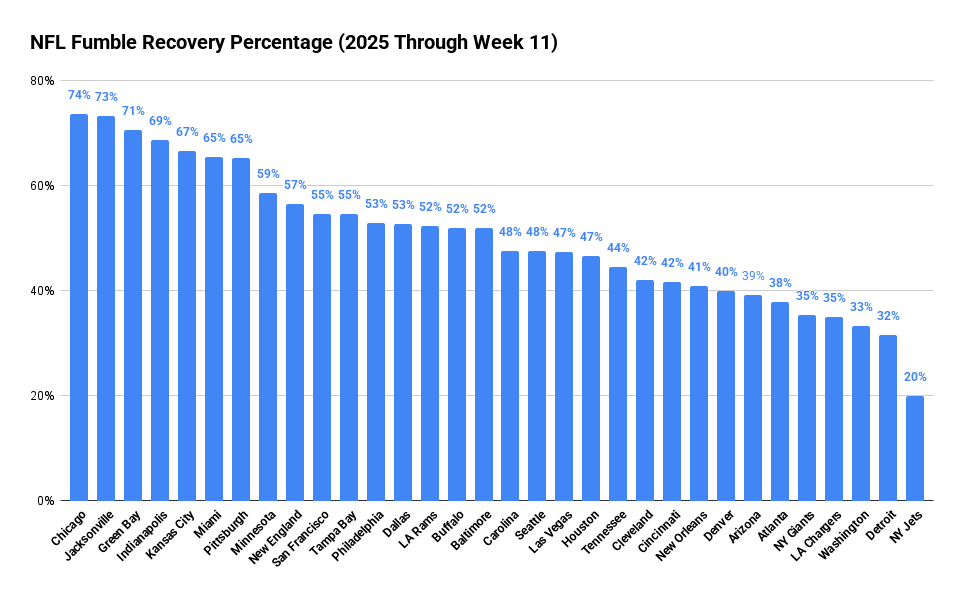
There’s bad luck, and then there’s this. You can’t explain it. The chance of winning a coin flip fewer than five times out of 20 tries is 0.59%, or about 1 in 169.
What did the Jets do to deserve this?
Okay, perhaps it just isn’t the Jets’ year, and their luck evens out if we include their fumble recovery success in previous years. After all, while a 1 in 169 chance is extremely low, it isn’t impossible that it could happen once over a 10-game sample.
Here’s where things get spooky: This is the norm for the Jets.
Well, they haven’t been this unlucky before, but the Jets routinely have one of the league’s worst fumble recovery rates.
The Jets have finished bottom-10 in fumble recovery rate in eight of the last 10 seasons. Across that span, they only had one season in which they recovered over half of live balls.
Take a look at their yearly rankings since 2016 (a 10-year streak of losing seasons):
2025: 20% (32nd)
2024: 52.4% (10th)
2023: 38.1% (32nd)
2022: 40% (30th)
2021: 35% (31st)
2020: 40% (27th)
2019: 42% (29th)
2018: 45.5% (25th)
2017: 50% (14th)
2016: 45.7% (23rd)
You might be thinking that there must be some degree of skill involved if the Jets are this consistently poor at recovering fumbles. One hypothesis could be that the defense recovers more fumbles than the offense, and since the fumble-prone Jets lose the ball more often than they force it out of the opponent’s grasp, it hurts their overall recovery rate.
Nope, that’s not true. Since 2016, the Jets, for all of the sloppiness they’ve endured at quarterback, have actually fumbled 19 fewer times than their opponents: 200 to 219.
Yet, out of those 419 fumbles, the Jets came up on the right side of just 176: a measly 42%.
At first glance, the 42% rate seems much less baffling than New York’s 20% rate in 2025. Over a 10-year sample, though, that’s a downright shocking mark for a coin-flip proposition. In fact, it’s even more inexplicable than the Jets’ 20% recovery rate in 10 games.
As we mentioned earlier, there is a 0.59% chance (1 in 169) of winning a coin flip fewer than five times out of 20 tries. However, the odds of winning a coin flip fewer than 177 times out of 419 tries are almost 10 times lower: 0.0618% (1 in 1,618).
Across 10 years, the impact this has had on the Jets’ success is remarkable.
Consider that across 419 fumbles, the Jets should have secured about 210 of them. They actually came up with 176, which means their fumble luck has cost them 34 turnovers over the last 10 years. That’s 3.4 turnovers per year based solely on luck.
Since any one game could be flipped by a single turnover, we’re talking about the possibility of the Jets losing up to three games per year based on their luck with fumbles. That might not be an exaggeration: Since 2016, the Jets have lost 40 one-score games (four per year) in which they did not win the turnover margin, third-most in the NFL. Who knows how many of those would have flipped if the Jets got the ball to bounce their way 34 more times?
This season alone, the Jets are tied for the NFL lead with four one-score losses in which they did not win the turnover battle (vs. Pittsburgh, Tampa Bay, Miami, and Carolina). In those four games, there were 10 total fumbles, and the Jets did not recover a single one of them.
Personally, I’m a logical, analytical thinker. I like numbers. I like cold, hard data. I don’t believe in curses, ghosts, or just about anything that cannot be explained with a spreadsheet.
But stuff like this? It makes me rethink my outlook on life a little bit.
Somebody up there doesn’t like the Jets.