

Cardinals’ Michael Carter talks Thanksgiving, volunteering
Michael Carter participated in the Arizona Cardinals’ community outreach at the Phoenix Rescue Mission ahead of Thanksgiving.
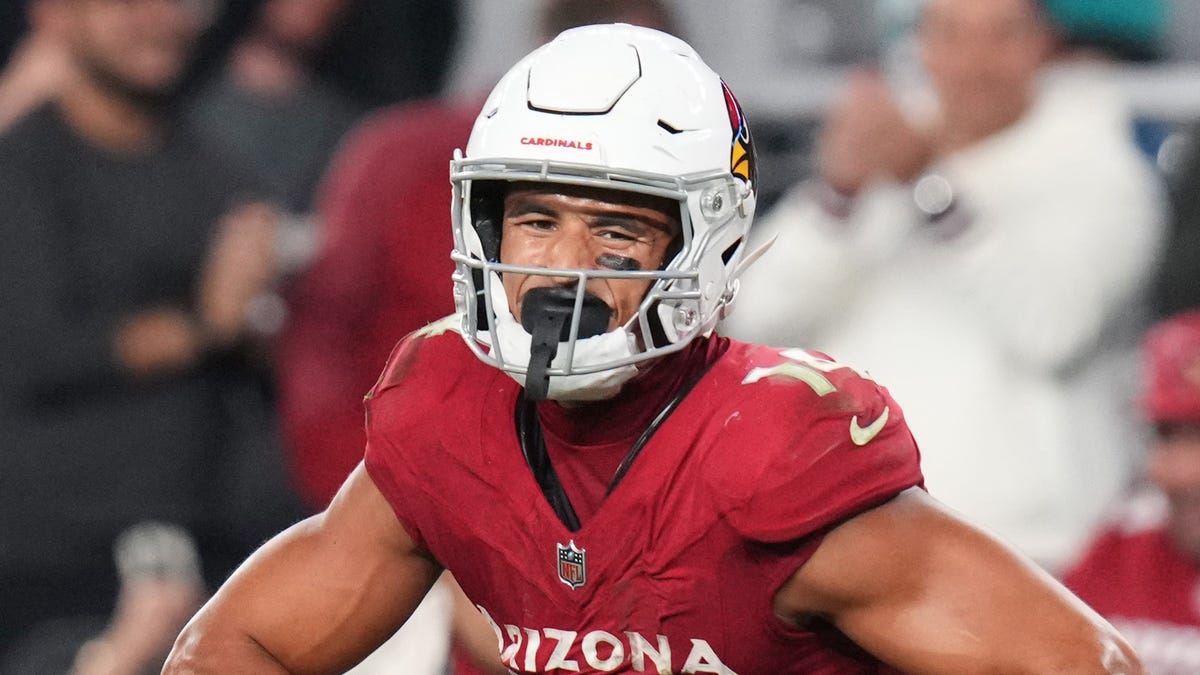
Arizona Cardinals wide receiver Michael Wilson has emerged as a bright spot in a difficult season.Wilson’s football intelligence and on-field chemistry with quarterback Jacoby Brissett allow him to exploit defensive tendencies and find open space.
For three months, it has been difficult to find any positives in the Arizona Cardinals’ 2025 season. Instead of contending for a playoff spot, they’re contending for a top-five draft pick. With a loss this weekend, they will guarantee a sub-.500 record — before the end of November.
But over the past two weeks, Michael Wilson has provided a much-needed silver lining. In two games without Marvin Harrison Jr., he has 25 catches for 303 yards. No player in franchise history has ever matched both those marks in a two-game span.
In the short-term, Cardinals head coach Jonathan Gannon and offensive coordinator Drew Petzing have said that they plan to tweak the offense to create more opportunities for Wilson, even when Harrison returns.
“When you produce in this league, we’re gonna give you more opportunities to continue to do that,” Petzing said.
And in the long-term, Wilson has proved that the Cardinals do not need to upgrade their second wide receiver spot, which had once seemed like a potential weakness entering the offseason. They could still use a downfield speed threat, but that’s an easier — and cheaper — fix than finding a new No. 2 wide receiver.
So, what’s behind Wilson’s success?
Wilson’s physical traits
Wilson’s breakout starts here. Receivers don’t put up the stretch that he has without some standout physical tools. For Wilson, that’s his size, strength and body control.
Those traits have repeatedly shown up on contested catches. Over the past two games, he has 11 such grabs, per Fantasy Points Data. Only eight other players have more than 11 contested catches — on the season.
The first play here was Wilson’s best catch of the year. The 49ers cornerback hooked his arm around Wilson’s right hand, forcing him to start his catch with one hand. Somehow, he was still able to bring the ball in through contact and keep control as he went to ground.
It doesn’t always look that impressive, but Wilson’s contested catches are a consistent trait. Often, they come on shallower routes, either with defenders draped on his back or delivering hits after the catch.
They’re also nothing new. The final clip here was against Green Bay back in Week 7, when Wilson converted a third down by contorting himself to high-point a pass, even as the safety arrived with perfect timing over the top.
“It’s trusting my hands to make plays away from my body and not try to body catch,” Wilson said. “I think that was one thing I needed to work on from my rookie year.”
On the season, Wilson has brought in 14 of 18 contested targets (77.8%). Harrison is improved in that area after catching just 10 of 27 as a rookie, but he still lags behind Wilson, with five catches on nine such targets this season (55.6%).
It’s not just Wilson’s contested catches that show his physical ability. He’s also developed into a strong route-runner. He credits his work with wide receivers coach Drew Terrell, who has taught him how to launch off the line of scrimmage.
Wilson does not have elite speed, but with that initial explosiveness, he can still put defenders in conflict.
The first play here came at the end of regulation against the Jaguars. Wilson described it as “a phenomenal play call” by Petzing, who had identified the Jaguars defensive backs playing aggressively on short, in-breaking routes.
Still, Wilson was the one who had to execute, selling the stop route before releasing deep, where Jacoby Brissett could have found him for the game-winning touchdown with a better pass.
It wasn’t the only time he won with his route-running against Jacksonville. On the second clip here, he won with a deep curl route to help the Cardinals get a first down after being backed into third-and-13. On the third clip, he had tight coverage on an out route but was able to use his physicality at the top of his route to create separation.
Those two plays show two different types of route-running required to win against good cornerbacks. Wilson has both in his repertoire.
“The biggest things are the violence and pace at which he plays the game,” Petzing said. “He’s extremely decisive as a route runner, plays a very physical brand of football.”
Wilson’s mental approach
It doesn’t require much time with Wilson to understand that he has unique intelligence. It’s evident in the detail he provides and the clarity with which he speaks. After all, he did go to Stanford, where he double majored as an undergrad and stuck around for his master’s degree. His preference, initially, was to major in engineering before he realized it didn’t fit into his football schedule.
That shows up in his processing speed on Sundays — and it’s been especially evident since Brissett took over.
Throughout the week, those two text about how they want to run certain concepts, with Brissett sending clips of coverages that he thinks they can exploit.
Take, for example, the 49ers game two weeks ago. Brissett identified that cornerback Deommodore Lenoir likes to slice in front of crossing routes in man coverage. And in the third quarter, the Cardinals got the look they wanted.
Knowing Lenoir’s tendency, Wilson ran his route with an inside release and subtly angled toward the middle of the field to sell a crossing route. Then, as soon as Lenoir tried to jump in front of the play, Wilson broke back to the outside, where Brissett had room to find him for a 34-yard completion.
“I could show you the text right now,” Wilson said. “And it played out exactly like that. And he does that continuously throughout the week.”
Sometimes, though, those adjustments have to happen on the fly.
“You can coach a lot,” Gannon said. “But there’s certain instincts involved in playing every position that it’s hard to get your players to comprehend what is needed to win the down. Certain players have that feel and those instincts.”
Wilson is one of those players.
At first, this might look like a simple slant route. Wilson, though, revealed that the play initially called for a 10-yard dig. But as the ball was snapped, he saw the 49ers bring a blitz, clearing out the middle of the field.
“I feel the middle of the field vacate so that means they’re blitzing and there’s pressure,” Wilson said. “Let me just come be quarterback friendly, snap my route off early. And Jacoby and I have a natural rapport for just getting open and catching the football.”
On a day when Wilson caught 15 passes for 185 yards, Gannon told him that this — a simple 9-yard gain — was his favorite route of all.
Wilson’s feel for space also regularly shows up against zone coverage.
On the first play here, against Jacksonville, Wilson felt the hook zone defender — the linebacker initially aligned in the slot — opening his hips to the outside as Wilson began his route.
Understanding the Jaguars’ coverage, he knew that meant there would be space open over the middle of the field. So rather than accelerate out of his break and into the path of the safety, Wilson sat down in the open space, giving Brissett an easy option.
The second play, against San Francisco, was similar, just against a different coverage. The 49ers were in Cover 4, with a linebacker occupying the underneath zone over the middle of the field.
Wilson had plenty of space underneath the four deep defenders, but he knew that his dig route would take him directly into that linebacker. So again, he slowed down out of his break, finding the available space instead of running full throttle toward the linebacker, which would have taken him out of the play.
This is another area in which Harrison has also made strides this season, particularly since a difficult performance in Week 4 against Seattle. While Wilson has been significantly more efficient against man coverage as the WR1 than Harrison was, their numbers are closer against zone.
Per Pro Football Focus, Harrison is averaging 2.40 yards per route run against zone since Week 5. In his two games without Harrison, Wilson is averaging 2.55 yards per route run against zone.
“I’ve been playing football since I was 8,” Wilson said. “…. You just do things so many times that you have a natural feel for how to get open and how to catch the football. This is my 17th season playing football. It’s just banked reps.”
In Year 17 — and Year 3 in the NFL — those banked reps are paying off for both Wilson and the Cardinals.