
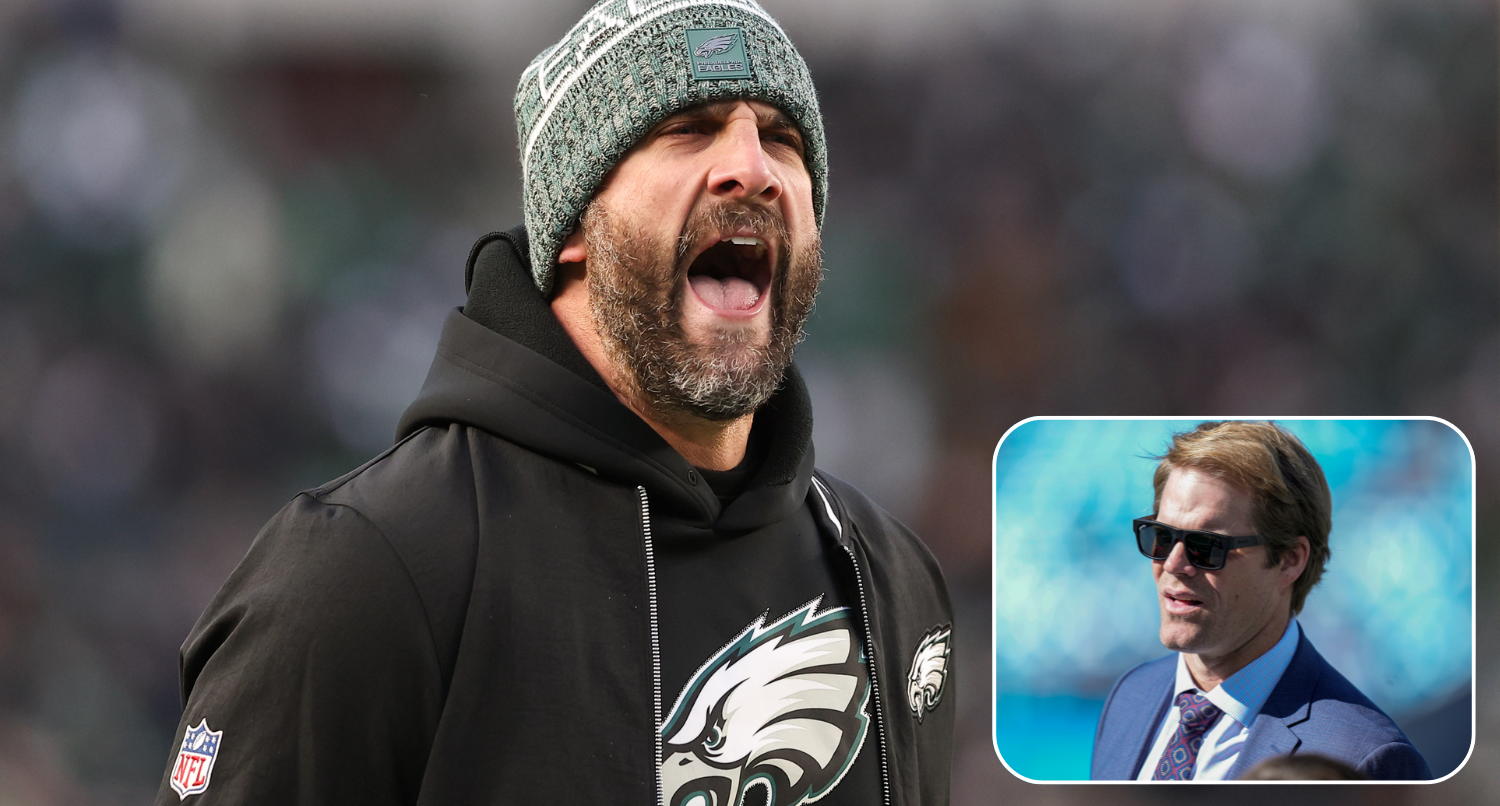
Most of us sitting in our living rooms on Black Friday couldn’t believe that the Philadelphia Eagles would go for two down by nine, but most of us aren’t Greg Olsen. And most of us aren’t deeply embedded in the analytical community.
This is how Olsen separates himself. Separates himself from Tom Brady, who has vastly improved as a broadcaster, but hasn’t cemented himself as the No. 1 analyst in Awful Announcing’s NFL announcer rankings the past two seasons. There’s Olsen, and there’s everyone else, and that’s because he embraces analytics. That’s because he explains the game the way it’s actually being played in 2025, not the way it was played in 1995. That’s because he does the homework that so many others in the booth simply don’t bother doing.
And the former Carolina Panthers tight end wasn’t even calling Friday’s Eagles-Bears game; that honor belonged to Al Michaels and Kirk Herbstreit, but he still made his presence felt on X. And to be fair, it wasn’t just Olsen. It was dozens of others on the platform, but it was the NFL on Fox broadcaster who understood what Herbstreit and Michaels — and apparently the rest of us at home — failed to see.
The Eagles just made it a nine-point game with a Jalen Hurts-A.J. Brown touchdown with three minutes and 10 seconds remaining. They were down by nine, but conventional wisdom says to kick the extra point and make it a one-score game. But conventional wisdom doesn’t account for an eight-point deficit being a one-score game only about 43 percent of the time. And it surely doesn’t account for the fact that you’re going to need a two-point conversion at some point anyway, so even if you thought — and yes, the author of this article included — that Nick Sirianni was leaning way too far into his inner Dan Campbell, perhaps you didn’t consider what Olsen laid out in a series of posts.
The 2 pt conversation is this
Philly trailed by 15
That’s a 2 score game slightly less than 50% of time (2pt success rate)
It’s a 3 score game the remaining %
You want to know as early as possible how many possessions you need.
That’s why you go for 2 down 9
It’s not…
— Greg Olsen (@gregolsen88) November 28, 2025
As Olsen explained in his posts, we’ve all been conditioned to think an eight-point game means you need one touchdown and a conversion to tie. But the math shows that’s only true about 43 percent of the time. Compare that to a seven-point deficit, which is legitimately a one-score game 94 percent of the time. The difference is massive, and treating eight points like it’s basically two possessions makes way more sense than pretending it’s the same as being down seven.
The premise of the 2pt conversation is we have been beaten over the head with the notion being down 8 is a 1 possession game.
We need to educate the way the game is played
7pts- 1 score game 94% of the time
8pts- 1 score game 43% of the time
Treat 8 pts as 2 possessions.…
— Greg Olsen (@gregolsen88) November 28, 2025
The other piece some of us missed is that you’re going to need that two-point conversion eventually anyway. Going for it when you’re down nine versus waiting until you’re down eight doesn’t magically make it easier to convert later. If anything, you’re worse off if you wait and fail because now you’re attempting an onside kick with even less time on the clock. The real advantage of going early is the potential to be down seven, not the certainty of being down eight. You’re not choosing between nine and seven; you’re choosing between nine with a shot at seven or accepting eight and hoping for the best later.
When Emmanuel Acho pushed back and suggested Philadelphia might not defend as aggressively when down nine compared to down eight, Olsen had a simple counter: wouldn’t they defend even harder if they cut it to seven? The order of scoring doesn’t change the math. Putting off the conversion just to avoid the uncomfortable decision in the moment doesn’t make it any more likely to succeed.
So the argument is the defending Super Bowl champs won’t play as hard down 9 as they would down 8?
What about if they were down 7?
8+7 is the same as 7+ 8
Delaying the inevitable 2pt try to “feel better” is ridiculous@EmmanuelAcho https://t.co/Gwyfe2yiDl
— Greg Olsen (@gregolsen88) November 29, 2025
Sirianni’s postgame comments made it clear this wasn’t some spur-of-the-moment gamble.
He’s done extensive work on being down nine and said he’s always going to go for two in that situation. The idea is that you want to know exactly what you need right there. If you go down seven, obviously, it’s a one-score game. If you go down eight, he knows it’s technically a one-score game as well, but the math tells a different story. In that scenario, he’ll always go back and look and reconsider things, but with three timeouts to potentially stop the clock and get the ball back, if you get the conversion, you know you need one more score. If you don’t get it — which they didn’t in this particular case — you know you’re going to need it at some point, and it’s better to know early what you need going forward.
@nfloncbs Do you agree with this strategy? #footballstrategies #sportsstrategies #nicksirianni ♬ original sound – NFL on CBS
Most analysts would have been just as confused as the rest of us. Olsen not only understood the decision immediately but also took the time to explain and defend it publicly while everyone else was piling on Sirianni. That’s what separates him from the pack. He’s doing the homework. He’s studying these exact situations so when they happen in real time, he can explain the logic instead of defaulting to what feels comfortable.
The Eagles lost 24-15. The two-point try didn’t work. So obviously, everyone wants to act like Sirianni made the wrong gamble. But here’s the thing about analytics: the process matters more than one result. You can make the right call and have it fail. That doesn’t retroactively make it the wrong call. Sirianni knew exactly what he was doing, even if most of us watching at home didn’t. And Olsen knew it too, even though he wasn’t calling the game. That’s why he’s the best in the business right now.