
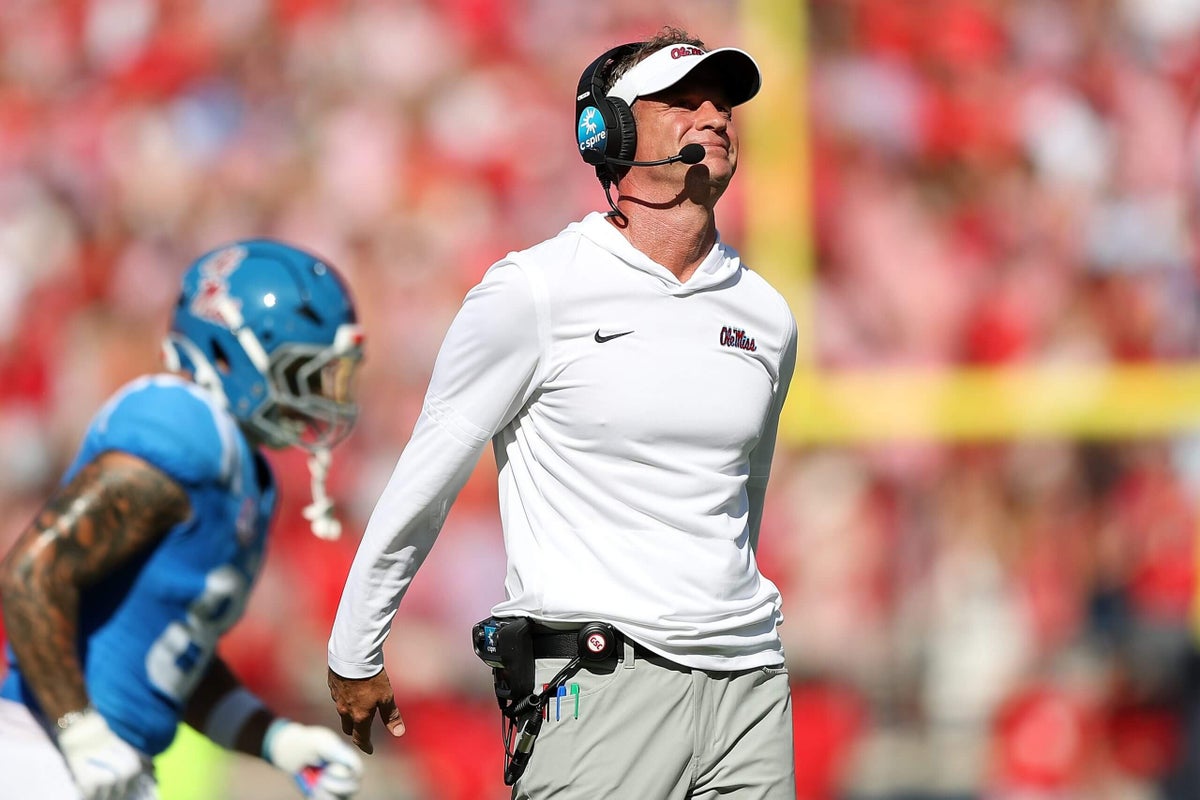
Lane Kiffin finally closed down what many called a three-ring circus. Given his lack of championships, it made more sense to call it a no-ring circus.
Kiffin is a very good coach who will win a lot of games at LSU. But he is not a proven Nick Saban or a proven Bear Bryant, a truth that made the transition from Ole Miss’ Egg Bowl victory Friday to Ole Miss’ Egg-On-Their-Face defeat Sunday more painfully absurd than it had to be.
On one hand, this was a straight-up betrayal of everything it means to be part of a team. On the other, the calendar says it’s the price of doing business in major college football. Right after notarizing a $54 million goodbye to the fired Brian Kelly, LSU said hello to Kiffin with a monster contract that mercifully ended this low drama while illustrating something significant about the industry.
Lane Kiffin is exactly why the player revolution in major college sports needed to happen.
To the old-schoolers out there pining for the day when athletes faced transfer restrictions and penalties and when a fair compensation package included nothing more than a full scholarship and all-you-can-eat training tables, two words of advice:
Shut. Up.
Coaches have always been able to do what Kiffin just did — trade one school for another whenever the hell they felt like it, leaving behind players who were required every day to embrace an all-in approach until Coach All-In raced for the exits and greener grass.
Kiffin had a chance to win a national championship this season at Ole Miss. Instead, he abandoned his players before the playoffs started, for what, exactly?
A more storied SEC program and a recruiting area that allows him to rely a bit less on the transfer portal to build his team?
Ole Miss stepped up and made salary and the financial commitment to roster construction non-factors in this spectacle, but Kiffin ran the fly pattern anyway. So be it. Even though he didn’t need to dispatch family members to Baton Rouge and Gainesville, Fla., on reconnaissance missions while his Rebels were finishing their historic 11-1 regular season, the man has a right to pursue whatever he’s pursuing. Just like Kiffin had that right in 2010, when he walked out on Tennessee one year into a six-year contract, leaving behind a complete campus mess.
— Lane Kiffin (@Lane_Kiffin) November 30, 2025
But the players should have had that right decades ago, long before the age of revenue sharing, name, image and likeness deals, and portal free agency liberated them to follow their coaches’ lead and chase their own dreams.
“I would argue that the players should actually have more rights than coaches in that regard,” said attorney Jason Setchen of Athlete Defender, a longtime advocate for student-athletes in NCAA eligibility, compliance and disciplinary issues.
“A player’s time in college is finite, where for coaches it can be infinite. A coach can go anywhere in the ups and downs of a career and always rebound. But if players end up in the wrong spot for a year, that’s a lost quarter of their eligibility. … They should have the right to make business decisions every year.”
And they finally do under the current system. Players can now transfer multiple times, and they no longer have to sit out a year as part of a school-friendly penal code.
They can also be compensated beyond the traditional full ride that didn’t account for the money they were making for their universities. Athletes are now paid 22 percent of revenues, which seems light, along with approved NIL deals that aren’t nearly as lucrative as Kiffin’s latest haul. On3.com lists Texas quarterback Arch Manning’s NIL valuation and roster value at $4 million, which isn’t in the ballpark of Kiffin’s new salary.
And yet a great quarterback is just as valuable to a team as a great head coach. In fact, it should be noted that “coach” is often just another word for “guy who couldn’t play at this level.” The players are the main product in this multibillion-dollar industry, and they need to be protected and respected for the fact that they risk bodily harm every week while essentially working a full-time job (major college football) and taking 12 to 15 credits’ worth of classes on the side.
It’s always been a lot harder to be a young Division I player than a Division I coach, and that was never reflected under (thankfully) bygone NCAA rules. In the bad old days, when a coach left his team, the athletes and their career ambitions were often at the mercy of their coach’s replacement.
“When a coach leaves, the kids are left holding the bag,” Setchen said. “With every new coach comes a new system, a new coaching style, a new relationship … and they have the right to evaluate that. If it doesn’t work for them and they want to play for somebody they’re more comfortable with, that opportunity should be there for them.”
Setchen called the NCAA’s decision to eliminate college football’s spring transfer window in favor of a single 15-day window in January “an egregious step backwards … that forces players into a corner to make a decision now without the benefit of full spring practice with their teams.” Though players can still enter the portal if their coach leaves, they now must wait until five days after that coach’s successor is hired.
Again, even in a time of updated player protections, NCAA elders impose limits on the athletes that aren’t imposed on the adults who lead them.
In the Kiffin case, Setchen said transparency was imperative because his decision affected so many other people, and because the shutdown of the spring portal window hit student-athletes hard. “It puts a lot of pressure on kids right now who should be focusing on final exams and the College Football Playoff, and now they have to worry about who’s replacing (Kiffin) and how will that affect me and should I go in (to the portal) or not go in,” Setchen said. “Many of those kids are happy there and don’t want to transfer. That’s a lot of stress.”
Even though Kiffin knew his exit would hurt his players’ odds of winning a national title that could impact the rest of their lives, he still bailed on them. Imagine if a star Ole Miss player did the same thing or announced in advance he was entering the portal when it opened Jan. 2.
In his second career as the moral conscience of college football, Saban made the case for Ole Miss to let his former Alabama assistant and fellow Jimmy Sexton client remain employed in Oxford through the playoffs. This is the same Saban who fired Kiffin a week before their 2016 Bama team played for the national championship because he felt the offensive coordinator was too distracted by his upcoming job as head coach of Florida Atlantic. You can’t make it up.
The most reasonable pro-Kiffin suggestion made by an ESPN TV analyst came from Joey Galloway, who said on his “Nonstop” podcast that the Ole Miss players should get to vote on whether an assistant coach should take control or Kiffin should finish the season before heading to LSU.
No way that would ever happen, because NCAA institutions never give their student-athletes any more power than they have to. Ole Miss wasn’t about to let Kiffin spend another day on campus gathering intel and persuading players and staff members to eventually follow him to Baton Rouge.
So the school gave Kiffin the boot just like Michigan once gave head basketball coach Bill Frieder the boot before the 1989 NCAA Tournament, ordering him to get going to Arizona State and allowing his assistant, Steve Fisher, to lead the Wolverines to the national title.
If the Rebels do the same thing under Pete Golding, Kiffin will never hear the end of it. He hurt a lot of people in this protracted process, but at least he turned a spotlight on the gross inequities that used to exist — and still do to some degree — in major college sports.
The coaches have always done whatever they wanted, whenever they wanted, for the sake of career enhancement. Don’t ever again resent players for finally being free to do the same.