
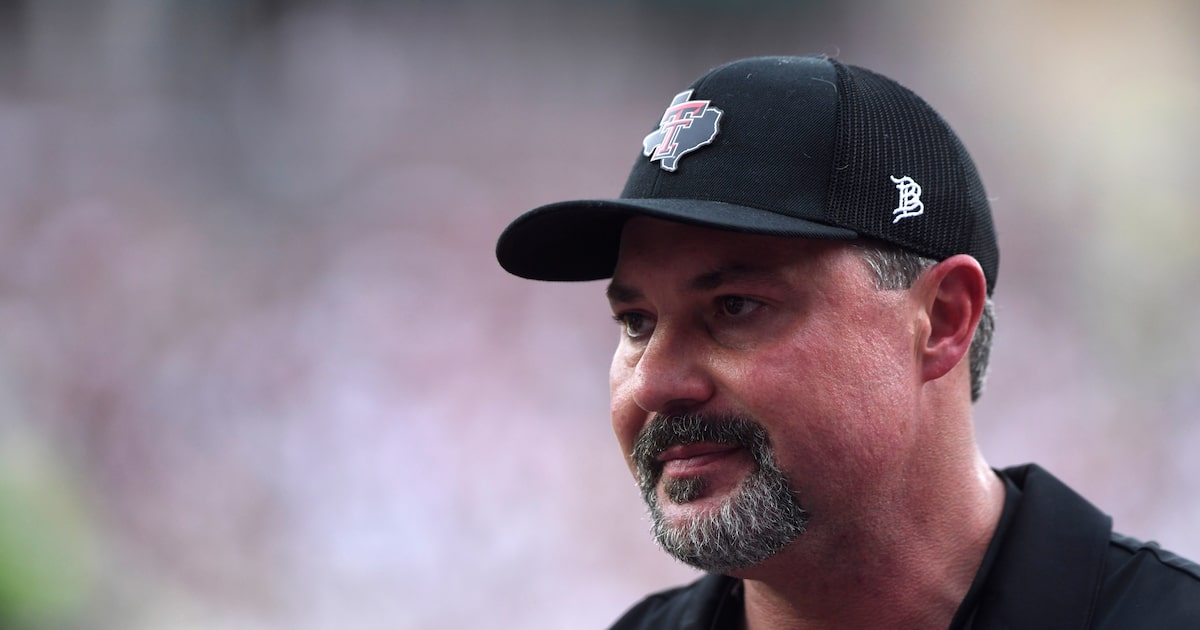
Cody Campbell is as Texan as they come.
The Lubbock native was a fourth-generation Texas Tech graduate, whose great-grandfather was part of Tech’s first class in 1925. He joined the Red Raiders program as an offensive lineman in 2000 as part of Mike Leach’s first recruiting class.
After his brief NFL career was cut short due to injury, he and his business partner John Sellers made their billions in oil and gas. They have since invested their fortune back into their alma mater that Campbell says gave him everything.
“My life wouldn’t be where it is in any aspect, personally or professionally, without the lessons that I learned through college sports,” he told The Dallas Morning News in a recent interview.
Sports Roundup
As chairman of the Tech Board of Regents and the school’s most influential athletic donor, Campbell has played an instrumental role in shaping the academic and athletic institution Tech has become.
But until this fall, his fame and impact were mostly known within state lines. Over the last five months, however, that has changed dramatically.
Campbell, 44, led a group of donors on a spending spree of over $20 million to revamp Tech’s football team. Roughly $12 million was spent on 21 transfers alone, providing an immediate boost that helped the Red Raiders reach a top-five ranking nationally and the Big 12 championship for the first time. No. 5 Tech will face No. 11 BYU at AT&T Stadium Saturday at 11 a.m.
“We’ve gotten our money’s worth,” Campbell said. “It’s been pretty cool to see it come to fruition.”
Between flights from his home in Fort Worth to watch his Red Raiders in Lubbock each Saturday, Campbell fields calls from President Donald Trump as an advisor on college athletics, films commercials broadcast to national audiences and devotes countless hours and dollars to a larger mission he’s now taken on.
The small-town West Texan has become the face of a new movement.
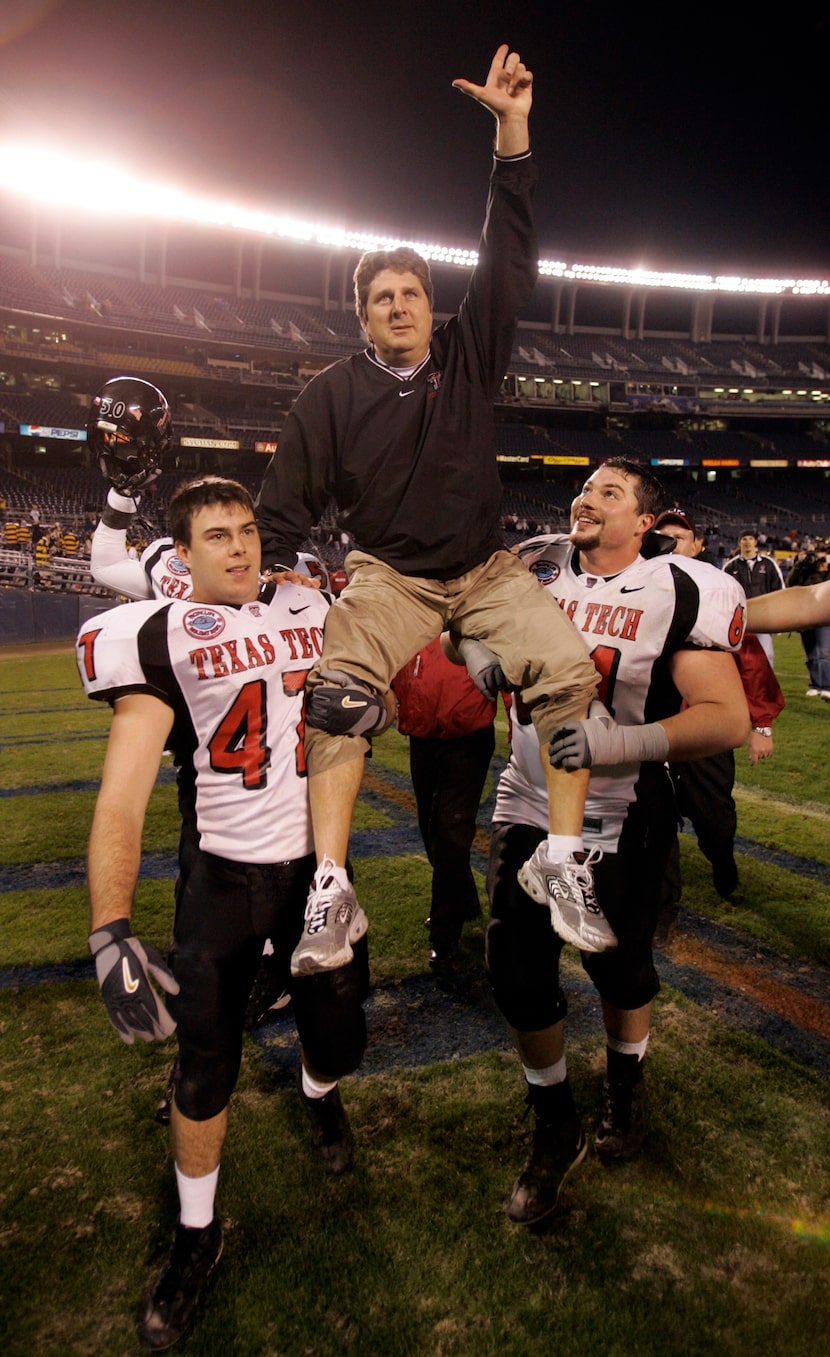
Texas Tech head coach Mike Leach is carried by Clay McGuire and Cody Campbell (right) after their victory against the University of California in the 2004 Holiday Bowl at San Diego’s Qualcomm Stadium.
File Photo / Staff
Campbell is leading the charge to reform the Sports Broadcasting Act of 1961 — the law that gave professional sports leagues an antitrust exemption that allows them to bundle and sell the TV rights of their franchises. Campbell believes if college athletics were given that same exemption and could bundle the rights to their games as one, rather than by conference, they could generate $7 billion in new revenue.
He believes that money could be used to save women’s and Olympic sports that don’t turn a profit in an era where college athletic departments are already under more financial strain due revenue sharing with their athletes.
“The average budget deficit for the 136 FBS schools is $20 million per year per school right now,” Campbell said. “There are definitely the haves and have-nots. And there are a lot more have-nots than there are haves.
“We need to make it so the small schools have enough money to survive and stay in business. That’s the goal here — just to preserve opportunity.”
His radical idea has gained steam largely due to a massive investment by the billionaire himself and the work of his own nonprofit. But it’s been met with ample pushback from commissioners and high-ranking conference officials in the Power Four, who doubt pooled rights could have the impact Campbell says they would.
But with multiple college sports-related bills being introduced and the SCORE (Student Compensation and Opportunity through Rights and Endorsements) Act set to be voted on this week, Congressional involvement in college sports appears inevitable. Campbell just hopes his pitch will be a part of it.
“When Cody is looking at the big picture, he’s looking at what’s best for college sports, male and female and just overall,” Texas Tech head coach Joey McGuire said. “It’s great to have a guy like that, because at the end of the day, man, I want to win. I want to beat everybody. But this sport is giving me everything that I have, so I want to help protect it as much as possible.”
Related
 How Campbell worked his way to Washington
Playing college football may have been the defining moment of his adolescence, but Campbell was no jock.
In addition to being an All-State offensive lineman, he was a National Merit Scholar. He graduated from Tech with honors, double major in finance and business economics and a masters in finance.
His strong academic background becomes clear when he explains his current endeavors.
As the rules started to change in college sports about four years ago allowing for players to be paid, Campbell began his research.
“At that time, it was really aimed at how does Texas Tech best position itself to be successful in this environment?” Campbell said. “How do we make sure we stay ahead of it? I dug in deep and researched it and worked on it.
“Through all the legal research we had done, it was very clear that the only real way to stop the chaos is through congressional action.”
Despite having no political background, Campbell had the idea of approaching the Trump Administration and helping them develop their stance on the future of college sports.
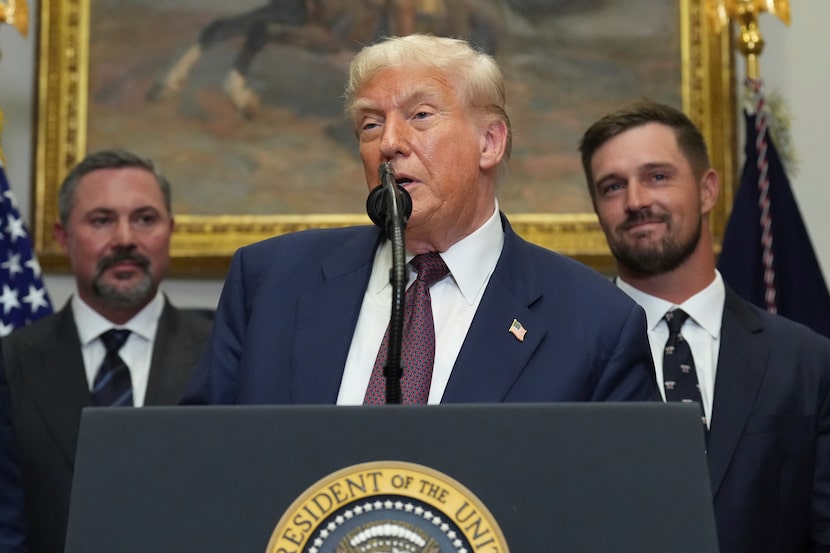
President Donald Trump speaks as Cody Campbell, left, and professional golfer Bryson DeChambeau listen during an event for the signing of an executive order restarting the Presidential Fitness Test in public schools, Thursday, July 31, 2025, in the Roosevelt Room of the White House in Washington.
Jacquelyn Martin / AP
He felt there was historical precedent for a president’s involvement, as Teddy Roosevelt’s efforts to decrease injuries and deaths in football in the early 20th century gave way to the formation of the NCAA.
Campbell’s plan, which launched last December, started with informal conversations and developed into a more official role on the Presidential Council on Sports, Fitness and Nutrition.
He was a force behind the “Saving College Sports” executive order in July, which aimed to impose guardrails on NIL.
Simultaneously, Campbell worked with his own nonprofit Saving College Sports — a group of multiple sitting chairs of university boards and billionaires — to advocate for his own reform plan and lobby lawmakers.
That plan centers around the future of college sports broadcasting.
A plan to reform college sports TV deals
In between the action of an exciting college football season, you may have seen Campbell on your television at some point this fall.
The billionaire invested in multiple TV spots explaining his proposal. Those commercials and social media were two of the primary ways he got word out.
Last weekend two of the major TV Networks (ABC/Disney and Fox Sports) refused to air @SavingCollSprts ad, that calls out the greed of the Conference Commissioners as being a major roadblock to solving the problems in College Sports. One of the networks told us it was a “business… pic.twitter.com/7K6hO0Sv13
— Cody Campbell (@CodyC64) October 11, 2025
Campbell’s philosophy stems from the changes in college sports. He argues that since the cost side of college sports is now becoming more professionalized with NIL and revenue sharing, the revenue side should become professionalized as well.
“College sports is the second most popular sport in aggregate in the country,” Campbell said. “The NBA, for example, has about half as many viewers as college football does. But the NBA makes twice as much money as college football does.”
His solution: reform the the Sports Broadcasting Act of 1961. That law allows professional sports teams like the NFL to bundle all of their games and sell them to media organizations, rather than doing so by individual teams.
In college sports, conferences control the media rights. If conferences were to try to bundle the rights to broadcast their football games, they would be breaking antitrust laws.
Campbell said in one of his commercials that he believes doing this would generate at least $4-7 billion in additional revenue that could be split between schools. He doesn’t believe it needs to be split evenly, and the schools that get a larger piece of the pie now could continue to.
“It could not be any more inefficient than it is right now,” he said. “Because it’s so fractionalized, the universities just don’t have as much bargaining power. They can’t drive as good of a deal.”
Campbell says that’s a problem for universities that are operating in the red. He worries that women’s sports and non-revenue sports outside of football and basketball will be cut as a result.
“In my mind, the opportunity that the high jumper gets at Washington State or Fresno State is just as important as the opportunity that the football player gets at the University of Georgia or Ohio State,” he said. “There’s no difference. It’s life-changing for both of them.”
He’s also lobbying for a new governing body that would replace the NCAA, saying it’s a necessity if the Sports Broadcasting Act were reformed and that the NCAA shouldn’t be trusted with that level of power to negotiate a deal of that magnitude.
The NCAA previously controlled college football broadcasting rights until 1984 when a Supreme Court decision found the organization had an illegal monopoly over television rights. The NCAA now only owns championship media rights.
But Campbell argues college sports are in a far different position now than they were the last time broadcast rights could be pooled.
He was introduced to the idea a few years ago during his research and has made it the central argument of his platform.
“None of the ideas are original,” Campbell said. “I’m just maybe louder about them, and pushing them a little harder.”
Related
 Facing pushback
Campbell is far from the only person advocating for some congressional involvement in college sports. Lawmakers, athletic directors and commissioners alike have hoped for a federal NIL bill that provides even more structure, limits states from passing legislation that gives their programs the upper hand and protects them from endless lawsuits that keep popping up left and right.
“We need a skinny NIL bill that will basically do the fundamental foundations of what we need to be able to not live in a litigious environment every single day where we’re getting sued constantly and we’re playing defense,” Texas A&M athletic director Trev Alberts said over the summer. “We need to get back on playing offense in college athletics.”
Bills of that kind have been proposed. The House is expected to vote this week on the SCORE Act, which is mostly concerned with the NCAA’s priorities like blocking athletes from becoming employees and limited antitrust protection mainly from lawsuits involving eligibility issues.
Campbell supports elements of the SCORE Act. While it doesn’t include changes to the Sports Broadcasting Act like he hopes for, he took to X Monday afternoon to urge House members to vote for the bill as to “continue momentum, conversation, and debate, so we can find a comprehensive and effective solution that will preserve this great National Treasure.”
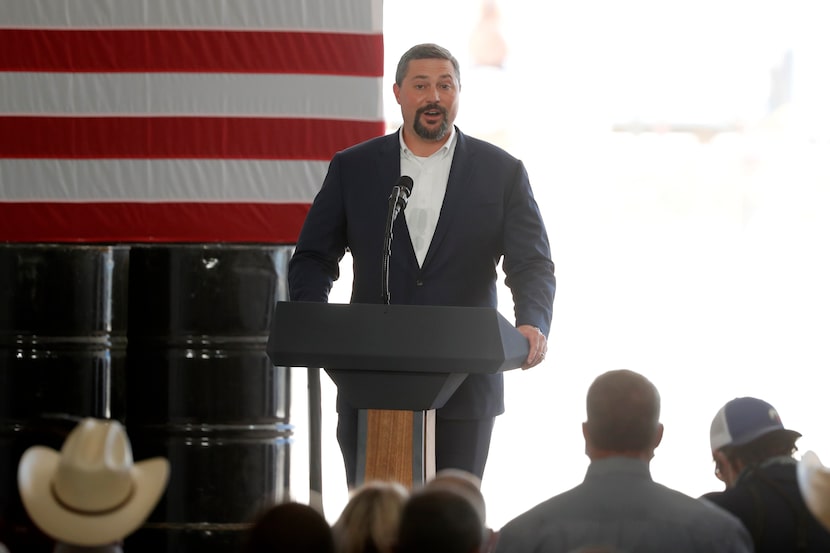
Double Eagle Energy co-CEO Cody Campbell make remarks before introducing President Donald Trump who made remarks about American energy production during a visit to the Double Eagle Energy Oil Rig, Wednesday, July 29, 2020, in Midland, Texas.
Tony Gutierrez / AP
There is also the SAFE (Student Athlete Fairness and Enforcement) Act, which was proposed on Sept. 29 and, among other things, does call for a rewrite of the Sports Broadcasting Act that would lift restrictions on college conferences from combining to sell their media rights together. The SAFE Act faces an uphill battle getting out of the Senate Commerce committee. Sen. Ted Cruz (R-TX) controls the group as chairman and isn’t expected to usher the bill to a floor vote.
Conference commissioners have pushed back even harder on potential reforms to the Sports Broadcasting Act. The ACC, SEC, Big 12 and NCAA all declined to comment to The Dallas Morning News specifically on Campell’s proposals. But all have publicly supported the SCORE Act over the SAFE Act because of the media rights aspect.
Big 12 commissioner Brett Yormark and SEC commissioner Greg Sankey have spoken out against Campbell’s efforts, particularly after he called them “very, very self-interested.”
“Cody is entitled to his own opinion, but not his own facts,” Yormark told the AP in October. “I’ve never said pooling media rights will increase revenue. The only thing I have said is that hope isn’t a strategy. There are unintended consequences to amending the [1961 Sports Broadcasting Act] that Cody and his team need to better understand.”
ABC and Fox even refused to air Campbell’s commercials during the Oct. 4 games because he called conference commissioners “greedy.” Campbell said they agreed to air the ads once he changed “conference commissioners” to “powerful special interests” in the script.
While some of the most powerful individuals in college sports have been outspoken against Campbell’s wishes, he says that’s not always a bad thing.
“I think that [NCAA President] Charlie Baker is a very good man, and I think he has very good intentions. He hasn’t been at the NCAA for a long time. He didn’t create the problems that they have,” Campbell said. “But what we’ve observed is that everyone is aware of the fact that the majority of the problems that we have in college sports today were created by the NCAA and that the NCAA is very incapable of solving them. So when they go in to lobby for something that’s contrary to our platform, it’s generally more helpful to us than it is hurtful to us.”
With all the success Campbell has had in his own business, with Tech’s historic season and with his commercials playing on repeat, it’s difficult to ignore his loud message. And he doesn’t appear to be quieting down or slowing down any time soon.
“Communities revolve around college sports,” he said. “I can tell you Lubbock definitely does, but so does Stillwater, Okla., so does Morgantown, W.V., and Manhattan, Ks. A lot of times I think, especially in D.C. and on the coast, people forget about how important it is to so many people. It’s worth saving.”
Texas Tech sports contributor Ty Kaplan contributed to this report.
On Twitter/X: @Lassimak
Brett Yormark makes pitch for Texas Tech, BYU to both represent Big 12 in CFPCollege basketball poll (12/1): Texas Tech climbs a spot in AP Top 25
Find more Texas Tech coverage from The Dallas Morning News here.