
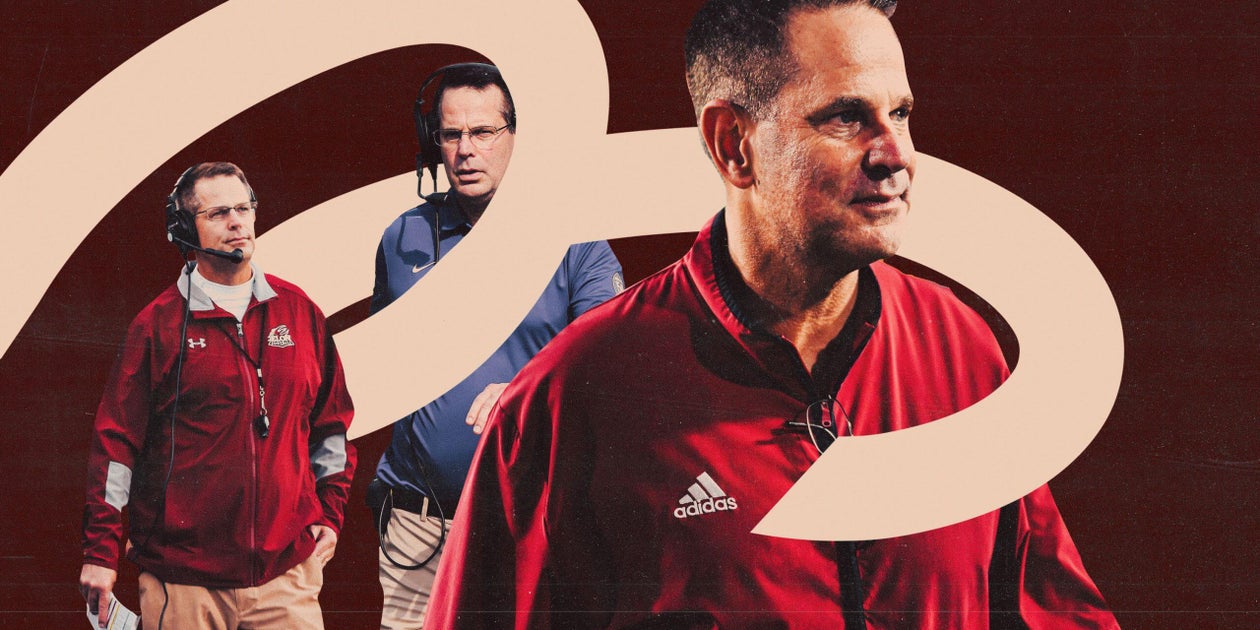
To comprehend a scarcely believable college football reality, wind back 40 springs to the Piedmont region of North Carolina. There we find Davidson College, a school of fewer than 2,000 undergrads and a member of the Division I-AA Southern Conference, apparently unbothered by being bad. The previous two seasons featured four wins total. Practice schedules accommodated classes and labs, and not the other way around. Doing your best was more or less the bar for success.
Into this deep wallow walked 23-year-old Curt Cignetti, for the very first time a full-time assistant coach.
He had some thoughts on things. The notion that it was enough to try hard against better-resourced schools irked him. You have to believe you can win, Cignetti would tell players. On-field standards, meanwhile, were set aggressively and personally. When his quarterbacks didn’t nail a practice rep — a not-uncommon event — the former West Virginia backup took over and slung it himself. Between Cignetti and another staffer who eagerly hopped in drills, then-senior Jay Poag cracked a question before one workout:
Hey guys, think I’m going to get to throw some today?
“I talked at our senior banquet that year,” says Poag, who’s now the athletic director and head coach at Ambassador Christian School in Huntersville, N.C. “And I can remember the laughter when I stood up and said, ‘I think I might be the only quarterback in the country (where) my two coaches threw more passes in practice than I did.’”
So that’s how it started. How it’s going is a surrealist montage. Curt Cignetti is now a sandpapered 64 years old and in his second season as head coach of the Indiana Hoosiers, who are all of the following: undefeated, ranked No. 2 in the nation, playing for a Big Ten championship against No. 1 Ohio State on Saturday and a lock to reach the College Football Playoff twice in a row. This is a program that, in the preceding three decades, finished with a winning record four times. Then Cignetti arrived and the roof came off. It is fair to ask how. And why.
The answers might be more fun if they involved some sort of sorcery. They do not. A search for secrets through the lesser-known history of Curt Cignetti is one reintroduction after another to the Curt Cignetti everyone sees right now. “A cocky nerd,” in the words of Joe Gray, who had him as a tight ends coach for three years at N.C. State. The same straight-shooting, single-minded, film-obsessed, even-keeled but occasionally quirky football brain as ever.
The dots along his timeline aren’t droplets of magic potion. But they do connect.
“Football is what makes him tick,” says Elon deputy athletic director Steve Roach, who was Cignetti’s boss for two years at Division II Indiana University of Pennsylvania (IUP). “He loves it and his preparation is like no one I’ve ever seen. And the motor never stops.”
Or as former Pittsburgh coach Walt Harris puts it: “He is a little different. He’s going to say what he thinks. And that’s not negative. That’s reality. What you see is what you get.”
What you see, specifically, is a lifelong immunity to an identity crisis.
It could’ve caved in on the son of the late Frank Cignetti Sr., a Hall of Fame coach known best for his 20-year run at IUP, where the field bears his name. Curt Cignetti was a football kid and then a football man and eventually grinded his way to Nick Saban’s first staff at Alabama back in 2007. It’s the sort of gig that typically chainsaws through velvet ropes on the way to something bigger. It didn’t. Instead, Cignetti famously bet on himself, dropping two competitive levels to take his father’s old gig for his first head coaching opportunity in 2011, which led to jobs at Division I-AA Elon and then Division I mid-major James Madison and, at last, the chance to run a Big Ten Conference program generally accustomed to irrelevance.
His career record as a head coach is now 142-37. Anyone who rode the Curt Cignetti riptide along the way learned this: He does not pretend to be someone else. The job is the job, and nothing matters except that which leads to success. “He was similar to what I see now: very direct, very strong, very passionate, and pretty about the business,” says Mark Comalander, who played quarterback for Cignetti at Rice in 1986 and 1987. “He was pretty motivated to get stuff done.”
There is tunnel vision, and there is a path seen in a pinhole and willed through it. Even though Davidson found a way to backslide in that fall of 1985 — it lost eight straight games to open a 1-10 slog overall — the sheer force Cignetti applied to the job reshaped the experience. Football, and the gig, was it for him. That alone provided a jolt. “It was refreshing,” Poag says. “It didn’t equate into wins. But we had a lot more fun.” The next fall, Cignetti dove into another morass with a new staff — Rice had won four games in the previous four seasons — and didn’t come up for air. It was both an “amazingly fun and competitive quarterback room,” per Comalander, and enough to make him abandon the idea of a career on a college sideline.
“I don’t know that they ever slept or ever went out,” Comalander says, “because it seemed like all they ever did was work.”
Guys, you gotta love the pro-cess, Cignetti would tell his players, drawing out that long ‘o’ like a proper scion of western Pennsylvania.
This was inside the N.C. State tight ends meeting room in the early 2000s. He might as well have been talking to himself. “He had sort of an uncommon focus,” former N.C. State tight end Andy Vanderveer says. “I’m not sure what else excites him in life. The dude is just really focused on football and handling his job.” During Cignetti’s previous stop as a Pittsburgh assistant coach, handling the job required attendance at a West Allegheny High School basketball game; one of the players, Kirk McMullen, vowed to play tight end for the Panthers if Cignetti showed up to watch.
McMullen had zero Division I scholarship offers. Pitt was offering only a walk-on spot. Cignetti drove through the snow, sat in the bleachers amid coaches from 10 lower-level schools and secured the commitment on the spot. A short ride for due diligence, but maybe something more innate, too: McMullen went on to play in 36 games across four seasons and started twice for the Cincinnati Bengals in 2001. “You’re going to get back what you put in,” McMullen says now, echoing another Cignetti mantra years later. “And I was that guy.”
The pro-cess, as it were, also involved film. So much film. “He was the ultimate preparer,” Gray says. Plays, in practice or in games, wound and rewound dozens of times. A never-ending search for corrections or advantages. “It was over and over and over, of whether you took a six-inch step or a three-inch step,” McMullen says. Often it became a sort of stream-of-Cignetti-ness, in which players listened to their position coach work through his own musings about what a defense might do and how to counter it. A one-man debate.
“He was the one guy that always had his eyes on everything,” McMullen says. “He was watching. Always watching. He always had me on the phone on the sideline telling me, ‘That was good.’ ‘That was bad.’ ‘Can’t do that. Here’s how you’re going to fix it.’ It was more or less where you get constructive feedback all the time, so you’re able to constantly improve yourself.”
In a 2001 game against Duke, Willie Wright caught two passes for N.C. State. Both went for touchdowns. It was one of his lowest-graded performances in two seasons with Cignetti as his tight ends coach, because he missed a couple blitz reads — including one that preceded a scoring catch. “And he wasn’t happy about it,” Wright recalls. On another occasion, near the end of a blowout win, Wright pleaded with Cignetti over the sideline phone to give a little-used teammate a few snaps. Cignetti refused. The player didn’t know his assignments. Someone could get hurt.
Wright begged on, and his coach ultimately relented … with a warning: I’m going to hold you responsible if anything happens.
“That’s one thing Coach Cignetti was adamant on: You can’t play hard unless you know what you’re doing,” Wright says. “Don’t come in not knowing your stuff, or he won’t play you.”
Candor, upon further investigation, is as much a Curt Cignetti reflex as blinking.
“There was no tap-dancing — it was either good enough, or it wasn’t good enough,” Poag recalls. “Blunt” is the word that comes to mind for Harris, though he’d note that approach has its advantages for a head coach dealing with ambitious underlings.
“You’d rather know where a guy stands than (deal with) a guy that is smiling in your face and knifing you in the back,” the former Pittsburgh and Stanford head coach says.
But delivery makes a difference. The message must be heard.
So it’s been a smirk instead of a sledgehammer.
Upon fading down the stretch of a preseason conditioning run, losing to a teammate who caught him in the last 200 yards or so, former Temple quarterback Marc Baxter received a plainspoken assessment from his position coach. I’m impressed, Curt Cignetti told him. If the race was about toughness, you would’ve won. “It was a compliment, but almost like, ‘You still didn’t come in first,’” Baxter says. “He’s that guy. He will keep letting you know, reasonably.” Indeed, poor incompletions on a practice rep might be followed by a reminder: Dirt can’t catch the ball, Baxter.
When one N.C. State practice devolved into a scuffle, Wright took a blindside shot from a teammate, who then pinned him to the turf to continue the onslaught. In the film session that followed, Cignetti paused a clip of the sequence and zoomed in.
Is that you, Willie?
He zoomed in again. And again. And again.
“I know one thing,” Wright says now. “I didn’t get snuck anymore.”
The approach had some healing properties to boot. Gray sprained his MCL in the spring after his junior season and lost confidence in the joint, softening his cuts and muting his explosiveness. Not ideal for a player who fancied himself a pass-catcher. Cignetti cut through the sulking. You gotta do something, he told Gray. You’re putting limitations on yourself. So Gray added 25 pounds of muscle over the summer and settled into a role as a blocking tight end. “Sink or swim,” Gray says. “He told me what I needed to hear at the time.”
Volume rarely made the point. “He’s very consistent. You know where he’s coming from and you know what you’re going to get,” former Pittsburgh quarterback Matt Lytle says. “He didn’t get too high and he didn’t get too low.”
He has permitted himself some highs. On the drive home following a rollicking comeback win over Mercyhurst in 2011, Jack Gallagher, the play-by-play radio voice for Indiana University-Pennsylvania, stopped for a bite and saw he’d missed a call. Upon dialing up Curt Cignetti, then the Crimson Hawks’ first-year head coach, Gallagher was greeted with a surprise spasm of joy.
“How’d you like that, Jack?!?” Cignetti hollered on the other end of the line.
“And I thought, wow, I never had a head coach call me on our way home after a game,’” Gallagher says. When he listened to Cignetti talk about Indiana’s thrilling, season-saving revival at Penn State on Nov. 8, Gallagher heard something like the same coach from so many years back. “I’ve seen a lot of stuff in my days,” Cignetti told Fox’s Jenny Taft on the field, beaming and sounding either hoarse or choked-up or both, “I’ve never seen anything quite like this.”
“I’ve seen a lot of stuff in my day, I’ve never seen anything like this.”@JennyTaft caught up with @CCignettiIU following @IndianaFootball’s win over Penn State pic.twitter.com/E75fUHAUAW
— FOX College Football (@CFBONFOX) November 8, 2025
But it was also after that game — capped by a catch from Indiana receiver Omar Cooper Jr. that immediately evoked comparisons to the greatest college football grabs ever — that Cignetti perfunctorily shook hands with Penn State interim coach Terry Smith before starting all the front-facing postgame obligations. “All the cameras are on him and I was like, ‘Oh, yeah, he looks exactly the same,’” Vanderveer says. Something is always next. It’s better to greet it with two feet on the ground.
“His coaching style, it’s relentless,” says Warren Messer, an FCS All-America linebacker for Cignetti’s Elon teams. “We want to be fast, we want to be surgical, and we never play with too many emotions. That’s what I remember. It’s the same message he’s giving to Indiana.”
Messer would know. He spent the 2024 season as a quality control analyst for his former coach in Bloomington, watching another Curt Cignetti transformation from the good seats.
The same abbreviated team meetings as everywhere else. The same hyper-efficient practices as everywhere else, with Cignetti getting his group on and off the field in maybe 90 minutes and keeping them fresh. The same insistence upon eliminating any self-imposed limitations that Messer heard in an auditorium at Elon — a message that dates to practice fields at Davidson College, years before any of the players hearing it now were even born.
“I know my man eats the same Chipotle order every day,” says Messer, who is now an assistant cornerbacks coach at SMU. “Ask him how many reward points he has.”
The same, the same, the same. Indiana has played 25 games with Curt Cignetti as head coach. It has won 23 of them, and counting.
In October, the man who couldn’t wait to get out of a place that didn’t care about football four decades ago agreed to a contract extension with a school that can’t imagine life without him. He now makes north of $11 million a year. “I’m seeing the same things now that we were seeing at IUP, as far as how he goes about his business,” Roach says. “It’s just a bigger stage. His model hasn’t changed too much.”
Invariance, learned and lived, and rewarded in kind. “He’s got the blueprint,” says Elon coach Tony Trisciani, who was Cignetti’s defensive coordinator before taking over when his boss decamped for James Madison. “He’s built that from birth.”
If there is a part of the story the voices from his past can’t quite square, it is the spectacle of Curt Cignetti. The guy who, upon his hire at Indiana, fielded a question about selling his vision to recruits and spat out a line for the annals: “I win. Google me.” The guy who led Indiana to its first-ever 11-0 record this season, was asked what it meant and replied — grinning, unmistakably — “It means we won one more than we did last year, when we were undefeated.” The guy who has inspired and is seemingly OK with a “Coach Cignetti Pose Cam” feature on the scoreboard at home games.
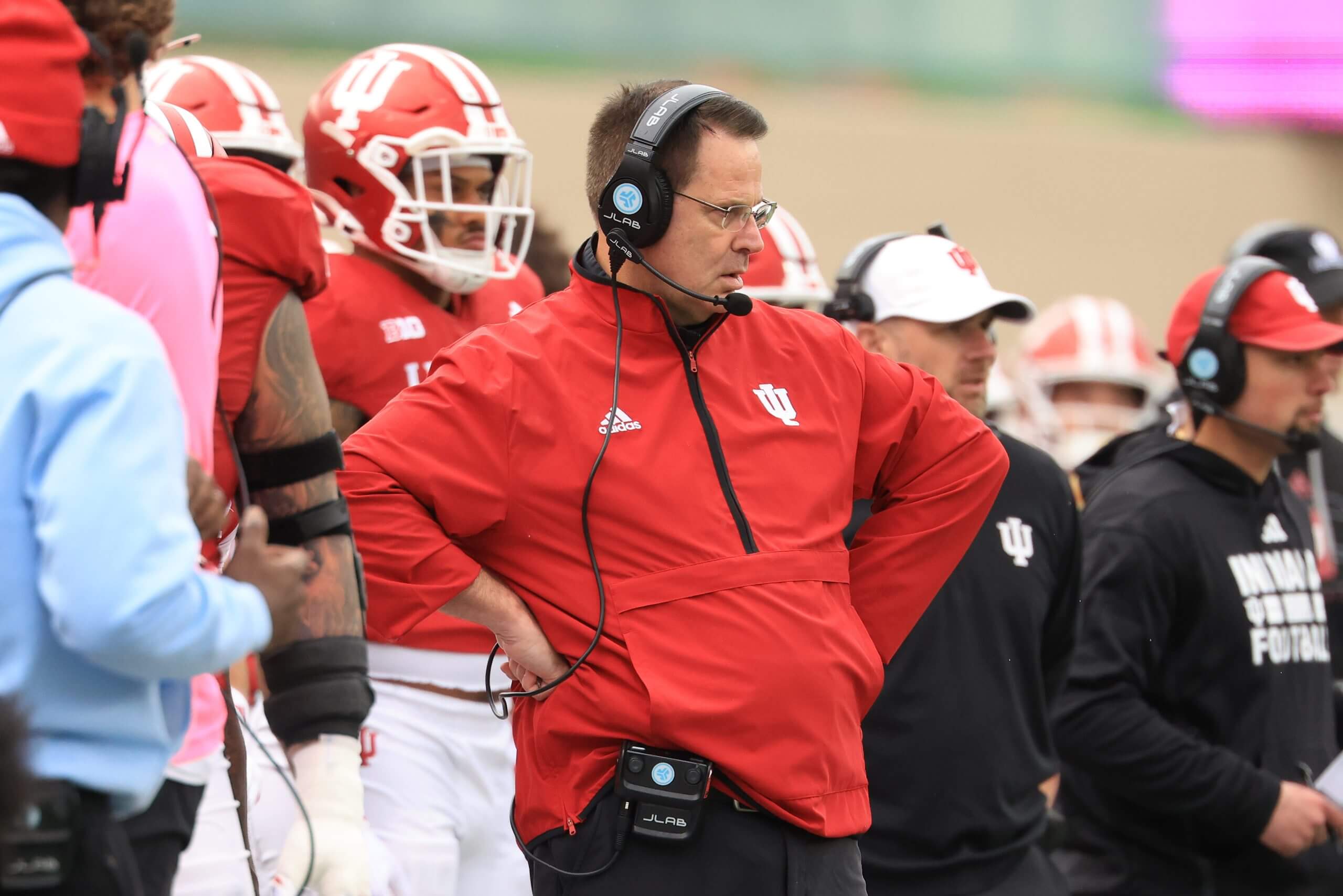
Curt Cignetti reacts during the Hoosiers’ game against UCLA on Oct. 25 at Memorial Stadium in Bloomington, Ind. (Justin Casterline / Getty Images)
It’s not the same guy Jack Gallagher remembers being economical with his words during pregame interviews, lest opponents get a bead on information. It’s not the boss who left the distinct impression with Trisciani that less can be more. He’s created another personality for himself, is how McMullen puts it with a laugh. The compulsive football man with an entertainment business on the side.
Since, Cignetti has tried to explain himself. No one paid attention to Indiana football. He had to make people pay attention. So he said what he said, welcoming the commotion only as a means to an end.
He gets people to believe almost all the time.
Almost.
“I crack up on some of the interviews because I go, yup, that’s Curt,” Comalander says. “I would certainly be of the position that he was very confident at 25, even without the success he had the last 40 years. It really doesn’t surprise me. It’s an amazing path. It’s not an accident where he is, right?”