
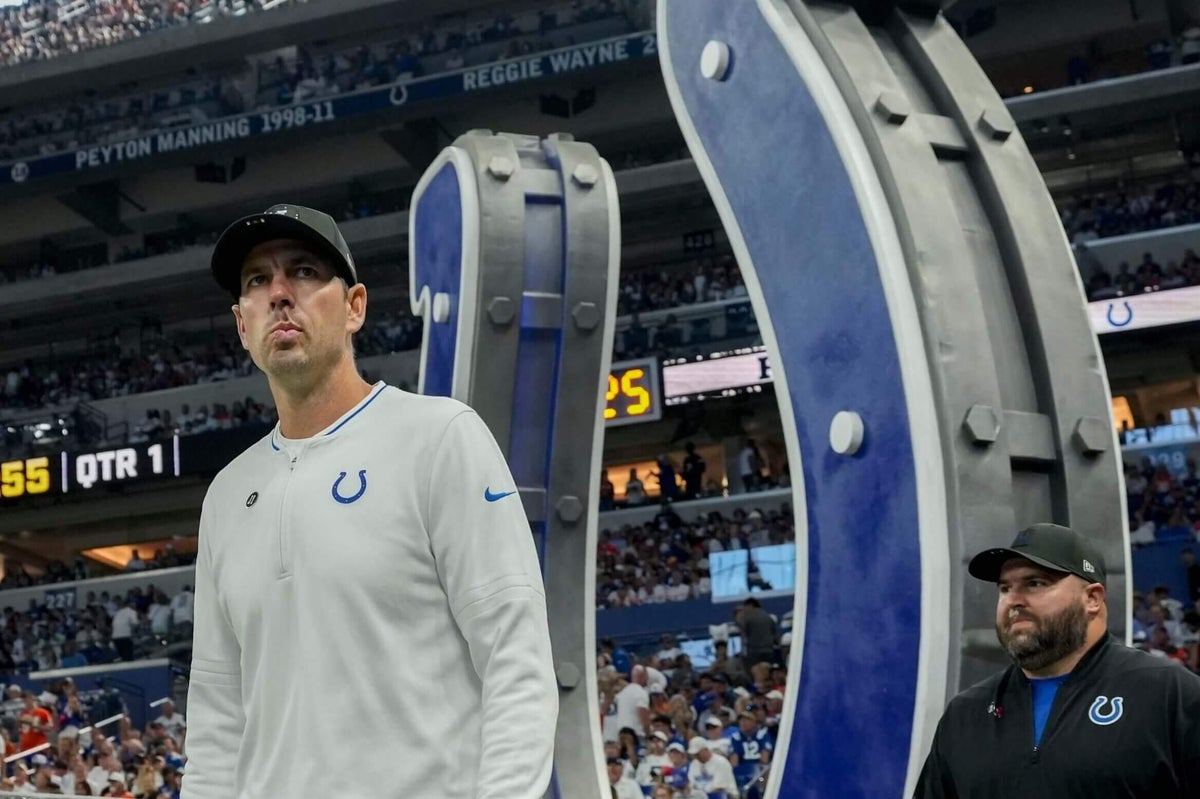
This year was supposed to be different. Early on, it seemed like it would be.
The Indianapolis Colts won their first season opener since 2013, and they started 2-0 for the first time since 2009, the last season they appeared in the Super Bowl. After dismantling the Los Angeles Chargers at SoFi Stadium to improve to 6-1, Colts quarterback Daniel Jones finally revealed that even for one of the most subdued players in the league, he still took joy in silencing naysayers.
Asked what outsiders should know about the Colts’ surprise turnaround, Jones chose his words carefully, but defiantly.
“Um, I don’t know,” he told CBS. “Sounds like y’all didn’t know much.”
Jones’ verbal jab was as close to any public trash talk he’d shared since joining the Colts and helping them flip their fortunes. But the swagger this team had in October now feels like a distant memory, replaced by a familiar phenomenon that’s defined so many Indy teams in recent years: the inability to win the big game.
Most Colts fans probably don’t need or want this particular history lesson, as the Colts’ recent late-season collapses are hard to forget.
• We start in 2021, when the Colts needed to win their regular-season finale to make the playoffs. They lost 26-11 to the lowly Jacksonville Jaguars, which led to the ousting of Carson Wentz as QB.
• We could have ignored the abominable 2022 season, but it’s worth noting the Colts were 3-2-1 before firing coach Frank Reich; they then dropped their final seven games of the year under interim coach Jeff Saturday.
• In 2023, the Colts just needed to win their regular-season finale to win the AFC South and make the postseason. Again, they came up short, falling 23-19 to the Houston Texans after backup running back Tyler Goodson dropped a late fourth-down pass.
• Last year, the Colts needed wins against the Denver Broncos (Week 15) and New York Giants (Week 17) to keep their playoff hopes alive. They lost both. The lowlights, of course, were Jonathan Taylor inexcusably dropping the ball before crossing the goal line at Denver, and Indy getting routed by Drew Lock and the Giants, who had lost 10 straight games entering the day.
Sensing a theme here?
This year, the Colts have now lost three of their last four games, all of them against AFC opponents, and dropped back-to-back games for the first time this season. They blew an 11-point, fourth-quarter lead on the road against the Kansas City Chiefs and followed that up by scoring a season-low 16 points in a home loss to the Houston Texans.
Indianapolis will now turn its attention to the Jacksonville Jaguars, who are tied with the Colts atop the AFC South at 8-4, but own the division lead thanks to their superior record against common opponents. The Colts haven’t won in Duval County since 2014, five years before Jones even entered the NFL.
“I definitely expect a high sense of urgency and guys being ready, eager to correct what we need to correct and improve,” Jones said after losing to the Texans. “No one’s losing confidence, or certainly no one is going to get too wound up about it. But we know what we have to do and we know we have to improve and make progress.”
Indianapolis’ last playoff appearance was when they went 11-5 in 2020 and finished the season 4-1 in December and January. Since then, the team has gone 9-12 in December and January, having faded down the stretch on a nearly annual basis.
The signs of yet another unraveling are hard to ignore. Let’s start with the quarterback. Jones was playing at an MVP-caliber level for the first two months of the season, posting a passer rating of 109.5 during the Colts’ 7-1 start, while completing 71.2 percent of his passes for 2,062 yards and 13 touchdowns against three interceptions. He also had four rushing touchdowns and just two fumbles (none lost) and nine sacks.
Over his past four games, however, Jones has tapered off considerably. His passer rating has dipped to 86.6 during this 1-3 stretch, while completing 61.9 percent of his passes for 979 yards and six touchdowns against four interceptions. He also has just one rushing TD and seven fumbles (three lost) with 13 sacks.
Part of Jones’ regression can likely be attributed to him reportedly playing through a fractured left fibula. The Colts claim Jones has “no restrictions,” though that’s clearly not the case. The QB who scrambled for 19 yards on a crucial third-and-21 in the fourth quarter of a comeback win against the Atlanta Falcons in Week 10 is not the same guy we saw this past Sunday, when Jones’ lone rushing yard came on a fumbled snap that he dove on to recapture. The Colts have also said Jones’ reported fibula fracture can heal throughout the season, but it’s fair to question how quickly he’ll get back to full strength when he has a 300-pound defensive lineman diving at his injured left leg.
“I feel good enough to play,” Jones said after Sunday’s game. “Doctors cleared me to play, so that’s what I’m going to do.”
Even beyond QB1, the Colts’ offense no longer looks like an infallible juggernaut, especially in the trenches. The Colts’ offensive line has taken a significant step back, and it has not only negatively impacted Jones, whose sack percentage has risen from 3.6 in his first eight starts to 9.7 percent over the last four weeks, but also the star running back beside him: Taylor.
The two-time Pro Bowler averaged 106.3 rushing yards per game through the Colts’ 7-1 start, highlighted by a staggering 1.78 yards before contact per rush, despite 33.6 percent of his rushes coming with eight defenders in the box. In his last four games, Taylor is still averaging 108.0 yards per game, though 244 of his 432 yards during that span were against the Falcons in Week 10.
Taylor’s yards before contact per rush have also dipped to 1.28 while facing eight-man boxes at a higher clip (39.8 percent). The question is: If Taylor no longer has the running lanes to play at an MVP level and take the pressure off of his injured QB, then how can this offense get back on track?
Colts coach Shane Steichen will surely have to get creative to answer that.
Meanwhile, the Colts will also deploy a new kicker this week after Michael Badgley, who was signed to replace the injured Spencer Shrader, missed three point-after attempts in seven games. Badgley was waived Tuesday and replaced by former Saints kicker Blake Grupe. Grupe is a perfect 15-of-15 on extra point attempts this year, but the biggest reason he was released by New Orleans last week was that he’s missed six field goal tries this year, including two between 30-39 yards and three between 40-49 yards.
Grupe’s leg could be the difference between the Colts regaining first place in the AFC South on Sunday against the Jaguars and the continuation of another late-season collapse. And let’s not forget, Indy has raised the stakes this year, betting big on this season by trading its next two first-round picks and wide receiver AD Mitchell to the New York Jets to acquire cornerback Sauce Gardner. Now, the two-time, first-team All-Pro is sidelined indefinitely after suffering a calf injury against the Texans. Meanwhile, star defensive tackle DeForest Buckner remains on injured reserve for at least one more game due to a neck injury, and the Colts’ pass rush has suffered significantly without him.
The issues, most of them unavoidable, continue to pile up for Indianapolis. But in order to flip the narrative of simply being the same old Colts, who do just enough to get your hopes up before letting you down, they have to win games like the one coming up Sunday.
A lot is on the line from here on out, and with the margin for error dwindling, the Colts don’t need any reminders of what’s at stake.
“This is a new year,” veteran cornerback Kenny Moore II said, dismissing his team’s recent late-season blunders.
The Colts better prove it.