
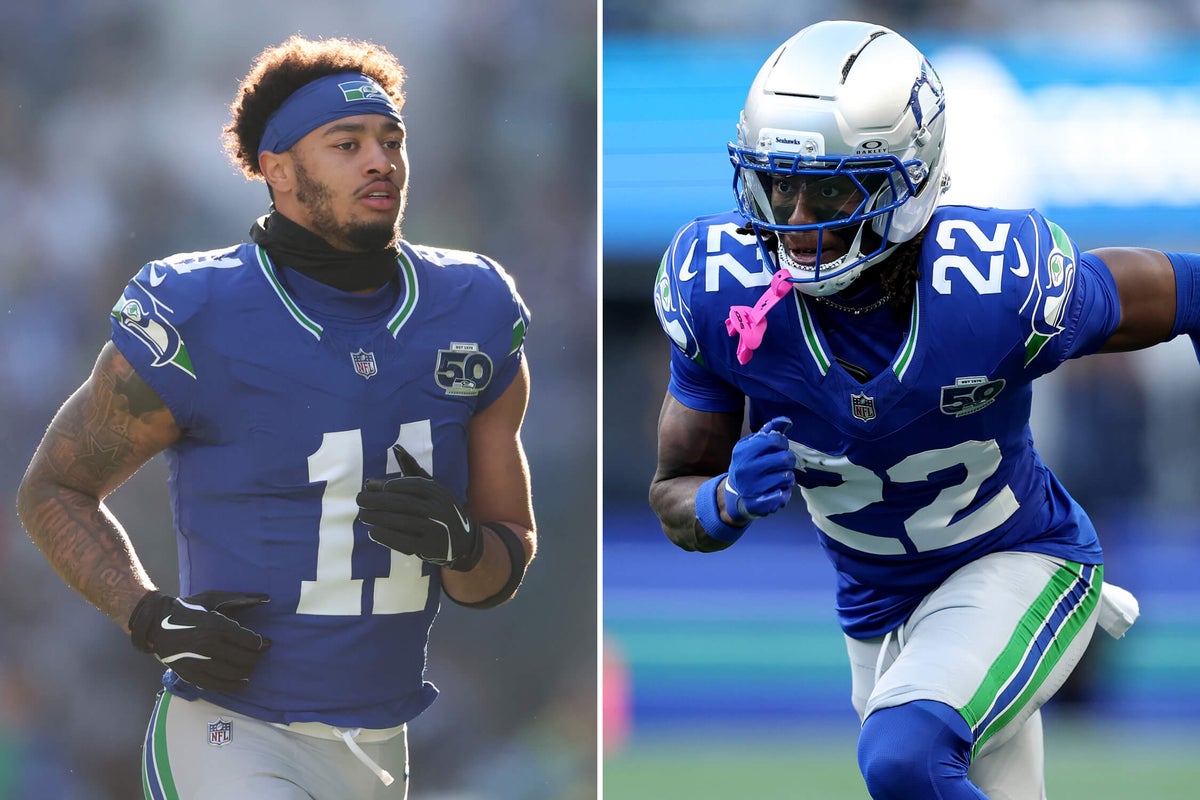
RENTON, Wash. — Jaxon Smith-Njigba is no longer on pace to break the NFL receiving yards record, but he remains on track to deliver an all-time great season. He’s also the engine of one of the league’s top-scoring offenses.
At the same time, the Seattle Seahawks’ offensive output in a 26-0 victory over the Minnesota Vikings on Sunday was a reminder that Smith-Njigba might also be the tires, the steering wheel and the gas pedal. In other words, the Seahawks’ offense goes as its No. 1 receiver goes. And when he’s not rolling, as was the case in Week 13, Seattle’s offense can sputter.
Smith-Njigba entered Week 13 averaging 119.4 receiving yards per game, putting him on pace to be the first 2,000-yard receiver in league history. The Vikings sold out to limit his production, and they succeeded. Smith-Njigba had just two catches for 23 yards, his lowest output since a 79-yard outing against the Arizona Cardinals in Week 4. In that game, he wasn’t targeted until the second half, hauling in all four of his catches against single coverage by Max Melton.
The Vikings limited Smith-Njigba to two targets and zero catches in the first half, then didn’t let up. They consistently threw extra bodies at Seattle’s top offensive weapon, daring someone else to beat them in the passing game. Sam Darnold threw for a season-low 128 yards, and tight end AJ Barner led the team with four catches for 35 yards. It was the first time all season that someone other than Smith-Njigba led Seattle in receiving yards.
Smith-Njigba’s first catch came in the third quarter in one of the few instances he didn’t receive extra attention. He ran an out route, and Isaiah Rodgers left him to get underneath a corner route from Cooper Kupp. The play gained 6 yards. Smith-Njigba didn’t even run a route on his second reception, also in the third quarter. Darnold received the snap and immediately tossed it outside to Smith-Njigba, who made Rodgers and safety Harrison Smith miss on a 17-yard catch-and-run.
Seattle didn’t need much from Smith-Njigba and the offense Sunday, thanks to the defense forcing five turnovers and outscoring the Max Brosmer-led Vikings by themselves.
However, these final six games are critical for the Seahawks as they try to not only win the NFC West but also secure the No. 1 seed and a first-round bye. To accomplish both goals, they must ask themselves whether they are too reliant on Smith-Njigba to function at an elite level. And even if the answer is no, they still need a better plan for when teams inevitably sell out to top their best player.
To be clear, Vikings defensive coordinator Brian Flores did not uncover a blueprint that future opponents can easily copy. Flores’ versatile, blitz-heavy defense takes time to learn, implement and execute. The Falcons, Colts, Rams, Panthers and 49ers can’t just adopt that over the course of a few days before playing Seattle.
The overall strategy is repeatable, though. The Vikings often put two defenders in Smith-Njigba’s area early in his route, even if that meant giving another Seahawk an easy opportunity to make a play.
On third-and-6 in the first quarter, they doubled Smith-Njigba and left Barner the entire middle of the field to beat linebacker Eric Wilson for an 11-yard gain. On the next play, a quick-game concept, two defenders immediately flew to Smith-Njigba, leaving Kupp open for a 6-yard catch over the middle. On third-and-11 two plays later, Minnesota dropped an edge rusher into Smith-Njigba’s slant window while a cornerback hovered over the top. Cody White was wide open for a 21-yard reception.
Seahawks coach Mike Macdonald cited White’s catch as an example of how they sometimes need to operate when teams double Smith-Njigba.
“We need more of those if people are going to decide to take Jax away,” Macdonald said.
Smith-Njigba has accounted for 45.6 percent of Seattle’s receiving yards, which would be the second-highest yardage share in the league since at least 2000, trailing only Brandon Marshall’s 45.7 percent of the Chicago Bears’ receiving yards in 2012 (all stats provided by TruMedia unless stated otherwise). Darnold is tied for the league lead in explosive pass rate (plays of at least 16 yards). Smith-Njigba has 30 such receptions; Kupp is second on the team with just nine.
In theory, the acquisition of Rashid Shaheed in exchange for fourth- and fifth-round draft picks should have made this a non-issue. (Tory Horton has missed the past four weeks with a shin injury, which isn’t helping.) Shaheed’s speed is his superpower, and his familiarity with Klint Kubiak was supposed to make for seamless integration into the offense.
In four games, Shaheed has just 37 receiving yards, with more rushing attempts (five) than receptions (four). His 21-yard catch in Week 11 is his only reception to produce a first down. While they’re not completely apples-to-apples comparisons, Shaheed has been notably less productive than other wideouts dealt ahead of the trade deadline.
In four games with the Jacksonville Jaguars, Jakobi Meyers has 18 catches for 245 yards and two scores with 13 first downs. Adonai Mitchell has played in three games with the Tyrod Taylor-led New York Jets, recording 11 catches for 154 yards with one touchdown and seven first downs. Even Jets receiver John Metchie III has 14 catches for 132 yards and two touchdowns.
It is too early to draw conclusions based on a few games, but it is worth wondering why Shaheed hasn’t been more involved in the offense and whether that might hinder Seattle late in the season and into the playoffs against better defenses. The Seahawks’ third-and-long conversion rate of 13.4 percent is the lowest in the league (the average is 25 percent). In those obvious passing situations, they would benefit from having a reliable No. 2 option.
Seattle has attempted to find Shaheed on a few deep shots. The Rams’ Emmanuel Forbes Jr. swatted away what would have been a 25-yard touchdown in Week 11. The Titans doubled Shaheed on a go route, prompting Darnold to look elsewhere. Darnold was hit while throwing a post route to Shaheed later in the game, and the ball was nearly intercepted. Kubiak called what appeared to be a play-action shot play for Shaheed on Sunday, but the Vikings were on top of it, and Darnold had to evade pressure.
“Shaheed has done a great job,” Macdonald said. “I know we haven’t gotten the ball to him as much as we want, but it’s kind of like our run game — just keep doing what you’re doing. There’s a lot of detail that has been getting caught up since he’s walked in the door. That’ll allow him to create some more opportunities. But really pleased with how he’s been since he got in the door.”
The Seahawks have the No. 8 scoring offense by points per drive, and the game against the Vikings might look like an outlier by the end of the regular season. The next five defenses they’ll face rank 17th, 16th, fourth, 24th and 13th in points allowed per drive. There will be opportunities to get Shaheed and other pass catchers involved in ways that prove fatal for the opposition. That might happen this week against an Atlanta defense that is mediocre outside of its pass rush, which is one of the best in the league.
Also encouraging for Seattle: The run game is improving. Ken Walker III and Zach Charbonnet have combined for more than 100 rushing yards in four consecutive games, and their combined success rate has been above league average in three of four (the Rams loss being the exception). Seattle’s run game can’t yet carry the team to victory, but it’s steadily coming along.
An efficient, explosive run game is another way the Seahawks can punish teams for allocating resources to stopping Smith-Njigba. And finding that counterpunch will be important down the stretch.