
Join the huddle. Sign up here for Ravens updates in your inbox.
The AFC North was supposed to be above ridicule this season. The Ravens entered 2025 with Super Bowl expectations. The Cincinnati Bengals had a championship-worthy offense. The Pittsburgh Steelers haven’t had a losing season in over two decades. And the Cleveland Browns — well, they looked bad enough on paper that they wouldn’t get in anyone’s way, would they?
Three months into the season, the division race has become a back-road traffic jam. The AFC North is the NFL’s only division with every team at .500 or worse. Sunday’s showdown between the 6-6 Ravens and 6-6 Steelers looms large not only because of the division title implications but because of the fading wild-card hopes for the two rivals.
The most glaring indictment of the division’s quality might be that the 4-8 Cincinnati Bengals, who shocked the Ravens last Thursday in Baltimore, somehow have a not-totally-crazy path to the division title despite a historically awful defense.
“I think you never would have envisioned 6-6 at this point with the expectations,” Ravens inside linebacker Roquan Smith said Wednesday. “But, at the end of the day, expectations are expectations, and they don’t mean anything.”
He added: “If you told me, Week 14, at the beginning of the season, you’ll be tied for first place, you control your own destiny, I’m signing myself up for that every day of the week and twice on Sunday.”
The Ravens have big issues this season: an inconsistent, injury-prone quarterback, an ineffective running game, a low-caliber pass rush. But there are cautionary tales across the division as well. As the Ravens look to close on a third straight division title, here’s what they can take away from the struggles of three familiar foes.
Steelers: Defenses can get old and expensive in a hurry
The Steelers’ front office made a big bet that the core of Pittsburgh’s defense, consistently one of the NFL’s best, would age well. It has not.
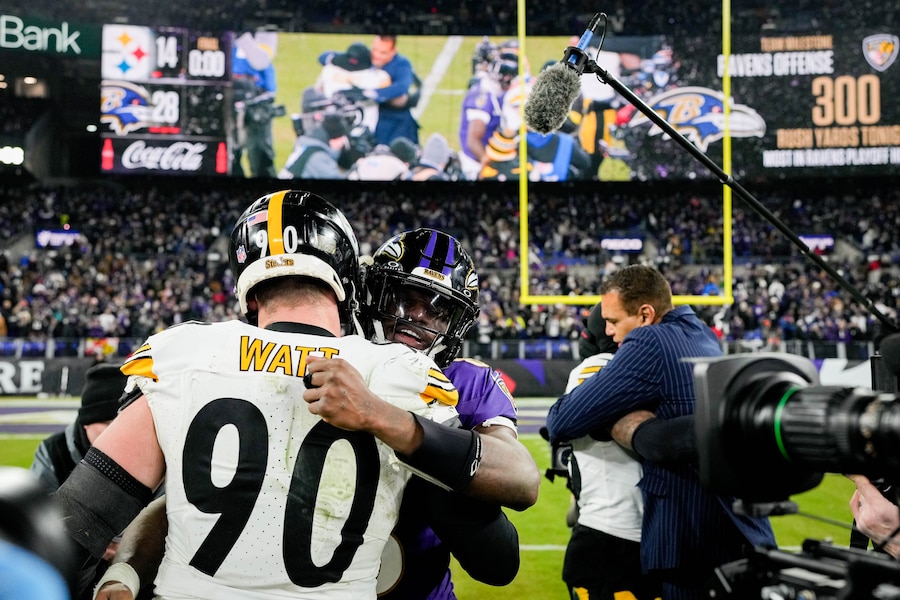
According to salary cap website Over The Cap, the Steelers are spending an NFL-high $150 million on their defense this season, about $15 million more than the runner-up New York Giants. That includes a $23.4 million salary cap hit for outside linebacker T.J. Watt, a $22.8 million hit for defensive lineman Cameron Heyward, a $19.5 million hit for defensive back Jalen Ramsey, an $18.6 million hit for outside linebacker Alex Highsmith and a $17.7 million hit for inside linebacker Patrick Queen.
The results have been incommensurate with Pittsburgh’s bill. The Steelers’ defense is 12th in opponent-adjusted efficiency, according to FTN, but recent results have been more alarming. Since a 4-1 start, Pittsburgh is 24th in expected points added per play and 21st in success rate, according to analytics site RBSDM.com.
And Steelers stars are starting to look their age. Watt, 31, has seven sacks in 12 games and could finish the season without double-digit sacks for only the second time since his rookie year. Heyward, 36, has graded out as an elite interior lineman on Pro Football Focus but has only 1.5 sacks in 12 games. Ramsey, 31, has struggled in man coverage at cornerback and has been more impactful at safety. Cornerback Darius Slay, 34, who joined the team on a one-year, $10 million deal this offseason, agreed to part ways with Pittsburgh this week after a disappointing 10 games.
Is there a lesson for the Ravens to learn? Smith’s cap hit is set to jump from $15.7 million in 2025 to $32.7 million in 2026, the second-to-last year of his record-breaking contract extension. He will turn 29 in April and has looked slow in coverage at times over the past two years, though he could be on his way to another Pro Bowl season.
Cornerback Marlon Humphrey, meanwhile, has a $26.3 million cap hit in 2026, the final year of his deal. He will turn 30 next summer and has followed his All-Pro season in 2024 with a more erratic campaign. In recent years, Humphrey has generally fared better in coverage in the slot — a less glamorous, less expensive position than outside cornerback — but safety Kyle Hamilton’s relocation there this season has forced Humphrey back out wide for more snaps.
Together, Smith and Humphrey would account for over 19% of a projected $307.1 million cap in 2026, according to salary cap website Spotrac. Along with the Ravens’ handling of quarterback Lamar Jackson’s massive cap spike and defensive lineman Nnamdi Madubuike’s uncertain future, their financial management of their aging defensive stars will shape their roster flexibility for next year and beyond.
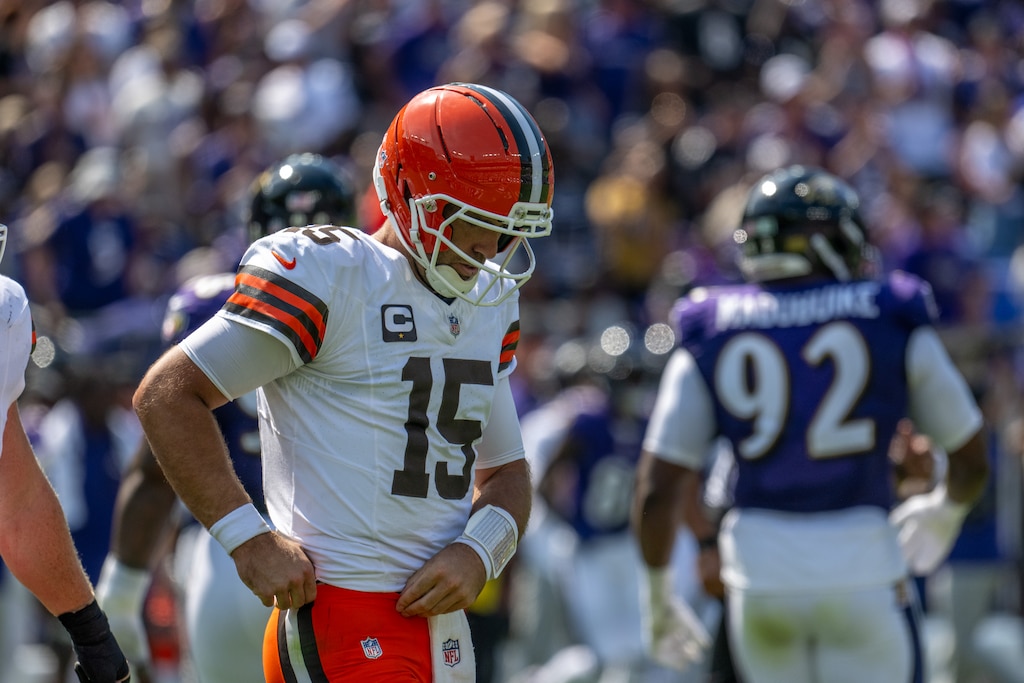
Former Raven Joe Flacco began the season as the Browns’ starting quarterback. He is in Cincinnati now. (Jerry Jackson/The Banner)
Browns: An underperforming QB is better than an unplayable one
In 2023, Jackson became the NFL’s highest-paid player. Over the next two seasons in Baltimore, as he played at a Most Valuable Player-worthy level, his $52 million annual salary became a bargain.
This year, the returns have not been as team-friendly. Jackson ranks only 14th in QBR and EPA per play, but his 2025 cap hit is $43.5 million, the fourth highest in the NFL. His cap hit next year is, for now, $73.5 million, which would be the third highest.
But having an established quarterback on a big-money deal sure beats not having a quarterback at all, even if he’s on a dirt-cheap contract. Just look at Cleveland.
The Browns opened the season starting former Ravens quarterback Joe Flacco, who was playing on a one-year, $4.3 million deal. He lasted less than a month before being traded. Cleveland then moved on to rookie Dillon Gabriel, a third-round pick. He started six games and went 1-5 before losing his job because of a concussion. The Browns are now starting fifth-round pick Shedeur Sanders, whose EPA per play (minus-0.26) is even worse than Gabriel’s (minus-0.12).
Would a mediocre-to-good starting quarterback have been enough to salvage a decrepit, playmaker-deprived attack? Probably not. But he could have at least stabilized the Browns, fostering an offense more conducive to growth and development. Veteran wide receivers Cedric Tillman and Jerry Jeudy and veteran tight end David Njoku, all former Day 1 or Day 2 picks who’ve flashed plus traits over the years, rank among the NFL’s 20 worst receivers this season, according to ESPN’s tracking metrics.
Over the past two years, meanwhile, the Ravens’ skill position depth has flowered. Zay Flowers became a Pro Bowl wide receiver. Rashod Bateman earned another extension. Isaiah Likely and Charlie Kolar found productive roles at tight end. Justice Hill and Keaton Mitchell stepped up as reserve running backs. Their collective impact has been diminished this year, but with Jackson orchestrating the offense, the Ravens have almost always found their rhythm.
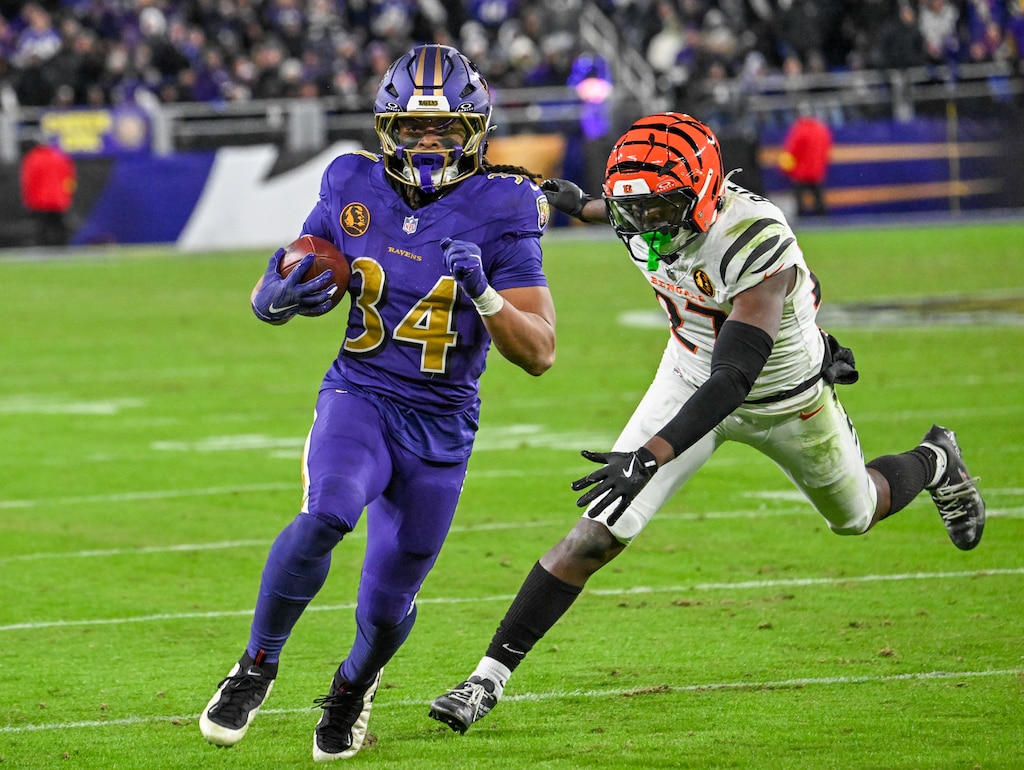
Ravens running back Keaton Mitchell eludes Jordan Battle of the Bengals to score a touchdown last week. (Jerry Jackson/The Banner)
Bengals: Good drafting matters — and so does good development
The Bengals paid a heavy price this offseason for offensive stability. In March, 18 months after signing quarterback Joe Burrow to a five-year, $275 million extension, Cincinnati finalized extensions with Ja’Marr Chase and Tee Higgins worth a combined average annual salary of $69 million — $10 million higher than any other wide receiver duo.
The hope was that the Bengals could draft and develop their defense back into respectability. But it didn’t happen in their final years under defensive coordinator Lou Anarumo, and it hasn’t happened this year under his successor, Al Golden. Even after stumping the Ravens’ offense last week, Cincinnati’s defense is last in the NFL in opponent-adjusted efficiency, according to FTN, and one of the worst in league history.
Over the past four years, the Bengals have drafted eight defensive prospects on Day 1 or Day 2. Only one, cornerback D.J. Turner, has turned into an impact player. Defensive linemen Zachary Carter (2022), Myles Murphy (2023), Kris Jenkins (2024) and Shemar Stewart (2025) have combined for 12 career sacks.
Cornerback Dax Hill (2022) and safety Jordan Battle (2023) both rank outside the top 80 in coverage grade this season among qualifying defensive backs on PFF, while cornerback Cam Taylor-Britt (2022) started only twice before suffering a likely season-ending Lisfranc (foot) injury. And linebacker Demetrius Knight (2025) has had a rough rookie year in Cincinnati.
The Ravens have fared better over the same span, finding a star safety in Hamilton in 2022 and landing potential secondary cornerstones in cornerback Nate Wiggins and safety Malaki Starks over the past two drafts. But general manager Eric DeCosta’s inability to draft another impact pass rusher, and Madubuike’s iffy long-term availability, will likely force the Ravens into using another Day 1 or Day 2 pick at the spot next April.
From there, the Ravens will need a development plan. At edge rusher, for example, Odafe Oweh had more highs than lows entering his fifth year in Baltimore, but he seemed to regress before a midseason trade. David Ojabo has struggled to overcome his early-career injuries. Tavius Robinson remains limited as a pass rusher. Mike Green has had a handful of quiet games as a rookie.
Growth is never linear, but preseason expectations were higher for this Ravens team at two key spots: along the offensive line and at outside linebacker. If they can’t afford to acquire help there via free agency or a trade, the Ravens will need to do better at cultivating talent in-house. They’ve already seen how quickly they can lose ground in a crowded race to the top.