
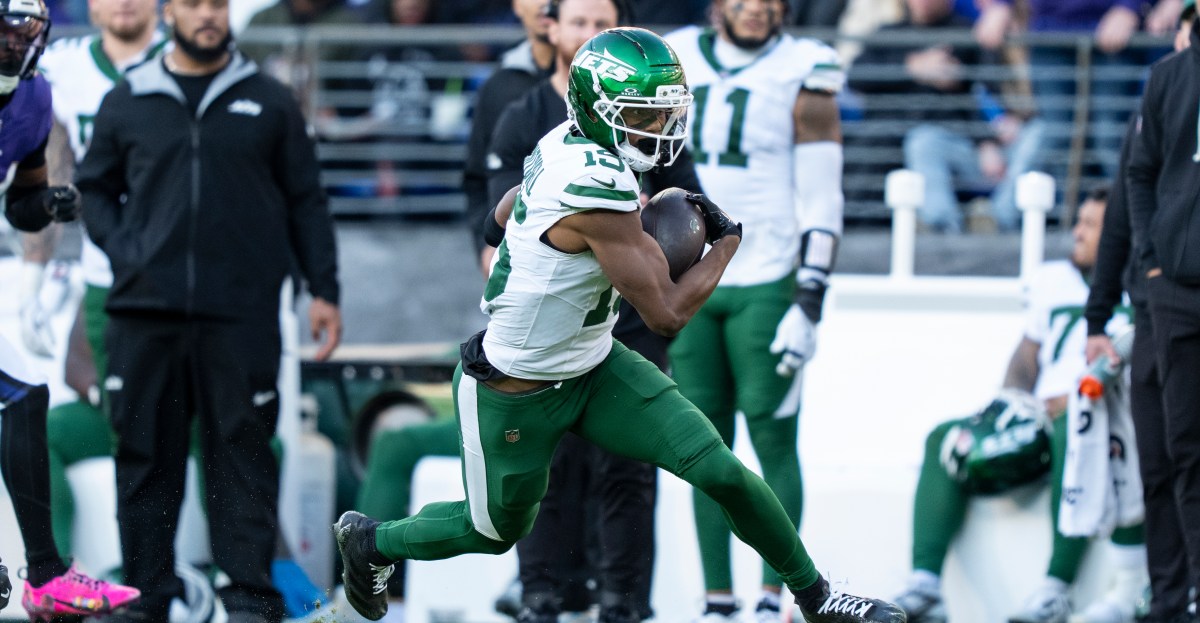
About a month ago, the Jets stunned the NFL world by dealing homegrown, former All-Pro corner Sauce Gardner to the Colts. The move drew near-universal praise from national media, largely because New York managed to land two first-round picks for a defensive player, something that’s almost unheard of throughout NFL history.
In national coverage, nearly all of the focus went toward how Gardner would fit in Indianapolis and what the Jets planned to do with their newly acquired draft capital. But there was another component of that trade, one that wasn’t even highlighted or included when the deal first broke.
Now, roughly four weeks later, that overlooked piece has become one of the primary reasons Jets fans still tune in despite a disastrous start to the season.
Let’s take a closer look at Adonai (AD) Mitchell: his background, his emerging role in New York, and how he could shape the Jets’ future.
Mitchell’s HS / College Background:
AD Mitchell was born and raised in Missouri City, Texas. He began his high school career playing quarterback, largely because he was the most dynamic athlete on the field. As he started to show high-end potential as a wide receiver, he still struggled to draw major recruiting attention. As a result, Mitchell moved to Antioch, Tennessee, a suburb about 12 miles outside downtown Nashville, where he focused full-time on developing as a receiver. Rated as a 3-star prospect coming out of high school, he eventually committed to the University of Georgia, spending his first two college seasons there before transferring to Texas.
Mitchell made an immediate impact at Georgia, posting 29 receptions on 52 targets for 248 yards as a freshman, an especially strong showing and an unusually efficient start for a former 3-star prospect, highlighted by a 1.66 yards per route run. His sophomore year was derailed by injury, which contributed to his decision to transfer to Texas.
It was at Texas where Mitchell truly broke out and established himself as a legitimate NFL prospect. In his junior season, he recorded 55 receptions for 845 yards and 11 touchdowns, quickly becoming one of the most dangerous vertical threats in the nation.
Much like his role at Georgia, Mitchell operated primarily as an X receiver, thriving as a downfield target with a 16.0 average depth of target and a strong 1.72 yards per route run. Perhaps most impressively, he dropped only one pass all year, finishing with an elite 1.8% drop rate — the fourth-lowest among receivers with at least 80 targets.
Mitchell chose to forgo his senior season and declare for the NFL Draft. Initially projected as a middle of the second-round prospect, he quickly climbed consensus draft boards thanks to an outstanding combine performance and elite athletic testing. Below is Mitchell’s RAS (Relative Athletic Score), a metric that aggregates a player’s combine and pro-day athletic results into a single 0–10 score, comparing them to historical results at the same position. While not a perfect measure, RAS consistently highlights top-tier athletes. Mitchell tested as one of them:
By draft day, Mitchell was widely viewed as a top-35 overall prospect. Scouting reports on him were remarkably aligned: evaluators saw a high-end athlete with prototypical size, excellent movement skills, and natural playmaking ability. Dane Brugler of The Athletic summed him up this way:
“Despite some wasted movements in his routes that need to be tightened up, Mitchell cleanly accelerates and decelerates at will with the fluid movement skills to create separation out of his breaks… Though not the strongest player through contact, he has the hand-eye coordination and pliable frame to adjust, high point, and reach throws most receivers cannot. Overall, Mitchell needs to become a more detail-focused receiver to fully unlock his talent, but he has the body length, loose athleticism, and catch-point skills to be a chain-moving weapon. He projects as a rangy, outside-the-numbers target with the lean, limber body type reminiscent of the late Chris Henry.”
Despite this, Mitchell fell a bit in the draft, which was a bit of a surprise. He was selected by the Indianapolis Colts at pick 52. Reports came out that Mitchell came across as a “bit of a wildcard” and there were character and health concerns in regard to his Type 1 diabetes diagnosis. Multiple AFC scouts expressed concern for Mitchell’s diabetes and character to Bob McGinn. An excerpt of the article can be found here:
https://x.com/BillyM_91/status/1780544832189907194?s=20
Mitchell’s rookie season in Indianapolis started with plenty of buzz but ultimately finished as a disappointment. After standing out throughout training camp and preseason, expectations were sky-high. Colts wide receivers coach and former All-Pro receiver Reggie Wayne only amplified the hype, calling Mitchell an “alpha” and an “elite separator.” Wayne went as far as to say, “He’s probably got the most separation of anyone in this league… we got a steal in the draft… just keep watching.” With praise like that, it was no surprise Mitchell opened the year as a Week 1 starter.
However, once the regular season began, things quickly became rocky. Although he earned early opportunities, Mitchell’s snaps steadily declined as the year progressed. In a deep and increasingly competitive receiver room, he slipped down the depth chart and eventually completely fell out of favor with the coaching staff. Young wide receivers like Josh Downs and Alec Pierce emerged and overtook him, and after logging 19 passing down snaps in each of his first two games, he reached that number only three more times across the next 23 games with the team.
Some of the concerns from his pre-draft profile began to show up on film. Concentration issues resurfaced, contributing to a 14.8% drop rate — far higher than anything he posted in college. Reports also surfaced suggesting he shied away from contact, and despite posting strong separation data, he struggled to find a consistent role outside of being a vertical threat. The low point came earlier this year against the Los Angeles Rams, when Mitchell’s costly fumble led to yet another benching and ultimately set the stage for his departure from Indianapolis.
If there was a video to sum up Adonai Mitchell’s career in a nutshell to this point, I’m not sure you can find a better clip. It showcases his freakish athleticism, his propensity to make big plays, but a mistake (foolish or unlucky depending on whom you ask) leading to a critical error at a crucial time.
Mitchell’s Analytic Profile:
Mitchell is the rare type of player where it’s remarkably easy to craft two completely different stories. Look at one set of traits or metrics, and you understand why he has such a passionate group of believers convinced he’s a future star. Look at another set, and it becomes just as clear why an organization might decide to move on.
I think the reality with Mitchell is more nuanced, and the truth sits somewhere between the extremes. There’s no question he’s a high-end athlete with rare physical tools, and the flashes show up both in the numbers and on film. Reggie Wayne wasn’t wrong when he called him a high-end separator. According to FantasyPtsData’s Average Separation Score (ASS), Mitchell ranked 7th out of 116 qualified wide receivers. ESPN’s Open Score, which uses player-tracking data from Next Gen Stats, painted a similar picture, placing him 9th out of 159 WRs and TEs. A big, explosive athlete who consistently gets open? It’s not hard to see why people buy into the upside.
But there’s another side to the profile depending on which metrics you focus on. Drops, which were not an issue in college, have become a major concern. Mitchell’s 14.8% drop rate last year was the fourth-highest in the league, and this year hasn’t been much better as his 13% drop rate still ranks among the highest at the position. His reception percentage (the share of targets he actually converts into catches) also raises eyebrows. Since entering the league in 2024, his 47.8% reception rate is among the bottom five of all wide receivers over that span. To be fair, much of this is influenced by his consistently high average depth of target, but even accounting for that, he’s underperforming relative to expectations. Is this a result of some of the concentration issues that have been discussed since college? Maybe, it’s hard to tell.
Adonai Mitchell and the Jets:
Given all of this, including Mitchell in the trade was a no-brainer for the Jets. The front office understands exactly where this team stands and what the current talent level looks like. In a season that quite frankly was over in October, taking a swing on a high-upside player at a position of need is the kind of move you absolutely make.
While a large share of the early-season offensive struggles fell on Justin Fields’ inconsistent play, the wide receivers didn’t offer much help either. Outside of Garrett Wilson and before the additions of Mitchell and John Metchie, this was a receiving corps that simply wasn’t NFL caliber. It was a group the Jets neglected in the offseason, and it showed. The unit offered little separation, little playmaking, and little support for any quarterback under center. And even more depressingly, little to no long-term hope.
In that context, betting on a physically gifted, high ceiling receiver like Mitchell wasn’t a gamble, it was an obvious opportunity. These are the exact type of players the Jets should be playing down the stretch. Cheap players with obvious long-term talent that can make mistakes and not be penalized. Credit to the Jets for understanding this. Aaron Glenn has raved about Mitchell from the second he entered the building and was assertive with the Colts for including him.
For the Jets, this move should not fundamentally alter the long-term plan at wide receiver. With a new quarterback almost certainly on the way (likely via the draft), the need for multiple NFL caliber pass catchers has never been more important. Mitchell has already shown he can be an effective deep threat in a complementary role, and that’s exactly how the Jets should view him unless he proves he can become something more.
And Mitchell doesn’t sound like someone who plans to waste a second chance. He’s already spoken openly about how much the game means to him, telling Colts beat reporter James Boyd of The Athletic:
“This is all I ever done, dog. This is pretty much the only thing I’ve ever really found joy in besides just being around my family. I hated school, so I knew I wasn’t gonna work a regular job. But now that this is my job, I just can’t take it for granted. I gotta make this work.”
Maybe this really is the right fit, a player who needs to make it work paired with a franchise that can no longer afford to get it wrong.
Sometimes, that’s how unlikely stories begin.