
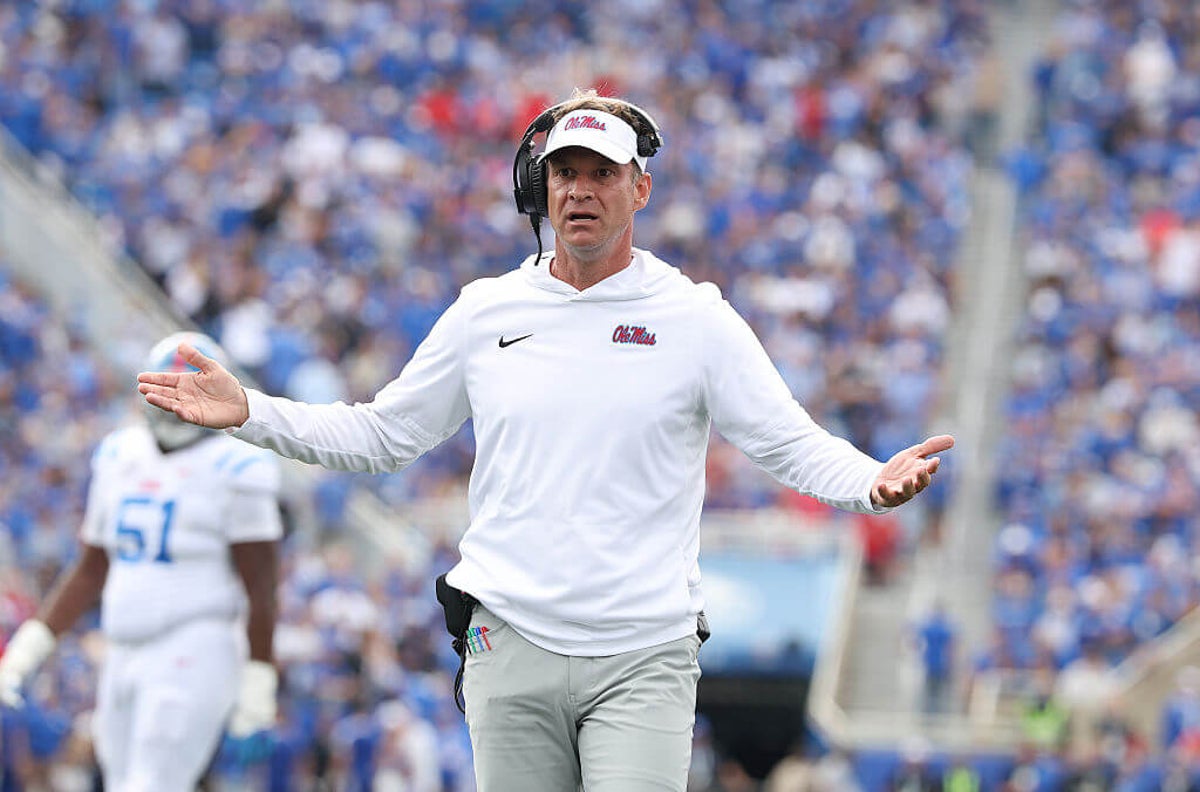
During his time at Ole Miss, head coach Lane Kiffin proclaimed himself to be the “Portal King.”
As transfer restrictions and rules around paying players loosened at the start of the decade, the Rebels stocked up on impact transfers, who have played a key role in the team’s historic run of three consecutive 10-win seasons.
But even in an age of transient rosters and rapid movement, college football coaches still largely believe that championship teams are built through high school recruiting. And though there are many reasons Kiffin left the College Football Playoff-bound Rebels to take over SEC rival LSU, one that should not go understated is the built-in recruiting advantages the Tigers enjoy.
In the pursuit of championships, high school recruiting still matters.
“It’s like the NFL Draft,” a Power 4 personnel director recently told The Athletic. “No one wants to live in free agency. You want to live in the draft and build your core there and then supplement it with positions that are needs (in the portal).”
In the last four seasons, no SEC team has had a larger portion of games started by transfers than Ole Miss. Since 2022, 60.9 percent of the Rebels’ starts have come from transfers, according to SportSource Analytics. The only other SEC team with more than half of its starts from transfers in that time span is Arkansas (51.7 percent).
The four teams with the fewest number of starts from transfers in the last four years? Georgia (8.8 percent), Texas (19.1), Alabama (23.6) and Texas A&M (25).
Roster construction, top 15 teams in CFP rankings
TeamStarts by recruitsStarts by transfers
90.4%
9.6%
84.5%
15.5%
83.0%
17.0%
73.7%
26.3%
72.3%
27.7%
62.6%
37.4%
61.9%
38.1%
61.1%
38.9%
57.4%
42.6%
55.2%
44.8%
46.4%
53.6%
41.3%
58.7%
36.7%
63.3%
34.1%
65.9%
33.7%
66.3%
Texas A&M general manager Derek Miller, when discussing earlier this year how the Aggies try to build their roster, said recruiting is the top priority.
“We are getting better and better because we pour into the development. It’s not just a cycle of quick-fix, get the best players, send them to the draft,” Miller said in September. “I firmly believe that (recruiting and development) is how you build a great team. It’s continuity and being able to play fast.
“Our (2025) high school class was a top-10 class. We’re not a portal program. (Using the portal) was a necessity. We believe in building through recruiting and developing those players.”
Recent College Football Playoff results seem to support that roster-building method. In the 2024 Playoff, the four teams that made the semifinals all had more than 75 percent of their games started by players they signed out of high school: national champion Ohio State (77.7 percent), Texas (79.3), Notre Dame (80.1) and Penn State (88.6).
In 2023, all four of the CFP teams had more than 79 percent of games started by homegrown players. Texas led the way with 86.4 percent, followed by national champ Michigan (85.3), Alabama (85) and Washington (79.6).
In this season’s Playoff chase, 10 of the top 15 teams in the latest CFP rankings have more than half of their starts from homegrown recruits.
That’s not to discount the value of transfers. Washington’s 2023 team doesn’t get to the national title game without transfer quarterback Michael Penix Jr. Transfer quarterback Quinn Ewers took Texas to consecutive Playoff appearances in 2023 and 2024. Last season, Indiana made the Playoff thanks in large part to an influx of talent Curt Cignetti brought from James Madison. IU’s quarterbacks the last two years, Kurtis Rourke (Ohio) and Fernando Mendoza (Cal), are both transfers.
Some of Ohio State’s biggest impact players during its title run, including quarterback Will Howard, safety Caleb Downs and running back Quinshon Judkins, were transfers. Texas Tech, Indiana and Ole Miss are all currently in the top 10 with heavy transfer contributions.
But for the most consistently successful teams, the foundations were built in recruiting. Of the top 15 teams in the current CFP rankings, the one with the fewest starts from recruits is Ole Miss, with 33.7 percent.
Roster construction, 2024 CFP field
TeamStarts by recruitsStarts by transfers
100.0%
0.0%
90.9%
9.1%
88.6%
11.4%
85.8%
14.2%
80.1%
19.9%
79.3%
20.7%
77.7%
22.3%
59.9%
40.1%
43.1%
56.9%
25.2%
74.8%
21.8%
78.2%
15.3%
84.7%
And it has yet to be proven that a coach can build a national champion with a roster heavier on transfers than recruits. Which is why LSU, even amid a few years of underachievement, provides a more consistent path to a title.
LSU’s average recruiting ranking from 2016 to 2025, according to the 247Sports Composite, is 7.1. Ole Miss’ average in that same time span is 22.8. And though it has trended up in the last five years, including two classes in the top 20, the Rebels haven’t signed a top-10 class since 2016 and have done so only twice in the last 15 years. LSU has signed top-10 classes 13 times in that span.
LSU is the lone Power 4 conference program in a talent-rich state. Many young Louisianans grow up rooting for and wanting to play for the Tigers. LSU has recruited at a top-10 level for the better part of this century, through four different head coaches.
“When LSU offers a Louisiana kid, it’s almost (an) automatic (commitment),” a former LSU recruiting staffer told The Athletic in October. “That program doesn’t traditionally offer in-state (players) without the intention of it being a take. Because they know when they offer a Louisiana kid, 90 percent of the time, that kid wants to go there or it’s that kid’s dream school.”
Kiffin’s goal is to bring a national championship back to LSU. The Tigers won one each under Nick Saban, Les Miles and Ed Orgeron. Brian Kelly was fired in large part because he didn’t get the Tigers close to that goal.
But the national title standard is achievable in part because of the program’s ability to stock up on home-state stars. In the 10 recruiting cycles from 2016 through 2025, Louisiana produced 935 players rated three-, four- or five-star recruits by the 247Sports Composite, seventh-most in the country. But when adjusting for population, Louisiana produced those recruits at the third-highest rate, even ahead of talent-rich havens like Texas, Florida and California. Of those 935 players, 9.1 percent were drafted, a higher clip than Texas (6.4 percent), Florida (6.3), Georgia (6.6) and California (5.8), according to SportSource Analytics.
And in the revenue-sharing era, recruiting is a more cost-effective way to build a roster. While transfer players are more proven and ready to contribute, they also cost a lot more than players who have been recruited and developed. A Power 4 general manager said his rule of thumb is that a high school recruit should cost roughly half as much as a portal player at the same position.
“It is cheaper to retain (recruited players), because they’re bought into the school and the culture and the coaching staff,” the Power 4 personnel director said. “You’ll be able to retain them for cheaper and bump them up every now and then.”
The cost may not matter as much in the short term for LSU, which reportedly promised Kiffin $25 million for the roster. That’s well above what LSU spent last year ($18 million, according to Kelly) and on par with what Texas Tech spent on its roster this season.
But building through recruiting, while supplementing through the portal, still appears to be the best path to a title. And it’s where Kiffin should, and likely will, start.
“The mission is simple: Bring the best players in the country to LSU,” Kiffin said Monday. “And it starts right here, in the state of Louisiana.”