
Want more ways to catch up on the latest in Bay Area sports? Sign up for the Section 415 email newsletter here and subscribe to the Section 415 podcast wherever you listen.
The last time we did one of these grand statistical check-ins, the 49ers were 4-1 — fresh off an improbable victory over the Los Angeles Rams. They had defied the odds of injury decimation to start that well.
But they couldn’t possibly keep up with the pack, right?
Wrong.
The bye week is here, and the 49ers’ nine wins are tied for the most in the NFC. While Kyle Shanahan’s team will likely fall out of that top spot as its players watch games from the couch Sunday, the 49ers will remain in excellent position when the Tennessee Titans come calling Dec. 14.
The 49ers will climb to at least the NFC’s No. 6 spot without even playing this weekend and might have a chance to rise all the way to No. 1 over a compelling four-game stretch to close the regular season.
Let’s look under the hood of the 49ers’ run to 9-4, then, and identify the truths and trends that got them here — and might determine their fate. We’ll start with a close inspection of the offense before dissecting the defense in a couple of days.
It’s taken two quarterbacks
Brock Purdy has been the NFL’s most efficient quarterback, by expected points added (EPA) per play, since he entered the league in 2022. He has constantly resided in the upper-right quadrant of graphs like the one below, which charts completion percentage over expectation (CPOE) on the X-axis and EPA/play on the Y-axis.
A problem in 2024: When the 49ers had to turn to backups to fill in for Purdy over two games, they did not enjoy QB play worthy of the top-right quadrant. That’s because it’s hard to land in that quadrant. But in 2025, Mac Jones — the 49ers’ No. 2 quarterback — has defied the odds and landed there anyway. In fact, he’s in better position that many No. 1 QBs.
Jones ranks No. 10 in ESPN’s QBR, which is the best way to quantify performance at the position and disassociate it from the myriad of surrounding variables in this chaotic sport. Purdy doesn’t yet have enough snaps to qualify for the QBR leaderboard, but he is on track to be in the top five — even when accounting for the three interceptions he threw against the Carolina Panthers.
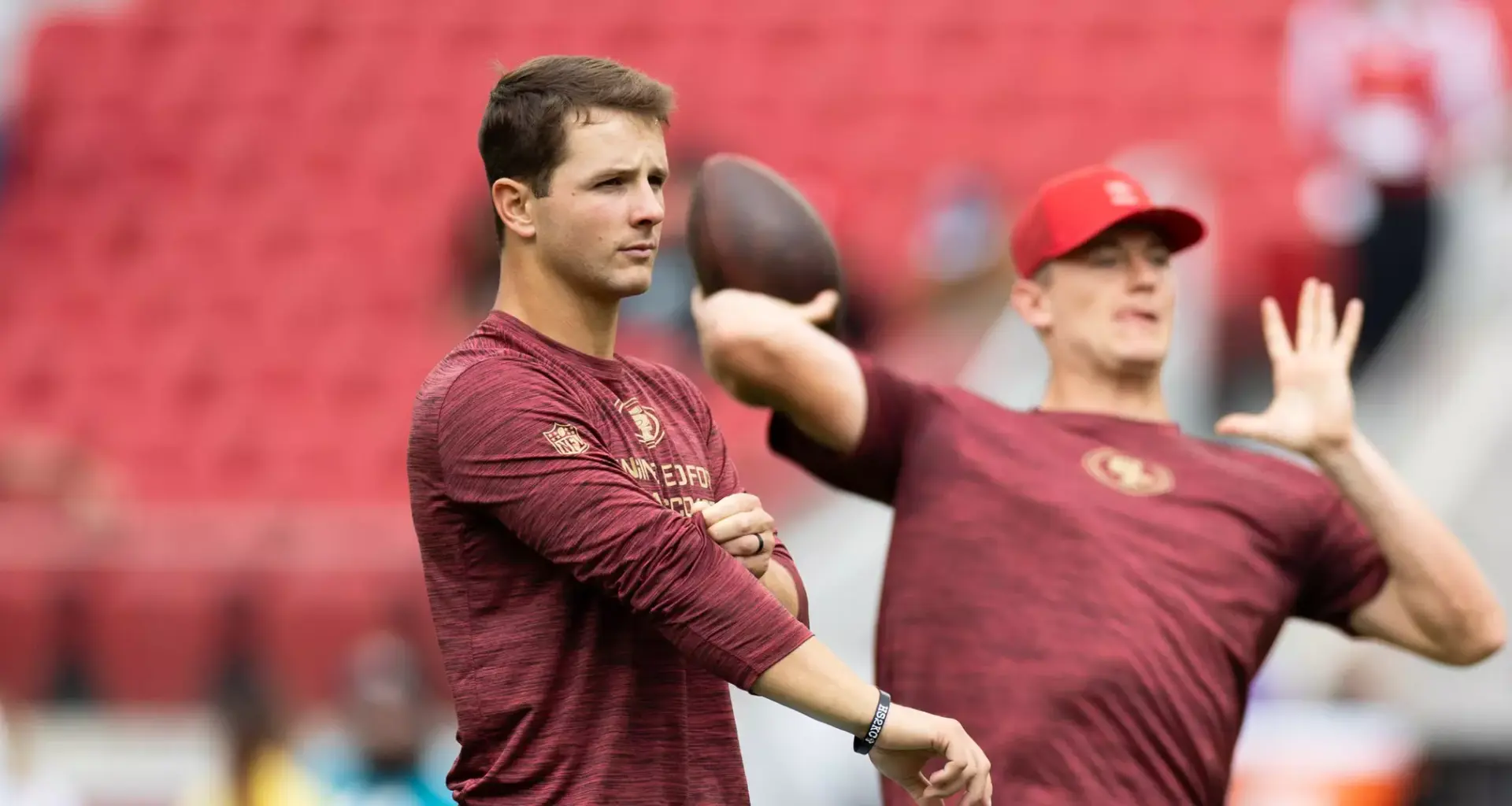
Put simply, the 49ers have the best quarterback room in the NFL. The team went 5-3 with Jones starting (it was 0-2 with backups in 2024) and is 3-0 since Purdy returned. The 49ers are now looking to push their offense to elite levels, and Purdy gives them a chance to do that, because he’s been the league’s best quarterback when it comes to avoiding sacks — by a wide margin.
With Brandon Aiyuk unlikely to play for the 49ers again, the offense faces an uphill battle to establish traditional perimeter-oriented explosiveness (more on that below). But Purdy’s escapability, combined with the uniquely talented weapons the 49ers have at running back and tight end, gives them a shot to hog the ball and score in bunches anyway.
An unusual (but hard) path to offensive success
Yards per route run (YPRR), tallied by Pro Football Focus, is the best measure of receiving efficiency within the context of an offense, because it factors in the total number of times a receiver is deployed on a pass pattern.
Most top-level offenses have multiple wide receivers register more than 2 YPRR. The 2023 49ers, for example, had both Aiyuk (2.65 YPRR) and Deebo Samuel (2.26 YPRR) exceed that mark, while tight end George Kittle (1.99 YPRR) was right at it. The league median for all pass catchers is 1.77 YPRR. Wideouts and receiving tight ends typically average higher marks than running backs, who typically run shorter routes out of the backfield.
Knowing all that, behold the 2025 49ers’ distribution (performance better than the league median is in blue; worse is in red).
The 49ers rank No. 29 with an explosive play rate of just above 8%, their worst mark under Shanahan. Much of the why is explained by the table above: They aren’t getting any above-average production from the wide receiver position.
As a whole, the 49ers rank No. 26 in average separation at the time of catch or incompletion (based on NFL Next Gen Stats’ tracking data), and they’re straining their way to overall offensive efficiency primarily through sheer volume receiving from Christian McCaffrey — who’s technically a running back. For much of the season, McCaffrey has led the NFL in both receptions and rushing attempts.
2 days ago

5 days ago

Tuesday, Nov. 25

So yes, Aiyuk — even at 70% of the spectacular version he was in 2023 — could benefit this team. But it appears unlikely that the estranged wideout will return this season, even if he is healthy enough to do so.
“The entire time, it hasn’t been great,” GM John Lynch said this week on KNBR of the team’s 2025 relationship with Aiyuk. “And so, you do your best to rectify those things, and then, everyone’s got to be professional and conduct themselves in that manner. … [It’s] hope [that Aiyuk will return] right now. And I wish it were a little bit more than that.”
The 49ers are bracing themselves to labor forward without Aiyuk’s space-generating presence. Some relief may come from fellow receiver Ricky Pearsall, who started off hot (2.29 YPRR before a Week 4 knee injury) but has yet to rediscover his rhythm within the offense. Pearsall has just five catches for 20 yards over his three games back.
Most realistically, the 49ers can pick up the necessary offensive slack through contributions from various avenues. One is Pearsall’s reintegration. The other is continued improvement of the run game, which struggled mightily through the first part of the season but has been markedly better since late October.
That’s when Kittle returned from his hamstring injury to again destabilize defenses with his unique versatility. Behold some staggering splits.
Success rate is the percentage of plays that generate a positive EPA.
Kittle, who’s simultaneously a top-notch receiver and run blocker, has again proved to be instrumental in unlocking Shanahan’s amorphous offense. The 49ers establish numbers advantages at the line of scrimmage when defenses don’t know if Shanahan will call a run or pass. Because Kittle is an A-list threat in both arenas, his presence is a game-changer when it comes to that all-important leverage.
It has opened enough room for McCaffrey to continue churning out the type of mass production that, in a righteous world, would make him a bona fide MVP candidate. McCaffrey has more than 800 yards in both the rushing and receiving departments, and he’s therefore on pace to become the first player in NFL history go 1,000-1,000 twice. But very little of that has come easily — and the 49ers have needed every single ounce of McCaffrey’s prodigious production to yield enough offense for their 9-4 record.
What will it take for the 49ers’ offense to continue building in the right direction?
Here’s some critical and often overlooked good news: The team’s offensive line has been notably solid this season, so it’s operating from a strong base.
Starting tackles Colton McKivitz and Trent Williams rank No. 2 and 3, respectively, in PFF run-blocking grade. The majority of the O-line has also scored above average in pass-blocking grade, although left guard Ben Bartch’s recent foot sprain — likely a season-ender — throws another wrench the 49ers’ way.
The 49ers had already been running a timeshare between Bartch and Spencer Burford at left guard, and that should help them work through this latest injury. But as the percentiles below demonstrate, the team lost possibly its best guard – as Bartch has scored better than Burford and even right guard Dominick Puni this season.
Percentile scores against other players at respective positions (tackles against tackles, guards against guards, and centers against centers).
The good news is that Puni has elevated his game with more distance from a preseason knee injury. When we last checked these O-line scores after Week 5, Puni ranked in the 43rd and 20th percentiles, respectively, in pass- and run-blocking grades. He’s now above average in both columns, so the 49ers are better positioned to absorb some struggles at the opposite guard position.
The data, though, verifies that they probably can’t afford another injury to a superstar such as Kittle or McCaffrey. They’ve strained to success so far — improving to No. 9 in offensive EPA per play in the three games since Purdy has returned — through reliance on unit-wide blocking that goes beyond the five O-linemen. The laborious nature of this season has extended to the pass game, where the 49ers have needed every ounce of Purdy’s escapability and McCaffrey’s supernatural talents to overcome their separation issues.
Despite those limitations, the 49ers are succeeding — and a further climb to top-five territory for the offense can’t be ruled out. Pearsall is likely a hinge point. Consistently explosive production from the wideout position would tilt the math firmly in the 49ers’ favor.
In fact, a climb to the top five might be necessary for this team to make a truly deep January run. And if the 49ers do reach those heights, they will not take an ordinary path to get there.
That tracks, because nothing has been conventional about the 49ers’ success through mountains of adversity so far. Brace for the strain to continue as Purdy and Co. circle the wagons for their final 2025 surge.