
EAGAN, Minn. — Last week, Seattle Seahawks coach Mike Macdonald said something that caught the attention of many around the NFL. He was talking about systems, schemes and philosophies. Macdonald succinctly laid out the types of teams that garner his respect.
“You can go to any great offense, defense or special teams unit in the league,” Macdonald said, “and I can point to you a system that is very clear on who they want to be identity-wise.”
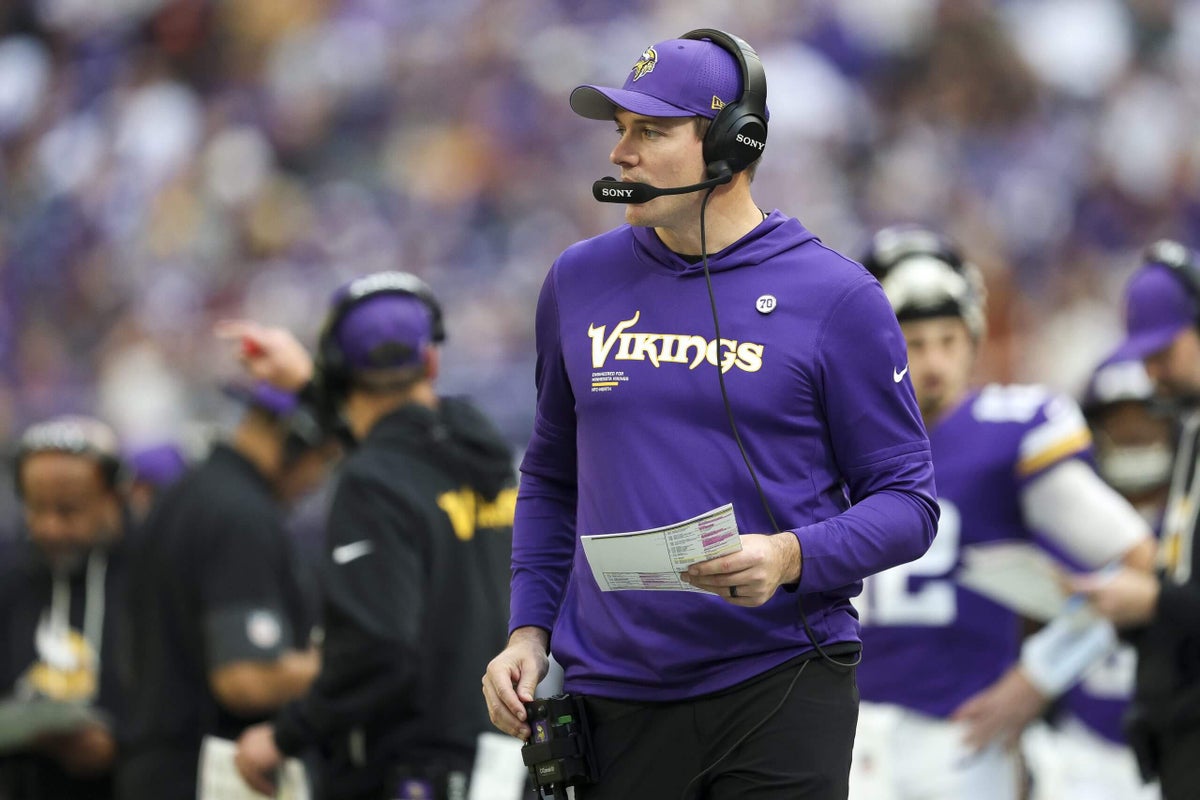
There is no gray area with the Minnesota Vikings offense. Head coach and play caller Kevin O’Connell prefers a vertical passing game.
One reason for this is his background as an NFL quarterback and passing game coordinator. The style fits the lens through which O’Connell sees offensive football.
Another aspect is the makeup of Minnesota’s roster. When you have a receiver who can play a bevy of positions and run all branches of the route tree — when Justin Jefferson is the face of your franchise — you don’t have much of a choice.
Everything flows from this bent. It informs roster construction. It affects how the team spends practice time. Had the Vikings never proven that this approach works, that’d be one thing. But they have. From 2022 to 2024, only six teams generated explosive passes at a higher rate. Only five teams won at a higher clip.
The challenge for O’Connell and the team in 2025 has been transitioning to a less potent formula with a smaller margin for error. A scheme that’s less explosive, but more efficient. Sunday’s result against the Commanders established this as a viable strategy, which has always seemed a wise approach with young quarterback J.J. McCarthy as the starter. It also underscored the need for this formula to be sustainable.
“You have to have a pretty unique plan,” O’Connell admitted Monday.
It does not feel too simplistic to say that the Vikings toggled between two worlds against Washington. On early downs, they utilized heavy personnel. Bigger bodies meant more mass to move men up front in the run game.
On late downs, the Vikings shifted to a more spread attack. McCarthy lined up in the shotgun on more than 80 percent of the third-down snaps. The setup provided him with a clear vision of where to attack.
For all of this to work as effectively as it did, it helped that Minnesota was facing a defense as porous as Washington’s. The Commanders’ front isn’t dominant against the run. They don’t apply pressure via exotic blitzes like Macdonald had the week before. And their secondary is not reliable, which prevents Commanders coach Dan Quinn from mixing coverages or playing his patented man coverage.
Washington was 28th in the NFL in pass defense and 21st against the run before the matchup, according to DVOA, an all-encompassing efficiency metric that includes strength of schedule. Any accurate assessment of the Vikings’ progress must account for the level of competition they faced.
But other factors helped bring Minnesota’s plan to fruition.
The starting five offensive linemen played together throughout the game for the first time this season. Left tackle Christian Darrisaw, left guard Donovan Jackson, center Ryan Kelly, right guard Will Fries and right tackle Brian O’Neill had shared the field for a total of 35 snaps over the first 13 weeks. They played 49 snaps together Sunday.
Minnesota’s defense also created three turnovers, increasing the team’s lead and making it easier to stick to the run game. The Vikings had only played 128 offensive snaps with a lead in the first 13 weeks. They played 54 on Sunday.
And McCarthy placed the ball on target and in rhythm. His 4.3 percent off-target rate was the lowest of his career, and he did not commit a turnover-worthy play in a game for the first time.
“When you’re trying to make the game plan friendly for the quarterback,” O’Connell said, “it’s (still) NFL football. There are a lot of layers to it, and the word simplification and all of that is getting thrown out. If it were that simple, I’d probably get a lot more rest throughout the week.”
This seemed to be the coach’s way of rejecting the idea that the team had suddenly and dramatically altered the offense. To his point, Minnesota motioned at a rate comparable to previous weeks. A few of the Vikings’ passing concepts in the game were new. Many of them asked McCarthy only to read one side of the field, just as they had in prior games.
When the Vikings beat the Detroit Lions in Week 9, they similarly played with a lead and ran the football. McCarthy was less effective that day on third down, but the simplicity of the systems in both games had features in common.
On Sunday, O’Connell described McCarthy’s first touchdown pass as a completion of the “four verticals concept,” a route distribution often installed early in the spring. Interestingly, Jefferson mentioned a third-quarter pass attempt the team drew up on the sideline to attack a particular coverage.
The play resulted in a 16-yard scramble from McCarthy. But had he maintained his balance and eye position in the pocket, he could’ve launched a wide-open deep ball down the right sideline. Fortunately, the Vikings dispatched of the Commanders early enough for this miss not to matter.
It does, though, make you wonder: Would this style work against a more menacing defense? Remove the downfield heaves, and two things happen: execution becomes paramount, and converting on third down becomes a necessity.
O’Connell knows this. It’s part of the reason he settled on his offensive identity in the first place. Perhaps the Vikings can spend their final four games working toward a middle ground — a developed trust in McCarthy to push the ball over the middle, without losing sight of the recipe that has worked.