
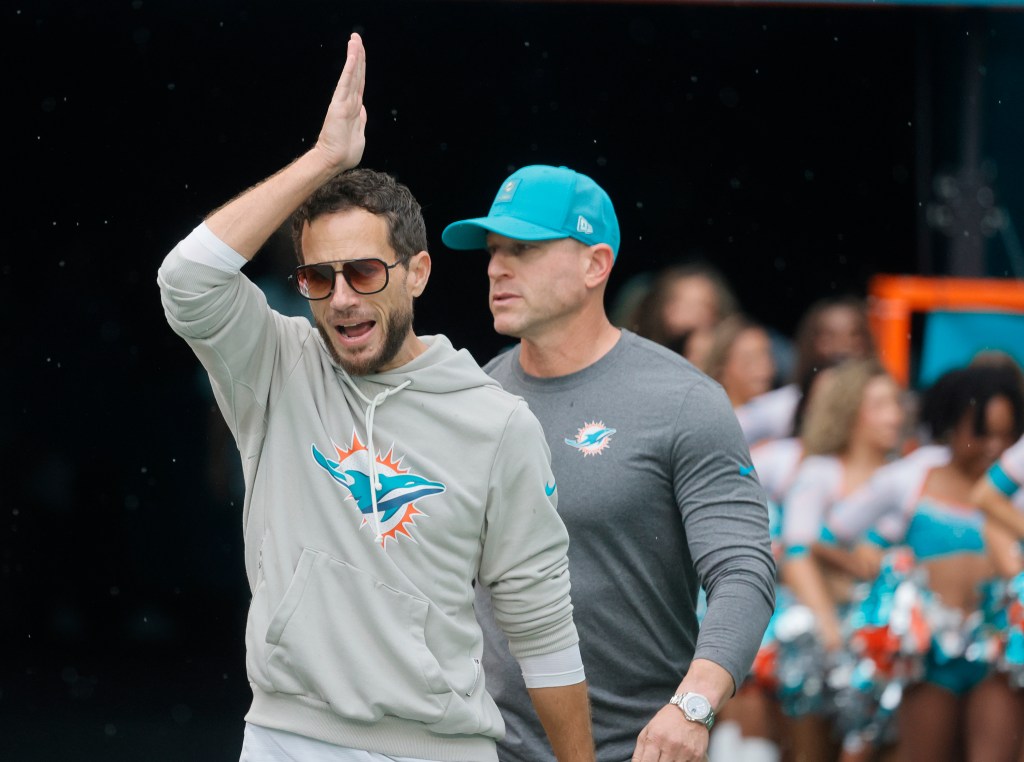
MIAMI GARDENS — Earlier this season I wrote that Dolphins coach Mike McDaniel shouldn’t return in 2026. The main reasons were because there was no change in offensive strategy or philosophy, and it appeared another season of mediocrity/status quo was underway. It appeared that after four seasons there wasn’t going to be significant improvement. I stand behind that 100 percent.
But now positive changes have been made. This team has a new identity. The new-school Dolphins (6-7) are on a four-game winning streak and have won five of their last six games because they’re playing old-school football — run game and defense. That’s right. That fancy, big-play, highlight reel-making, social media-friendly passing game is gone. This is a hard-working, blue-collar, grinding Dolphins team. Turnover margin is improved, penalties have decreased. I like this new identity.
Plus, there’s harmony in the administrative building, and players never quit after an 0-3 and 1-6 start.
But if McDaniel returns, which seems likely, you have to ask whether it’d be another prime example of the Dolphins celebrating the status quo after owner Stephen Ross said status quo isn’t good enough.
Ross greatly values process. And McDaniel is winning Ross over in that area.
So, in a way McDaniel’s return comes down to process vs. results.
At some point, results must matter. This is the NFL. It’s a results-based business.
Will McDaniel’s results in the problem areas — winning December/January games (8-10 regular season record; 1-0 this season), winning December-January road games (3-7 regular season; 1-0 this season), defeating playoff-caliber teams (4-16 entering the season; 1-3 this season) — merit a return for a fifth season?
McDaniel’s biggest saving grace to return, aside from Ross really liking his process, might be his shift to the run-based offense.
In that respect, the season-ending knee injury to Tyreek Hill was the best thing that happened to Miami’s offense. It forced the resurgent Dolphins to rely on the run. And the run is providing late-season hope and optimism.
If McDaniel commits to sticking with this run-first offensive system, I’d be open to his return.
But it’s not that easy.
Let’s face facts. The likelihood is that this season will result in mediocrity.
They’re most likely not going to win a playoff game.
They’re probably not going to earn a playoff berth.
They might not have a winning record.
They might not have a winning record vs. playoff teams.
Here’s what we know: if the Dolphins finish 9-8, McDaniel will have a 37-31 (.544) regular-season record, 37-33 (.529) including playoffs. In four years, he’d have two nine-win seasons and an eight-win season, along with two winless playoff appearances.
That’s Miami’s status quo the past two decades.
Earlier this season, I also wrote that this house of cards seemed on the verge of collapse. But the discovery of — and reliance — on the run game has brought the Dolphins back from the brink of destruction.
The big question is why did it take so long?
“You don’t all of a sudden desire and then understand the value of running the football,” McDaniel said Monday after I asked him about the recent commitment to the run game and what role Tyreek’s absence plays.
“You’re always intending to, but there’s a stark contrast when you’re able to do that and move the ball and score points. When your offensive line has the conviction based upon hours and hours and hours and hours of training and skill set, a run means something different.”
On Monday, McDaniel also stated something that I’ve been yelling for two years: “Eventually you have to succeed at something that people know it’s coming. There’s no tricky way or one player that can make you be productive when they’re preparing for it.”
You know what I’ve said about the previous Dolphins offense: the big-play passing offense was about two things — Tyreek and the threat of Tyreek. It was one-dimensional, predictable and easy to shut down. That’s not the case for the run-based offense.
We’ll know more about the upstart run game in a month. New England, who Miami plays in the season finale, is No. 3 in the league in run defense (89.5 ypg), and Tampa Bay, who Miami plays the week before New England, is No. 8 (100.6 ypg).
Right now, however, the run offense is more reliable than the Tyreek-based deep passing offense. The Dolphins can execute the run game more effectively against teams that are expecting the run. They have more success running against an eight-man front with De’Von Achane than they did throwing against a two-deep safety scheme with Tyreek and fellow speedy wide receiver Jaylen Waddle.
You might recall that I liked last season’s dink-and-dunk offense better than the big-play passing game. If/when McDaniel returns, the run-based offense must remain a fixture, a foundational piece. That should be non-negotiable. That unreliable big-play passing game must remain in the past.
I always said the Dolphins’ offensive issues are bigger than quarterback Tua Tagovailoa. They’re about strategy and philosophy. Strategic and philosophical changes have been made. The offense appears stable.
With Miami’s offense presumably/hopefully stabilized, perhaps the focus can shift to a different aspect of McDaniel’s possible return, whether it’d be settling for the status quo.