
I have unofficially unveiled my 2026 NFL Mock Draft 1.0.0.5 (Beta)!
You’ve probably read that caption 15 times on your Twitter timeline over the past week.
Fear not; I’m here to make a mockery of the mock draft monotony.
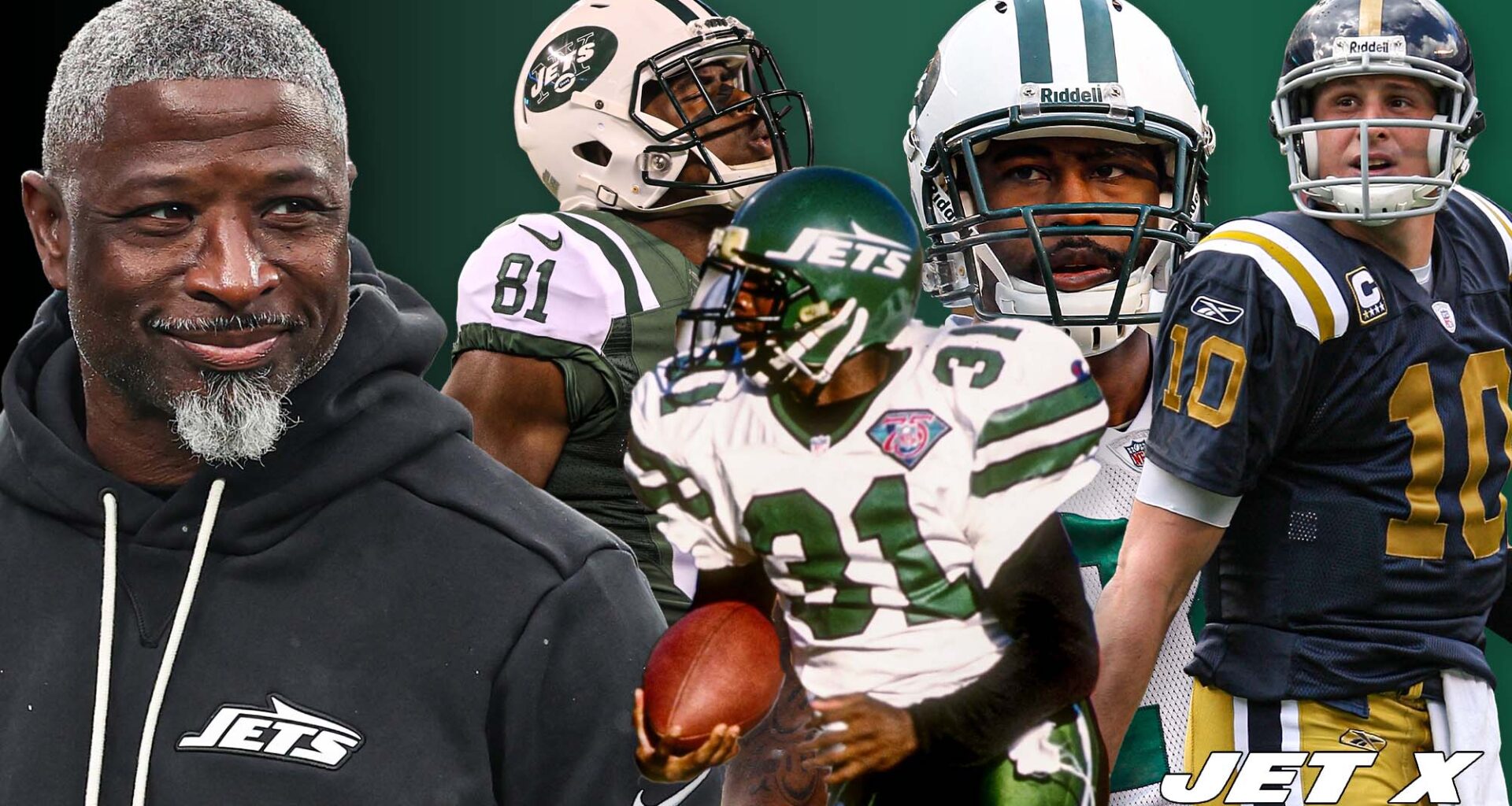
We’re still going to be doing a 2026 Jets mock draft, but with a twist: They can only select Jets draft picks from throughout franchise history.
The rules are simple:
At each of the Jets’ draft slots from rounds 1-4, they may only select a player chosen at that slot or within the following 10 slots (i.e. at pick No. 7, the Jets can choose a player formerly chosen by the Jets from Nos. 7-17)
From rounds 5-7, the pool expands to 15 slots up or down the board (i.e. at pick No. 194, the Jets can pick someone chosen from Nos. 179-209)
The idea is that we are building around the Jets’ current needs as they enter the 2026 offseason. Imagine that we are traveling back in time, intercepting these players on draft day, and bringing their rookie variants into the present day. (They would likely be shell-shocked by the supernatural experience, but let’s assume they’d acclimate just fine and resume on their normal career trajectories.)
So, without further ado, let’s hop straight into it. Make sure to subscribe and smash that like button.
Wait, hang on; there actually is further ado! I haven’t laid out the Jets’ draft picks yet!
We’ll be using the Jets’ projected draft picks as displayed by Tankathon, which also includes predictions for compensatory picks. That brings New York to a total of 12 draft picks:
Round 1, Pick 7
Round 1, Pick 18 (via Indianapolis)
Round 2, Pick 38
Round 2, Pick 47 (via Dallas)
Round 4, Pick 104
Round 5, Pick 177 (compensatory projection)
Round 6, Pick 194 (via Baltimore)
Round 7, Pick 218 (via Tennessee)
Round 7, Pick 239 (via Buffalo from Cleveland)
Round 7, Pick 253 (compensatory projection)
Round 7, Pick 255 (compensatory projection)
Round 7, Pick 257 (compensatory projection)
Note: Tankathon displays the Jets as having three sixth-round picks, but they actually have one; they’re due to send out two of the three via their trades for Harrison Phillips and Jarvis Brownlee. However, since it has yet to be reported which two sixth-rounders the Jets are giving up (among their three incoming sixth-rounders from Baltimore, Buffalo, and Denver), Tankathon continues to display all three sixth-rounders in the Jets’ possession, but the Jets only possess one of those; we just don’t know which. For the sake of this article, I have them keeping the highest projected pick, coming from Baltimore.
Okay, now there is no further ado.
Round 1, Pick 7
We would love to take a quarterback here. Unfortunately, our only quarterback option here is John Huarte, who the Jets chose 12th overall in the 1965 AFL Draft.
Huarte, a Heisman Trophy winner at Notre Dame, was beaten out in a quarterback competition by some guy named Joe Namath, and Huarte never played a down for the Jets. He finished his pro football career with one touchdown and five interceptions across 24 AFL and NFL games.
Luckily, we are left with plenty of tantalizing options outside of the quarterback position. The idea of Aaron Glenn coaching a younger version of himself (chosen eighth overall in 1994) is fascinating. We could go with defensive standouts like John Abraham, Shaun Ellis, and Sheldon Richardson, or we could even run a dual-Garrett Wilson offense.
It would be foolish, though, to pass up on the 14th pick of the 2007 NFL draft: Darrelle Revis.
Cornerback isn’t the Jets’ most gaping weakness right now, but it’s far from a strength. Their top cornerback, Brandon Stephens, has allowed six touchdowns to no interceptions in his lone season with the team.
Although Stephens has been mostly solid outside of his TD:INT ratio, the Jets need a game-shifting playmaker in their secondary after setting the NFL record with 13 straight interception-less games, and Revis Island can immediately help with that. Revis had three interceptions as a rookie and 14 over his first three seasons.
The pick: Darrelle Revis, CB, Pittsburgh
Round 1, Pick 18
After nabbing a shutdown corner with our first selection, the draft board falls perfectly for us. The Jets have two intriguing quarterback options at No. 18.
Neither prospect projects as a future Hall-of-Famer, but both are steady, high-floor passers who should be able to lead sustained success.
Our choices: Ken O’Brien (24th overall in 1983) and Chad Pennington (18th overall in 2000).
O’Brien and Pennington led the Jets to three playoff appearances apiece, tied for the franchise record among starting quarterbacks. Neither player made a case for Canton, but they were above-average starters in their primes.
From 2002 to 2007, Pennington had an 88.8 passer rating, placing eighth-best among the 33 quarterbacks with at least 1,000 pass attempts over that span. O’Brien had an 81.8 passer rating from 1985 to 1991, also placing eighth among quarterbacks with at least 1,000 passes over that span.
It’s a tough call, but we’re going to take O’Brien, as he offers a better track record of durability than Pennington.
The pick: Ken O’Brien, QB, UC Davis
Round 2, Pick 38
The Jets’ defense badly needs two things: physicality and pass-rush juice.
David “The Hitman” Harris (47th overall in 2007) would bring the former, but we’ll get both from Arizona State’s Mark Gastineau (41st overall in 1979).
A four-time All-Pro with 107.5 career sacks, including three seasons of 19-plus takedowns, Gastineau would rejuvenate the Jets’ dismal pass rush. It might not happen right away, as Gatineau had two sacks in his rookie year, but he leaped to 11.5 in 1980 and ascended to 20 in 1981.
The pick: Mark Gastineau, DL, Arizona State
Round 2, Pick 47
David Harris wasn’t the BPA at No. 38, but he’s still on the board here, as the Jets took him 47th overall in 2007. It’s an appealing idea to nab The Hitman as a continuation of our defensive revamp.
New York’s linebackers have been among the team’s most disappointing position groups in 2025. Jamien Sherwood and Quincy Williams were among the league’s most productive duos in 2024, but both players have struggled this year. They’ve been consistently exploited in the pass game and are getting thumped on the ground.
Would Harris be the right fit, though?
Harris, who was listed at 6-foot-2 and 250 pounds, was already considered a “thumper” by the standards of his era, one defined by physical linebackers. Almost two decades after he was drafted, the NFL is an entirely different league. In an effort to keep up with today’s horizontal offenses, linebackers are smaller and more athletic than ever, and yet, they are still the primary target of opposing offenses.
Harris might bring a renewed sense of physicality and toughness to the Jets’ defense, but teams like Miami would have a field day throwing passes over his head after getting him to bite on play fakes. For that reason, we’re going to make the unpopular decision to pass on the Michigan product.
Unfortunately, it leaves us with slim pickings, as the Jets have been ice-cold in this range of the draft. The 24 players selected by the Jets in the 47-57 range have combined to make just one Pro Bowl, which was earned by Justin Miller as a returner in 2006. A returner is the absolute last thing New York needs right now, though.
The best we can do here is to add a dependable complementary running back in Johnny Hector, who was chosen 51st overall out of Texas A&M in 1983. Hector played all 10 of his NFL seasons for the Jets, amassing 4,280 rushing yards, 41 rushing touchdowns, 1,661 receiving yards, and three receiving touchdowns. In 1987, he tied for the NFL lead with 11 rushing touchdowns.
The Jets need all of the offensive weapons they can get, regardless of position.
The pick: Johnny Hector, RB, Texas A&M
Round 4, Pick 104
This is a tough call between two players who would certainly boost the Jets’ offense: Jason Fabini (111th overall in 1998) and Jerricho Cotchery (108th overall in 2004).
Fabini started 114 games at tackle for the Jets across eight seasons, helping the team achieve four playoff appearances and six seasons with a .500+ record. He never made any Pro Bowl appearances or All-Pro teams, but he was a consistently durable and reliable starter for the Jets during one of their most successful eras.
Cotchery played 103 games across seven seasons in green, catching 358 passes for 4,514 yards and 18 touchdowns.
The Jets need a wide receiver more than a tackle. They already have the tackle spots locked down with Olu Fashanu and Armand Membou, while Garrett Wilson is still begging for help with three rounds of the draft in the rearview.
Cotchery, though, may take time to develop. Through two NFL seasons, he caught only 25 passes in 28 games. Cotchery didn’t catch his first touchdown until his third season, when he finally broke out with 961 yards and six touchdowns.
Fabini, meanwhile, could immediately provide the Jets with quality depth at a premium position. He started all 16 games as a rookie.
The Jets need players who are ready to support their rookie quarterback—it’s Ken O’Brien in this fantasy scenario, but this could be their scenario in real life.
It’s enticing to force the “need” pick and go with Cotchery, but we’re going to take Fabini, the best player available and the one with the best chance to help our young quarterback immediately. Yes, he’d be a backup on the initial depth chart, but injuries happen frequently at tackle, and we must be prepared. It would be immensely valuable to have a strong backup plan instead of letting our rookie quarterback develop scars because a turnstile tackle is sinking the offense.
Fabini also played guard in high school and late in his NFL career, so the Jets could also try him out at that position if they want to get him on the field right away. With John Simpson headed for free agency, the Jets might have a hole at guard entering the draft.
We’re prioritizing stability in the trenches with this pick.
The pick: Jason Fabini, OL, Cincinnati
Round 5, Pick 177
After nabbing the most famous member of the New York Sack Exchange in the second round, we nab its most unheralded member in the fifth round, Abdul Salaam (188th overall in 1976).
The Kent State product will bring much-needed depth to the Jets’ defensive line, ending the days of practice squad-level players logging significant reps.
The pick: Abdul Salaam, DL, Kent State
Round 6, Pick 194
I thought long and hard about taking a second chance on Quincy Enunwa, the 209th overall pick in 2014 out of Nebraska.
Enunwa flashed a tantalizing ceiling in New York, displaying a unique blend of physicality and athleticism. Unfortunately, injuries did him in, with those ailments primarily stemming from his head-down play style. Perhaps with a second roll of the dice and better coaching to control his health, Enunwa could fulfill his potential and become the long-term WR2 next to Garrett Wilson.
It’s too much of a risk, though. We need dependable, proven prospects, and that’s why we’re doubling down on our offensive line fortification with the selection of Dan Alexander (200th overall in 1977).
The LSU product played all 13 of his NFL seasons for the Jets, logging 183 starts at right guard. He is sixth on the franchise’s all-time games played list (192) and ranks ninth in approximate value (95), a metric from Pro Football Reference that attempts to estimate a player’s cumulative impact.
Two of the Jets’ starting offensive line spots are set to open up this offseason, with left guard John Simpson and center Josh Myers headed for free agency. Simpson and Myers have been the two weakest links, anyway. If the Jets want to set their sights on having a dominant offensive line, not just a “pretty good” one, they will look to upgrade over Myers and Simpson.
We shall see if they attempt to do that in real life. Here, though, we’re doing it by putting Fabini and Alexander alongside Olu Fashanu, Joe Tippmann, and Armand Membou, building a potentially league-best offensive line heading into 2026.
Obviously, this exercise is just for fun, but it’s exciting to think about what the Jets’ offensive ceiling could look like if they make this type of all-in commitment toward constructing an elite offensive line.
The pick: Dan Alexander, OL, LSU
Round 7, Pick 218
Well, after passing on Enunwa for Alexander, the door is still open to take him with the early seventh-round pick New York received in the Jarvis Brownlee trade, so we’ll go ahead and give Enunwa his second chance.
The pick: Quincy Enunwa, WR, Nebraska
Round 7, Pick 239
Adding more beef to a thin front-seven, we’ll gladly take defensive tackle Jason Ferguson (229th overall in 1997), who racked up 374 tackles and 20.5 sacks across 101 games (83 starts) with the Jets.
The pick: Jason Ferguson, DL, Georgia
Round 7, Pick 253
Choices are getting slim at this point. But I’m sure Chris Banjo would pound the table for Antonio Allen (242nd overall in 2012), an active playmaker for the Jets’ special teams across his four seasons in New York. Plus, who could forget his pick-six of Tom Brady in 2013? The Jets could desperately use one of those off Drake Maye right now.
The pick: Antonio Allen, S, South Carolina
Round 7, Pick 255
On their knees at the gateways of football heaven, begging for takeaways, the Jets’ defense could get a much-needed kick in the rear end from John Booty (257th overall in 1988).
The defensive back from TCU delivered three interceptions and two fumble recoveries in his rookie year, and he remains one of just three Jets rookies to record three-plus interceptions and two-plus fumble recoveries (along with 1985 rookie Kerry Glenn and fellow 1988 rookie James Hasty).
Booty was also a solid special teams player across three years with the Jets. We know that special teams are a priority for the Jets; look for them to covet players with special teams upside at this part of the draft in real life.
The pick: John Booty, DB, TCU
Round 7, Pick 257
Wrapping up our draft class, we add a little more help for the offense in David Knight (272nd overall in 1973), an underrated wide receiver from the Jets’ early years.
Playing all five of his NFL seasons with the Jets, Knight caught 73 passes for 1,189 yards and seven touchdowns. In 1974, a rare season in which Joe Namath started every game for New York, Knight was the Jets’ most productive wide receiver, leading the position group with 579 receiving yards and four touchdowns. Namath’s favorite target, though, was tight end Rich Caster, who racked up 745 yards and seven touchdowns.
The 1974 Jets missed the playoffs at 7-7, but Knight contributed to an explosive passing offense, which finished fifth-best in the league (out of 26 teams) with 174 passing yards per game. It was the Jets’ last top-five finish in passing yards until 1998, which, to this day, remains their most recent top-five finish.
The pick: David Knight, WR, William & Mary
Complete draft class
Round 1, Pick 7: Darrelle Revis, CB, Pittsburgh
Round 1, Pick 18: Ken O’Brien, QB, UC Davis
Round 2, Pick 38: Mark Gastineau, DL, Arizona State
Round 2, Pick 47: Johnny Hector, RB, Texas A&M
Round 4, Pick 104: Jason Fabini, OL, Cincinnati
Round 5, Pick 177: Abdul Salaam, DL, Kent State
Round 6, Pick 194: Dan Alexander, OL, LSU
Round 7, Pick 218: Quincy Enunwa, WR, Nebraska
Round 7, Pick 239: Jason Ferguson, DL, Georgia
Round 7, Pick 253: Antonio Allen, S, South Carolina
Round 7, Pick 255: John Booty, DB, TCU
Round 7, Pick 257: David Knight, WR, William & Mary