
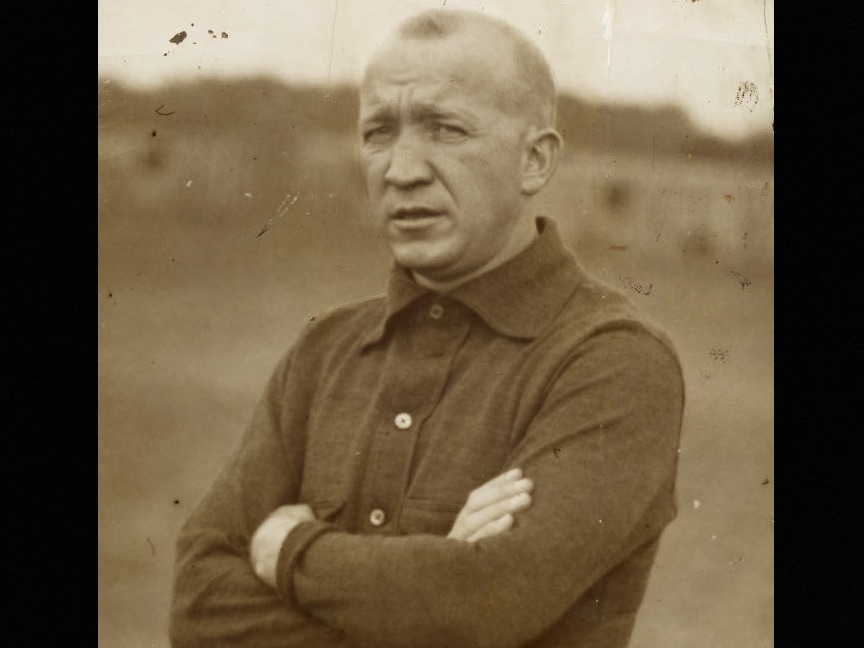
If you’re a fan of college football or the University of Notre Dame (or both), the last few weeks have provided a lot of reading material—and perhaps some rage material as well, as the Fighting Irish were left out of the College Football Playoff, costing them a chance at their first national title since 1988. The team announced in the aftermath it would forgo any bowl appearance at all this season, which caused its own controversy.
All that news may be why the 1940 film, “Knute Rockne: All American,” can seemingly be found on every streaming service these days. The film has the status of a classic, though one might be forgiven for thinking it’s not a whole lot better than “Rudy” in its sheer craven Golden Dome boosterism. America’s reviewer couldn’t get enough in 1940, claiming that “Hollywood has filmed the lives of weightier historical characters than Knute Rockne, but it is to be doubted that it has ever before got closer to humanity in its nobler aspects.”
Well, maybe. You’ll still cry when Ronald Reagan asks that they “win one for the Gipper,” anyway. Even if some biographers say Rockne made the whole story up.
What’s this?! Blasphemy to a certain portion of the American Catholic populace, I know, for whom Rockne remains a mythic figure—the founding father of the legend of the Fighting Irish. But stories about secular saints tend toward, well, the hagiographic.
Born in Voss, Norway, in 1888 to Lutheran parents (he would become Catholic in 1925), Knute Rockne came to the United States with his family in 1903 and grew up in Chicago, where he learned to play football. He did not begin college until he was 22, but starred for the University of Notre Dame in both football and track.
Graduating in 1914 with a degree in pharmacy, Rockne played professional football for several years, helping popularize the forward pass, though the sport had little of the cachet of today’s National Football League. In 1918, Rockne (who had served as an assistant coach during his senior year), took over as head coach at Notre Dame.
Over Rockne’s 13 seasons at the helm, the Fighting Irish would win 105 games, bringing home five undefeated seasons and three national championships (in 1924, 1929 and 1930). Among some of the legends Notre Dame produced under Rockne (who turned out to be a master promoter and a friend to many reporters) were George Gipp of the aforementioned movie fame; the “Four Horsemen” backfield of 1924, made famous by sportswriter Grantland Rice; and more than 30 players who would go on to become head coaches themselves, including one of Rockne’s successors, Frank Leahy.
“Rockne cultivated a nationwide fan base, in part based on his success; a century later he still holds the record for the highest winning percentage in the history of college football,” wrote Rachel Lu in America in 2019. Rockne’s impact, however, extended well beyond the field of play in an era when anti-Catholic bigotry was still very much a part of American life. “His Fighting Irish did much to revolutionize a great American sport, but the Notre Dame tradition is about more than stopping the wishbone offense or perfecting the forward pass,” Lu continued. “It is about surviving and thriving as a minority in a nation that is not always as hospitable as we might hope.”
At the peak of Rockne’s fame, however, tragedy struck: While on a flight from Kansas City to Los Angeles in March of 1931 to promote a forthcoming film, “The Spirit of Notre Dame,” Rockne’s plane crashed, killing all aboard. The grief extended far past the school. Over 100,000 mourners turned out for Rockne’s funeral procession before his funeral at the university’s Basilica of the Sacred Heart; headlines around the nation told the story of the crash; and U.S. President Herbert Hoover sent Rockne’s wife a public telegram saying “his passing is a national loss.”
To give a sense of Rockne’s importance to the American Catholic psyche at and after his death, consider this: America reviewed no less than five different books about Rockne between 1931 and 1932. While some, reviewers admitted, were rushed to print and a bit sloppy, another reviewer hailed an author’s thesis that “Rockne was a creative man builder and a perfect Christian gentleman” who had helped make Notre Dame such a beacon of Catholic education.
The editors weren’t always as positive: In an article on deficiencies in college education two years before Rockne died, America editor in chief Wilfrid Parsons, S.J., related a supposed quip from Rockne that, because his athletes had endured so many injuries, he “might have to play some students in his next game.” Not everyone, it seems, was impressed at the academic prowess of Notre Dame recruits.
Notre Dame football would enjoy continued success in the decades after Rockne, and in some ways become even bigger than in his day. In 1994, two new books offered different views of Rockne, and indeed of the entire Notre Dame football tradition: Shake Down the Thunder: The Creation of Notre Dame Football, by Murray Sperber, and Under the Tarnished Dome: How Notre Dame Football Betrayed Its Ideals for Football Glory, by Don Yaeger and Douglas S. Looney.
In a double review for America that year, Christopher Devron, S.J. (an alumnus of Notre Dame), noted that while Sperber gave Rockne credit for perfecting “the forward pass, the backfield shift and downfield blocking,” there was a lot else to the coach that “had little in common with the hagiographical character seen in the film ‘Knute Rockne—All American.’” Among the charges put forth by Sperber were that Rockne bet on games, gave sports writers jobs as game officials, recruited players with promises of summer jobs and used players who flouted N.C.A.A. regulations on amateur status.
Yaeger and Looney, on the other hand, held up Rockne as the morally upright counterpoint to the supposed depravity of the Lou Holtz years at Notre Dame. Their frequent references to Rockne, Devron wrote, “suggest they have naively bought the myth that he was a saint of his times who was the conscience of the sport.” Don’t credit Rockne with Notre Dame’s institutional successes, Devron cautioned, and don’t blame him for all its failures.
There is a larger-than-life statue of Knute Rockne outside Notre Dame’s football stadium now. There’s a matching one in his hometown in Norway. There’s even a town in Texas named Rockne.
One final personal note: Rockne, it turns out, had a small connection with my own alma mater. Loyola University, in Los Angeles (now Loyola Marymount University), had moved to a new campus in 1929 and had grand plans for their own football team to compete with U.C.L.A. and U.S.C. Judging from a letter from Rockne to the university president, Joseph Sullivan, S.J., in the school’s archives, Father Sullivan had asked if Rockne would be willing to trade snow for palm trees and take over Loyola’s program. In January of 1930, Rockne wrote back, saying “It will not be possible for me to consider any position for three years as that is the length of my contract still remaining here at the University. I expect to get out to California this spring and when I do I will certainly look you up.”
Rockne did visit the school later that year, and met with Loyola players and coach Tom Lieb, who had previously been Rockne’s assistant at Notre Dame. And a decade later, a fictional Rockne did coach briefly at the school, whose Sullivan Field served as a filming location for the aforementioned film: “Knute Rockne: All American.”
•••
Our poetry selection for this week is “Advent Poem,” by Leo J. O’Donovan, S.J. Readers can view all of America’s published poems here.
Other recent Catholic Book Club columns:
Happy reading!
James T. Keane
Related