
The roots of the Bears’ rebuild that has them in position to “take the North” — possibly this weekend — after a disastrous 2024 season of discombobulation are pretty easy to trace:
• Lovie Smith’s Texans beating the Colts in Week 18 in 2022 to give the Bears’ the No. 1 pick in the 2023 draft.
• General manager Ryan Poles parlaying that pick into a haul from the Panthers that ultimately included the 2024 No. 1 overall pick the Bears used to get quarterback Caleb Williams, but also wide receiver DJ Moore, right tackle Darnell Wright, cornerback Tyrique Stevenson, punter Tory Taylor and wide receiver Luther Burden.
• The presence of Williams at quarterback being arguably the biggest lure in hiring Lions offensive coordinator Ben (“I want this job”) Johnson, the hottest coaching prospect in the 2025 hiring cycle.
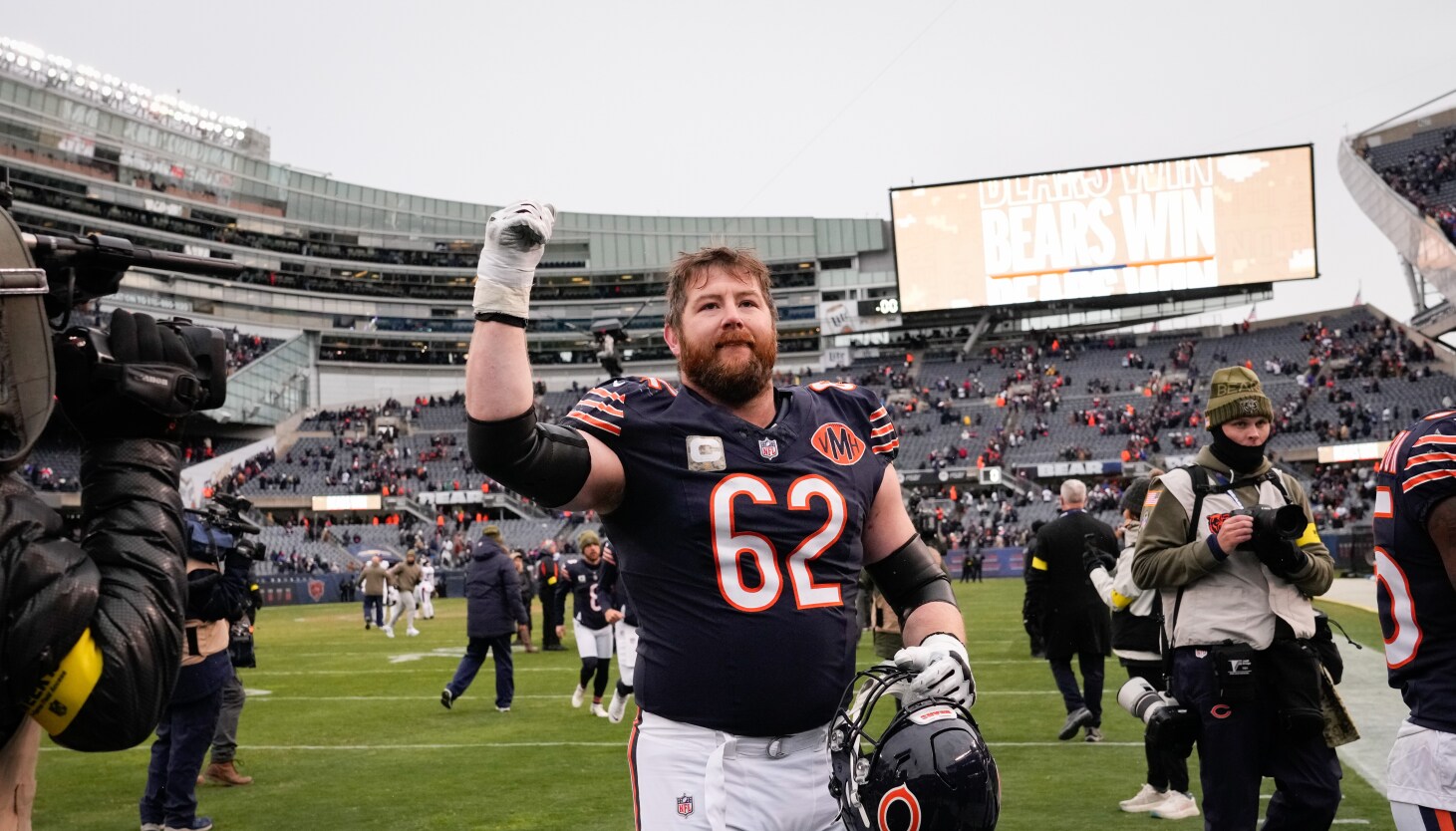
But after those three cornerstone events, the acquisition of All-Pro guard Joe Thuney in a trade with the Chiefs last offseason ranks as the biggest move by Poles that has accelerated the rebuild. Thuney has been as good as advertised. He’s not only playing at an All-Pro level at 33 and — knock on wood — playing virtually every snap this season, but in his own understated manner has provided leadership that has invigorated the offensive line as a unit and the offense, as well.
The acquisition of Thuney was as fortuitous as it was deft for Poles. Thuney was at the top of his game in 2024, but the Chiefs were in a salary-cap crunch and prioritized 26-year-old right guard Trey Smith. They signed Smith to a four-year, $94 million extension with $70 million guaranteed.
And with Thuney on the trading block, Poles’ relationship with Chiefs general manager Brett Veach, his former boss, as the Chiefs’ assistant director of player personnel likely put Poles first in line for a sweet deal — the best guard in the NFL for a fourth-round draft pick. What are friends for?
Poles made the deal even better by signing Thuney to a two-year, $35 million extension through the 2027 season, when Thuney will be 35. To get a player of Thuney’s caliber without overpaying on any level is pretty rare.
The Thuney upgrade was particularly notable Sunday against the Browns, with former Bears guard Teven Jenkins — the player Thuney replaced — starting for the Browns.
Jenkins represented the tough luck that has hampered every Bears general manager from Jerry Angelo to Poles in the post-Mike Ditka era — a good draft pick (No. 39 overall in the second round by Ryan Pace in 2021) who should have been a foundational player but couldn’t stay healthy. He missed 24 games in his four seasons. In his 38 starts, he left with an injury 12 times.
Thuney has upgraded the position on multiple fronts — ability and dependability. He stands with Johnson and Williams as a symbol of changing fortunes at Halas Hall.
2. Thuney’s presence has coincided with a big upgrade in continuity on the offensive line — another factor in the Bears’ success. In the Bears’ last 10 games, Thuney, center Drew Dalman, right guard Jonah Jackson and right tackle Darnell Wright have played 96.7% of the offensive snaps (621 of 642).
And while the Bears have used three players at left tackle this season, the transition from Braxton Jones to Theo Benedet to rookie Ozzy Trapilo has been virtually seamless, with the replacement as good or better than the previous starter. Playing next to Thuney is probably a factor in that.
3. Interceptions by linebacker D’Marco Jackson and cornerback C.J. Gardner-Johnson against the Browns highlighted another factor in the Bears’ success — uncanny depth. Backups Nahshon Wright (nine), Gardner-Johnson and Jackson have combined for 13 of the Bears’ league-leading 30 takeaways this season.
And those three are replacements for three of the Bears’ best defensive starters — All-Pro cornerback Jaylon Johnson, slot cornerback Kyler Gordon and linebacker Tremaine Edmunds.
4. Poles’ batting average has increased significantly since hiring Johnson, but almost every batted ball is falling in. Free-agent defensive end Dayo Odeyingbo was underperforming in the first half of the season and suffered a season-ending Achilles injury against the Bengals in Week 9. But Austin Booker has been an upgrade as his replacement, with two sacks (one on the final play of the blowout against the Browns) and nine quarterback hits since Odeyingbo was put on injured reserve.
And Trapilo’s failure to win the left-tackle job in training camp left a hole at a key position. But after replacing an injured Benedet against the Steelers, he has kept the job and is playing better with each game.
5. This is the Bears’ best season since 2018, when they went 12-4 to win the NFC North in Matt Nagy’s first season. But this team is in much better shape not only for a deeper postseason run if it makes the playoffs, but also for sustained success beyond this season.
The Bears’ running game in Johnson’s offense is a key difference. Led by D’Andre Swift and Kyle Monangai, Bears running backs are averaging 119.1 yards per game and 4.8 yards per carry — the most since the 2006 Super Bowl season with Thomas Jones and Cedric Benson, and the fourth-most since the Walter Payton era. In 2018, running backs, led by Jordan Howard and Tarik Cohen, averaged 88.4 yards per game and 3.8 yards per carry.
6. When Swift was in his first year in Johnson’s offense with the Lions in 2022, he struggled to play effectively through injuries, fell out of favor as Jamaal Williams thrived, had a career-low 99 rushing attempts for the season (down from 151 the previous season) and was traded to the Eagles in the offseason.
This year, Swift has played through injuries, continued to excel as rookie Kyle Monangai has emerged and is averaging a career high 71.4 rushing yards per game with seven touchdowns after rushing for 98 yards on 18 carries and scoring two touchdowns against the Browns. Swift has 191 carries for 935 yards in 13 games (4.9 average).
7. The Bears-Packers rivalry is one of the best in sports, but never better when the coaches have a contentious relationship and the teams face each other twice in a three-week span.
In 1985, Ditka’s Bears beat Forrest Gregg’s Packers 23-7 at Soldier Field, with William “The Refrigerator” Perry bull-dozing Packers linebacker George Cumby twice to pave the way for Walter Payton touchdowns, but the Packers were more miffed that the Bears took unnecessary shots at quarterback Lynn Dickey and called time out with 12 seconds left to set up a pass play with a 16-point lead.
Two weeks later, the Packers responded at Lambeau Field in one of the most memorably hostile games of the entire rivalry. Packers cornerback Mark Lee was ejected for shoving Payton out of bounds and over the Bears’ bench. And safety Ken Stills somehow was neither ejected nor arrested for a vicious cheap-shot late hit on Matt Suhey after a Payton run. There were six personal fouls in the first half alone.
The Bears won the game 16-10 and ended up winning the Super Bowl. The Packers finished 8-8 and didn’t make the playoffs for eight more years.
8. The Ben Johnson Effect: With two first-quarter touchdowns against the Browns, the Bears have outscored opponents 88-44 in the quarter this season, a plus-44 differential. Last year, they were outscored 92-27 in the first quarter, a minus-65 differential.
9. Josh McCown Ex-Bears Player of the Week: Ravens linebacker Roquan Smith had 14 tackles in a 24-0 victory over the Bengals.
10. Bear-ometer — 12-5: vs. Packers (W); at 49ers (L); vs. Lions (W).