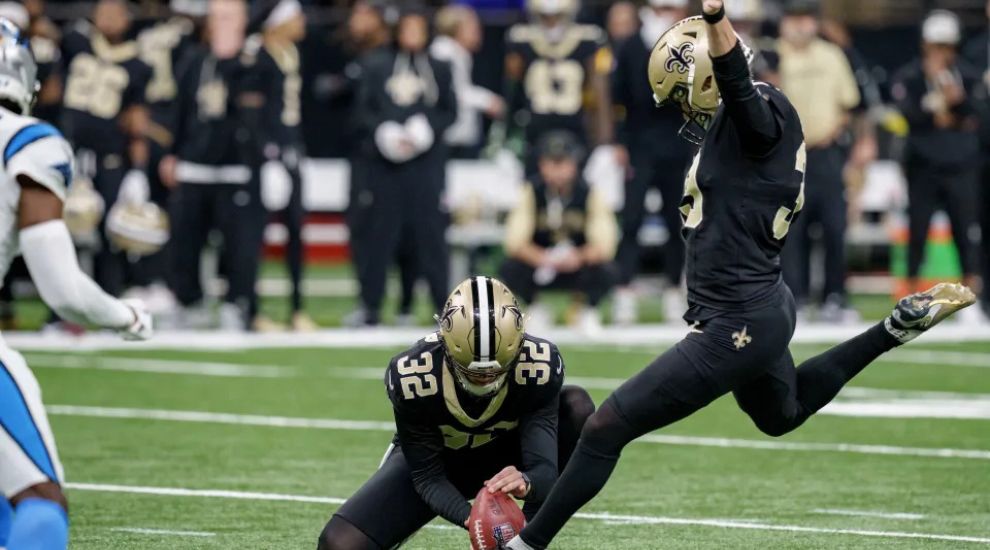

Charlie Smyth was smiling before he even knew he’d be needed.
With the clock ticking down in the fourth quarter at the Superdome on Sunday, New Orleans’ defence was still on the field, and the game was on the line.
Smyth, the New Orleans Saints’ young Irish kicker, was standing with his operation — long snapper Zach Wood and holder/punter Kerr Kroger — talking through nothing in particular, and everything that mattered.
“I had a feeling we were going to get the stop,” he said. Then, a laugh, shared between three specialists who know exactly how quickly their world can swing from quiet to decisive. “This is what we want, isn’t it?”
It wasn’t bravado. It was recognition. The past 18 months, Smyth explained, have been “a lot of quiet work in the background”. The glamour is the Sunday kick. The real job is the monotony that makes that moment feel familiar.
When the chance came, it arrived exactly as he’d pictured it — not as a test of nerve, but as the next step in a process he trusted. “Missing doesn’t even come into your mind,” Smyth said. “You just feel so ready for the moment.”
That’s the line that tells you what kind of transition this has been. Because in the NFL, a kicker can spend long spells watching, waiting, staying warm without draining the leg, staying loose without losing edge. Smyth knows the strangeness of that, coming from Gaelic football, where you are constantly involved, constantly in rhythm.
Over here, the rhythm is different. It’s built in the margins.
He described the week in New Orleans in practical detail: the Wednesday lift that turns the page to the next opponent, the meetings, the treatment, the careful management of a body repeating the same motion at high intensity. Specialists, he noted, have “a little bit more time to ourselves”, but that time isn’t downtime — it’s maintenance. “You really have to make sure your body’s right,” he said.
And then there’s the other adjustment, the culture of individual moments inside a team game.
In the GAA, celebration is shared but rarely personalised. In an NFL locker room, it can be pointed, loud, and unapologetic. After his game-winning kick, Smyth was handed the game ball. The room formed around him. The chant was his name.
For a young man from Ireland, it’s a scene that still feels slightly surreal. Smyth tried to put it back where he believes it belongs — in the collective work that created the chance.
“It’s not just the kick,” he said. The defence had to get the stop, Chase Young had to land the sack, the offence had to drive, and the coverage unit had to shape field position. Even on the play itself, Smyth’s first instinct was to credit the snap and hold, acknowledging the threat from Carolina’s block unit and the trust that lets a kicker swing freely.
That instinct matters, because the wider Smyth story is bigger than one kick. It’s about an emerging pathway and a rare skillset converting across codes, aided by the structure the NFL has put around international recruitment.
Smyth spoke warmly about the league’s International Player Pathway programme, and the small network of people who understand what it takes to make the jump.
He referenced calls and messages with staff and alumni — Paul Duffy, James Kirk, “Tag” and Dom — and the sense that this is no longer a novelty story but a growing pipeline. “Without the NFL’s initiative… I wouldn’t be here,” he said.
He’s also conscious of what comes next.
In the days after that kick, his phone “blowing up” with messages, Smyth described the balancing act between enjoying the moment and being honest about how quickly sport moves on.
“Unless I keep putting the ball through the uprights, then it mightn’t be so positive,” he said, with the matter-of-fact clarity of someone who knows this league has no long memory.
So the celebration was almost understated. Pizza back at the apartment with his mum, sister and girlfriend, “a few beers”, and the kind of tiredness that doesn’t settle easily. The mental energy, he admitted, lingers long after the final whistle. He joked about the post-game recovery routine — “sleepy tea and melatonin” — but the point was serious: the adrenaline of being responsible for the last act of a game isn’t something you simply switch off.
That’s the tightrope. In Ireland, the temptation might be to romanticise it — the Superdome, the noise, the scale. Smyth doesn’t dismiss that at all; he talked about standing for the anthem and looking around at a stadium that was “pretty much full”, the way the building “gets rocking” when the Saints are rolling, and what it feels like when the roar hits after you’ve done your job.
But then he pivoted, naturally, to what grounds him. “It’s hard to beat the 100 people standing on Mayo Bridge cheering you on after you hit a free,” he said, drawing a straight line back to the places and people that formed him. The platform is bigger now, but the meaning is still personal.
Perhaps the most revealing part of the conversation came when he was asked about doubt — the quiet moments of the last two years when he wasn’t on the field on Sundays, when the work stayed private and progress had to be self-measured.
Did he ever think about coming home?
“Not really,” Smyth said. Not because home doesn’t pull at him — he spoke about seeing his former teammates playing championship football and feeling that tug — but because he could see the trajectory. The sessions where he was kicking alone on a Monday, he admitted, could feel flat, “not… a competitive environment”. But he used them as discipline: stay ready, stay sharp, trust the craft.
In the Saints building, he says, that readiness has been recognised. There’s contract and roster stuff “going on in the background”, the hope of moving onto the 53-man roster, but Smyth keeps returning to the same point: control what you can control. “One kick at a time,” he said. “Owning that kick.”
It’s a simple sporting cliché until you hear it in context — from a player who has uprooted his life, changed his sport, and learned to live inside the NFL’s specialist paradox – not involved for long stretches, but judged forever on a handful of seconds.
And when those seconds come, the aim is not to feel the pressure. It’s to feel the familiarity.
Further Reading for Sport for Business members:
Read our Sport for Business Coverage of US Sport
SPORT FOR BUSINESS Upcoming Events



MEMBERSHIP AND EVENTS,
Aer Lingus and the College Football Classic, as well as all the leading sporting and business organisations in and around the world of sport, are among the 300+ members of the Sport for Business community.
This includes all of the leading sports and sponsors, as well as commercial and state agencies, individuals interested in our world, and an increasing number from beyond these shores taking a keen interest in Ireland.
Find out more about becoming a member today.
Or sign up for our twice-daily bulletins to get a flavour of the material we cover.
Sign up for our News Bulletins here.