
It doesn’t take a rocket scientist to look at this Saturday’s football schedule and identify which games viewers are more likely to flip on. But the severity of this weekend’s impending viewership blowout might inspire change in the College Football Playoff ranks.
As you probably already know, this Saturday is the closest thing we have to a Football Equinox. Both the College Football Playoff and the NFL will play vital games in competing television windows. It’s the second consecutive year this has happened, dating back to last season’s inaugural 12-team playoff.
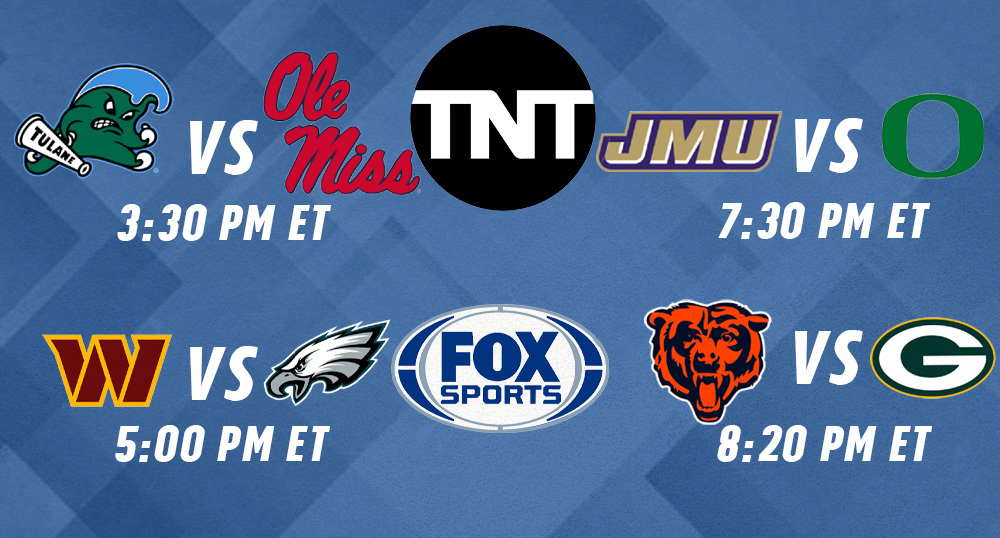
At 3:30 p.m. ET, Tulane and Ole Miss will kick off on TNT. After that, James Madison will take on Oregon at 7:30 p.m. Meanwhile, Fox will air an NFL doubleheader. Eagles-Commanders will start at 5 p.m., followed by Packers-Bears at 8:20 p.m.
With last season as our guide, these head-to-head matchups don’t exactly bode well for college football. The first two CFP games that aired directly against NFL competition last year, SMU-Penn State and Clemson-Texas, averaged just 7.5 million viewers on TNT. The NFL doubleheader, which featured the Texans-Chiefs and Ravens-Steelers games, averaged 15.45 million viewers across NBC and Fox, more than double the audience of the college games.
Things are slightly different this year. Last season, there was more overlap between the windows. The college games kicked off at noon and 4 p.m., while the NFL games started at 1 p.m. and 4:30 p.m. This year, the CFP will have a 90-minute head start rather than just an hour. And staggered start times could help end games at different times, allowing viewers to flip back and forth if desired.
That’s about where the good news ends for college football, however. The problem this year is game quality.
Both games competing with the NFL are projected to be blowouts. Ole Miss is favored by 17.5 points against Tulane. Oregon is favored by 21 points over James Madison. If these games get out of hand early, viewers will switch to the NFL en masse.
Both CFP games to compete with NFL games last year were blowouts as well, so perhaps the floor has already been set. The difference this year is the quality of the brands competing.
Last year, these games featured Penn State, Clemson, and Texas, all major college football brands with large fanbases, history, and plenty of casual appeal. This year, Oregon is the closest thing to a national power competing in these games, and they’re not exactly a ratings darling. Add to that that each game has a Group of Five school, which, by definition, aren’t big draws, and you get a situation that looks pretty dire for the CFP.
On the NFL side, Fox will have one game that can be considered very high quality and another featuring the reigning Super Bowl champion. The Packers-Bears rivalry is historic and carries massive NFC playoff implications. The Eagles don’t have much to play for other than seeding, but they should still command a solid audience.
It’s difficult to say just how badly college football might lose the viewership battle. If the NFL doubled the CFP last year, this year could see a triple. Maybe even more.
The question is, how bad does it have to get before the CFP considers a change? With playoff expansion imminent, it isn’t easy to weigh the options. More teams in the CFP necessitate more television windows, which likely means even more overlap with the NFL. But can the two sides work towards a solution? CFP expansion only adds so much value if its games are getting walloped by the NFL every year.
Had the CFP conceded this point last season and followed the NFL’s advice to move one of its three Saturday games to Friday, thus freeing up the schedule for both entities, this could’ve largely been avoided. Alas, the hubris that the first round of CFP action could compete with the almighty NFL has led us here.
With the future CFP format being anyone’s guess, who knows how schedules will shake out down the line? But one thing will be made clear this weekend: any television window without an NFL game is likely preferable to the current situation.