
Illinois lawmakers appeared unmoved Thursday by the Chicago Bears’ decision to consider building a new stadium in Indiana, expressing skepticism about the move and downplaying it as the organization’s latest attempt to gain leverage in tense negotiations.
Indiana officials, meanwhile, celebrated the idea of luring the Monsters of the Midway from their home state.
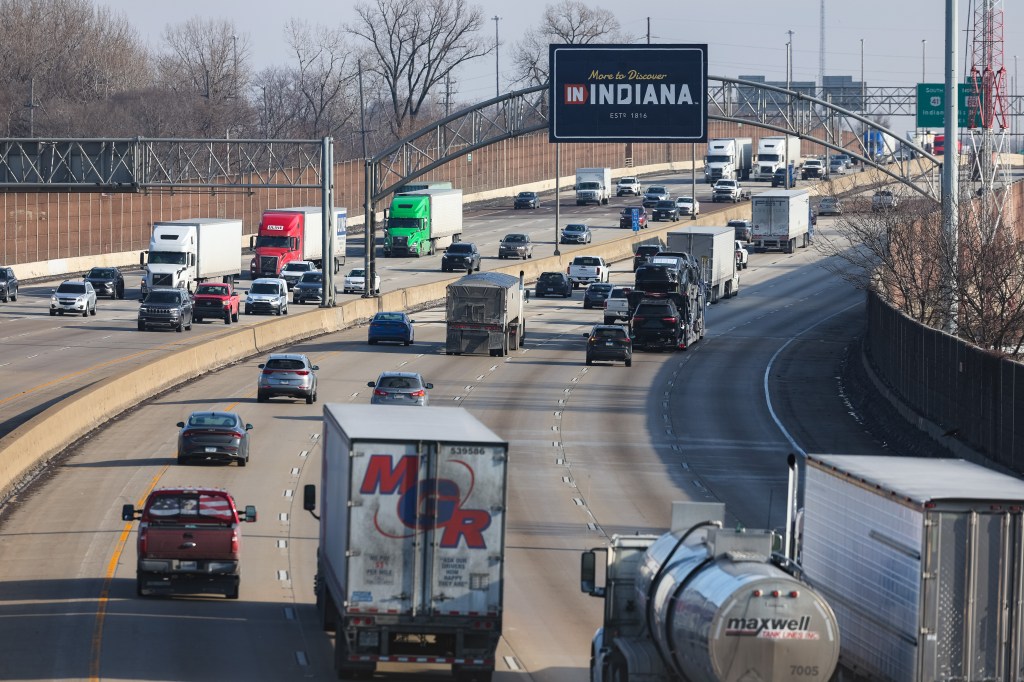
The Tribune first reported Wednesday that the team was looking at possible locations outside Cook County, including northwest Indiana, after Illinois lawmakers indicated a new Chicago-area football stadium wouldn’t be a legislative priority in 2026.
The Bears previously proposed spending $2 billion of their own money to build an enclosed stadium in Arlington Heights to replace Soldier Field. The team’s plan does not require state tax dollars to construct the facility, but the organization wants to negotiate their property tax costs and get state funding for infrastructure like roads and utilities.
State Rep. Kam Buckner, a Chicago Democrat whose district includes Soldier Field, said the Bears’ change of plans was baffling, but that interest in Indiana was “very predictable.”
“In negotiations, what you do is you create leverage by saying you have more options, and so I knew it was coming and I had actually forecasted this to folks months ago,” he said.
“What they should be focusing on right now is beating the Green Bay Packers,” Buckner said of the team’s upcoming game. “Instead of talking about a possible Super Bowl at a stadium that doesn’t exist, how about let’s play an actual playoff game in a stadium that does exist?”
State Rep. Mary Beth Canty, who sponsored legislation that would help the team build a new stadium in the northwest suburbs, said she remained committed to the Arlington Heights project. In voicing her continued support, however, she took a jab at the Bears for suggesting the franchise could leave the state.
“I encourage the Bears to engage with the General Assembly in good faith, without threats, so we can find a path forward to keep the Bears at home in Illinois,” she said in a statement.
The village of Arlington Heights also issued a statement saying both village officials and the Chicago Bears remain confident that the former Arlington Park property where the team wants to build is the best option, but a so-called megaproject bill is necessary to make it possible.
“We encourage our Illinois State legislators to move forward with the Megaproject bill,” Arlington Heights Mayor Jim Tinaglia said. “This legislation will help to keep the Chicago Bears in Illinois, within the limits of Cook County, and ultimately in Arlington Heights.”
State Sen. Bill Cunningham, a Chicago Democrat, said the Bears’ push for a property tax break in Arlington Heights is “a good starting point” because it doesn’t entail any cost to the state. But right now, he said, lawmakers have more pressing matters.
“Building a stadium for the Bears is not now and never will be a priority for the legislature,” said Cunningham, who is the Senate Democrats’ point person on stadium projects. “It doesn’t mean we can’t pull together a stadium package at some point. It just means we have more important things to tackle first.”
Though lawmakers repeatedly have said they are too busy with other issues to address the Bears stadium, the real obstacle has been convincing Chicago lawmakers to help the team leave the city.
The Bears need to address what to do about the seven years left on their lease at Soldier Field, which still has a taxpayer debt of more than $500 million from its 2003 renovation, Cunningham said.
“At the end of the day, they have a legislative math problem and (it’s) very hard to solve with Chicago legislators,” Cunningham said.
At issue is a proposed Illinois law that would allow large sponsors of “megaprojects” like sports stadiums or large factories to negotiate future property taxes with local schools and other taxing bodies.
The Bears say they need the legislation to know what their tax costs would be for the next 30 years or so. They also say they are looking for the state help to pay for infrastructure costs, not unlike the support other large projects such as the proposed quantum computing campus in Chicago or the Rivian automotive plant in Normal receive.
That legislation still has the support of Canty and state Sen. Mark Walker, a Democrat who represents Arlington Heights. Both lawmakers encouraged their colleagues Thursday to give serious consideration to granting the team’s property tax plan, with negotiations over infrastructure costs.
“I don’t think we should treat the Bears worse than we would treat any other large corporation with a development project just because they’re the Bears,” Walker said.
One site where lawmakers have expressed support for a new stadium is the former Michael Reese Hospital property on the Near South Side. Bears executives met Friday with Cook County officials to discuss the property, but team officials said it is not feasible because of building constraints and high costs to make it work.
Developers showed that the new Las Vegas NFL stadium, for example, would fit comfortably on the southern end of the site, Cook County Board President Toni Preckwinkle said.
Preckwinkle doesn’t think the state legislation will fly, adding, “We have to have reasonable proposals from the team.”
It’s not responsible, she said, to spend hundreds of millions of tax dollars on a professional sports facility, she said.
“Investments in public infrastructure is another story,” Preckwinkle said.
Chicago Mayor Brandon Johnson suggested the Bears’ flirtation with Indiana wasn’t serious.
“The Bears belong in the city of Chicago,” he said. “And I still firmly believe that their best position is in Chicago.”
Asked if the team was trying to gain leverage in negotiations by throwing Indiana into the mix, Johnson said, “If they are, it’s not good leverage.”
The door is “always open” to a Chicago stadium, Johnson said.
The reaction was predictably very different in Indiana, where Republican House Speaker Todd Huston called the potential economic boost “transformative.”
“That is super exciting,” he said. “We will be part of that conversation and look forward to supporting our friends in northwest Indiana on what I think is a great opportunity for our state.”
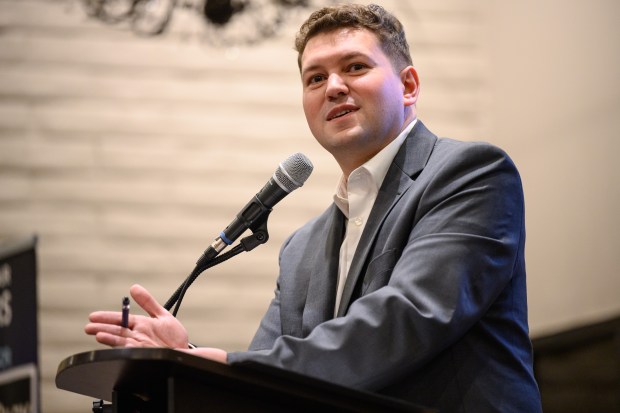 Portage Mayor Austin Bonta speaks during his State of the City address at Woodland Park on Nov. 19, 2025. (Kyle Telechan/for the Post-Tribune)
Portage Mayor Austin Bonta said he was thrilled by the Bears’ interest. While the Bears haven’t named a site in Indiana, Bonta said Portage would be a prime potential spot because of its proximity to multiple highways, a train line and Lake Michigan.
The Hillcrest Site, for example, is on the north side of I-94 and south of the train station, Bonta said. The city owns the land, he said, and officials would like to see the property developed.
State Rep. Earl Harris Jr., a Democrat from East Chicago, said state leaders want to talk with the team about what they need and how northwest Indiana could provide solutions.
Harris, who authored a law creating the Northwest Indiana Professional Sports Development Commission, said the agency will discuss the Bears proposed stadium at its meeting Jan. 6.
The best locations, he said, would likely be closest to the Illinois-Indiana border, such as East Chicago, Gary and Hammond.