
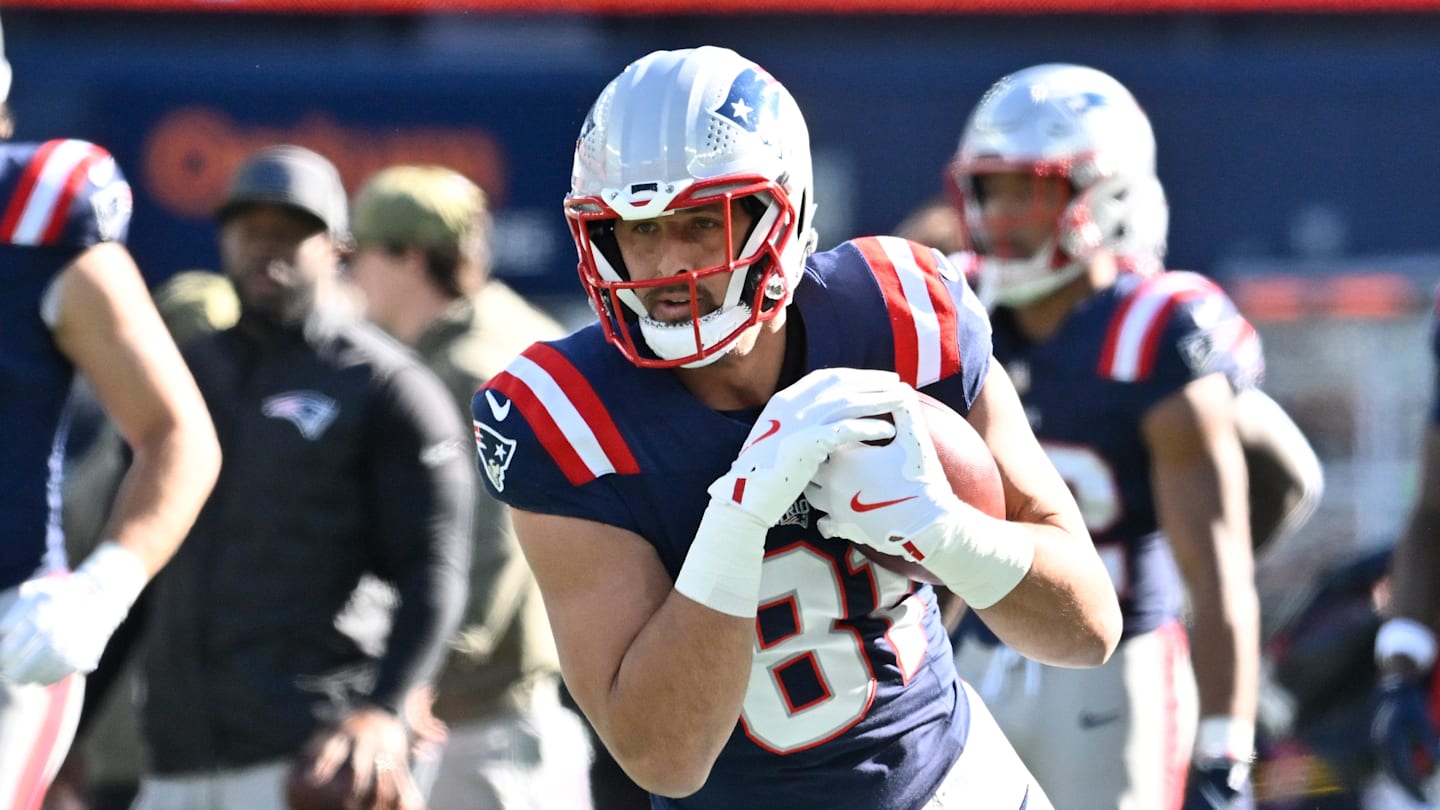
Austin Hooper arrived in New England on a one-year, $5 million deal as a veteran presence meant to complement Hunter Henry and solidify the tight end room. The hope was that the two-time Pro Bowler would provide reliable depth and a consistent receiving threat in a Patriots offense still finding its identity.
But as the 2025 season winds down, the evidence is mounting that Hooper is exactly what his contract suggests: a short-term solution who won’t be sticking around for the long haul. The problem isn’t that he’s been a disaster; it’s that he hasn’t been nearly good enough to justify the price tag or the roster spot when the team needs to be ruthless about efficiency.
Here are four reasons why Hooper shouldn’t last beyond the 2025 campaign in New England.
1. The Snap Count is the Loudest Whisper
To truly know a player’s value to a team, don’t look at the box score; look at the snap count. For Austin Hooper, that count is screaming “expendable.” His production has been modest, a polite way of saying “virtually nonexistent” when you consider the opportunities. Through the 2025 regular season, his stat line reads like a footnote: 16 receptions for 213 yards and a single touchdown. It’s a little sad to see, for a player who, at times last season, looked like one of the few functional pieces on a Patriots team that won just three games.
Here’s the damning part: his usage is trending straight into the abyss. In the recent Week 15 loss to the Bills, Hooper logged a season-low 16 snaps on offense and, in a truly spectacular disappearing act, was not targeted in the passing game for the second straight contest. When the team is fighting for every yard and every first down, a veteran tight end who is riding the pine and watching the ball fly by is a luxury the Patriots cannot afford to keep on the payroll.
2. The Blocking Regression
Hooper was supposed to be the reliable, two-way tight end, the veteran who could get his hands dirty in the run game while Hunter Henry stretched the field. Yet, even the supposed strength of his game, which was his blocking, has shown concerning cracks. One report noted that he has already allowed a staggering 31 pressures this season, a number that somehow surpasses his total from the entire previous year.
For a team that presently and historically relies heavily on its tight ends to execute its physical run blocking and play-action style, a decline in blocking efficiency combined with a disappearing act in the passing game makes for a poor value proposition. It’s the kind of performance that makes the front office start checking the calendar for his contract expiration date.
3. The Hunter Henry Problem (and the Cap Solution)
The business side of the NFL makes the decision to move on from Hooper an absolute no-brainer. He is a pending free agent after the 2025 season, and the Patriots have a clear, established TE1 in Hunter Henry. Henry is the guy who gets the red zone looks and the clutch third-down catches. Hooper is the guy whose snaps are being cut.
With the team needing to allocate cap space to other pressing needs, such as finding a legitimate receiving threat who isn’t Stefon Diggs, electing to re-sign a TE2 whose playing time is dipping and whose blocking is regressing makes zero financial sense. Hooper’s contract was a one-year, $5 million commitment that could reach $7 million with incentives. That $5-7 million is better spent on a younger, cheaper option or even a different, slightly younger veteran who can offer a more consistent, two-way threat at the position.
The Patriots have already demonstrated a willingness to churn the bottom of the roster. Hooper may be simply next in line for the cold, hard business that is the National Football League.
4. The 2026 Outlook: A Youth Movement is Coming
Looking ahead, the Patriots are building a team around a young core, and every roster spot must count toward sustained success. Hooper, who will be 31 by the start of the 2026 season, doesn’t fit that vision. The team needs a versatile, cost-controlled TE2 who can step in, not miss a beat, and has upside.
When the Patriots sit down this offseason to evaluate their 2026 roster, Hooper’s name won’t make it past the first round of cuts. He served his purpose as a stopgap, a veteran presence during a transitional year. But he’s shown New England exactly what he is: a veteran backup who can’t stick around when the team is ready to compete for championships. Expect the Patriots to let Hooper walk in the offseason, freeing up his commitment to pursue a player who can fill the role he played a couple of years ago.
More New England Patriots News and Rumors: