
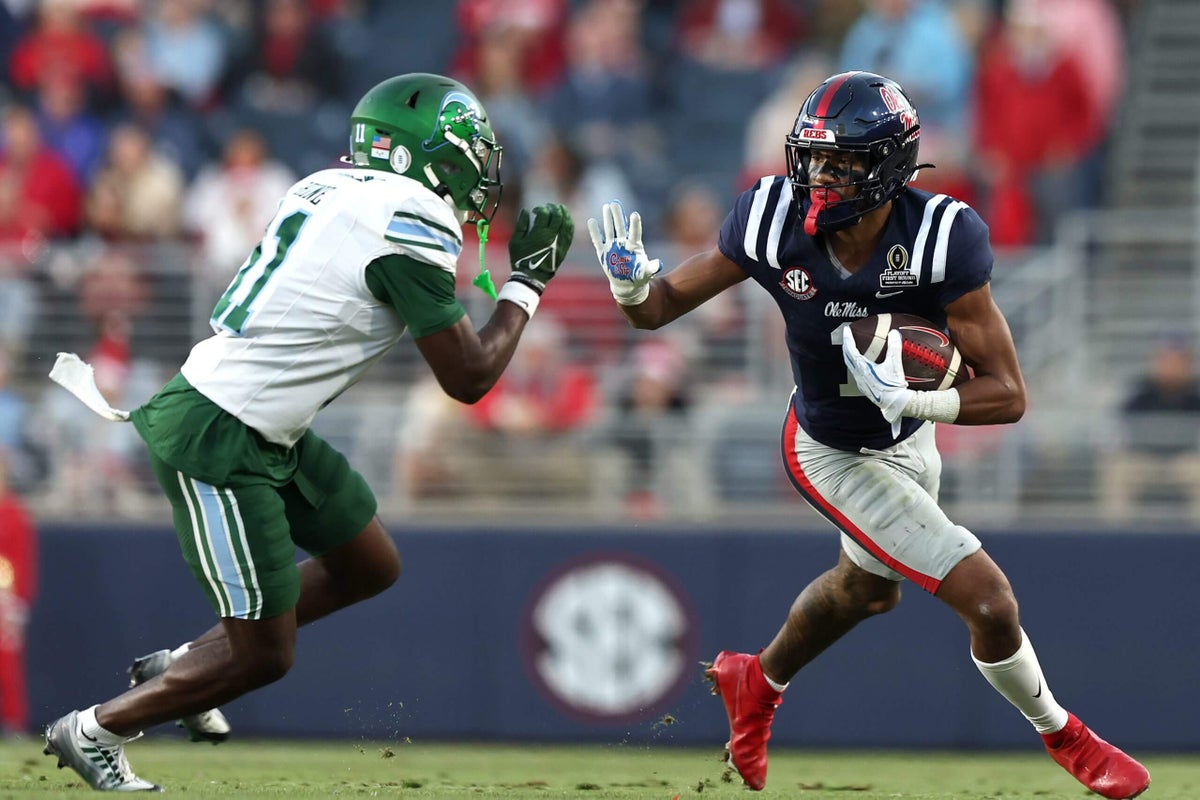
The College Football Playoff’s Cinderella stories ended early, again, when No. 11 Tulane and No. 12 James Madison were dominated by Ole Miss and Oregon in the first round. Saturday’s blowouts will only fuel more questions about future CFP formats and whether the Group of 5 deserves a guaranteed spot in the field.
With non-power conference teams now 0-4 all-time in the Playoff, the results raise a different question: Can college football produce a G5 Cinderella like the basketball mid-majors that captivate us every March?
“You never say never,” former Tulane star Shaun King said, “but I would give it a less than 2 to 3 percent chance.”
King isn’t a Group of 5 hater or an administrator stumping for the SEC/Big Ten. He quarterbacked undefeated Tulane in 1998 and was an assistant on South Florida’s two best teams, so he knows firsthand what a college football Cinderella could look like. But he’s also a realist who sees a championship clock that has effectively struck midnight on teams outside the Power 4.
The explanation requires a history lesson. Most of the previous Group of 5 greats that won major bowls and would have had a chance to advance in a Playoff had talent, experience and transcendent quarterback play that clicked at the same time:
Current Saints head coach Kellen Moore quarterbacked a 2009 Boise State team with more future first-round picks (three) than the Texas team that lost to Alabama in the national title game (two).
McKenzie Milton’s undefeated 2017 UCF squad featured seven future NFL Draft picks in its Peach Bowl win over Auburn; 17 of the 22 starters were redshirt sophomores or older.
TCU’s undefeated 2010 team started 13 seniors (including Andy Dalton) and five juniors/redshirt sophomores in its Rose Bowl win over Wisconsin.
The 2016 USF team was a notch lower, going only 11-2. But it had an incumbent standout quarterback (Quinton Flowers), a pair of future NFL running backs (Marlon Mack and D’Ernest Johnson) and a receiver who’s still in the league (Marquez Valdes-Scantling). A G5 team that talented with that much familiarity, King said, will “never happen again because of the portal and NIL.”
“Someone would have offered Marlon more money than we could match,” King said. “Someone would have taken Quinton Flowers from us.”
That’s what happened at Tulane. Last year’s quarterback, Darian Mensah, transferred to Duke as one of the portal’s top free agents and led the Blue Devils to the ACC title.
Saturday’s first game featured a former Green Wave starter, tight end Alex Bauman, in the lineup for Miami. Saturday’s last game featured another former Green Wave starter, all-conference running back Makhi Hughes, on the roster for Oregon, where he hasn’t even made an impact despite rushing for 1,401 yards last year.
As outgoing Tulane head coach Jon Sumrall said recently: “If you’ve studied my rosters the last couple years, I haven’t had the resources to keep very many of my good players. They all end up getting poached.”
So, for that matter, do the coaches. Sumrall made that remark during his introductory news conference at Florida, where he’s the incoming head coach. He spent the past three weeks wearing both hats (literally, in the case of his social media picture), just as Bob Chesney did with James Madison and UCLA. Power 4 programs aren’t immune to this issue — see: Kiffin, Lane — but it’s traditionally a bigger obstacle at the G5 level.
It’s an issue that’s growing, too, because of another thing hurting Cinderellas: money.
Although player salaries are generally hard to verify, the swelling financial gaps are obvious. Oregon defensive coordinator Tosh Lupoi’s $2 million salary is more than what JMU budgeted for Chesney’s salary and its revenue-sharing deals with players combined (almost $1.9 million).
Change the team names, and the problem remains. The football revenue of Boise State was about a third of what Oklahoma reported to the U.S. Department of Education when the Broncos shocked the Sooners in the Fiesta Bowl in January 2007. OU’s expenses (almost $19 million) roughly doubled the Broncos’ ($8.6 million).
By 2023 (the most recent available year), the Sooners’ revenue had exploded to almost five times what Boise State brought in ($124.9 million compared to $26.5 million). OU’s expenses mushroomed to more than three times Boise’s — a difference of $45 million. That’s a lot of extra analysts and recruiting staffers.
There are other factors, too, that make a mid-major run hard to fathom. Most of the best-resourced Group of 5 programs (Utah, TCU, Cincinnati) have already earned Power 4 invites, eliminating the top would-be Cinderellas. Weaker schedules will almost certainly put G5 teams at the bottom of every bracket, so their Playoff path starts on the road against one of the toughest teams. Saturday’s ugly showings, fairly or unfairly, will weaken the public perception of non-power teams in future CFP debates and formats.
Just because a Cinderella run seems nearly impossible doesn’t mean the Group of 5 — which will become the Group of 6 with the revamped Pac-12 next year — should be excluded from the field entirely. Alienating half the teams in FBS seems like a bad business strategy, not to mention an invitation for antitrust investigations. Plenty of Power 4 teams have been blown out in the Playoff before, too; was Oregon’s demolition of JMU that much uglier than the inaugural CFP game, the Ducks’ 59-20 shellacking of Florida State at the Rose Bowl?
But we can advocate for the G5’s spot in the bracket while also acknowledging its grim reality. The ecosystem has changed since Boise toppled OU or UCF self-claimed a national title. Match those G5 teams against the ones that played Saturday, King said, and the Dukes and Green Wave are double-digit underdogs.
So unless Memphis or Tulane or the next JMU finds its own Cody Campbell to bankroll an elite roster like Texas Tech did, the odds of a G5 Cinderella are low.
The glass slipper still belongs to March. Hopefully.