
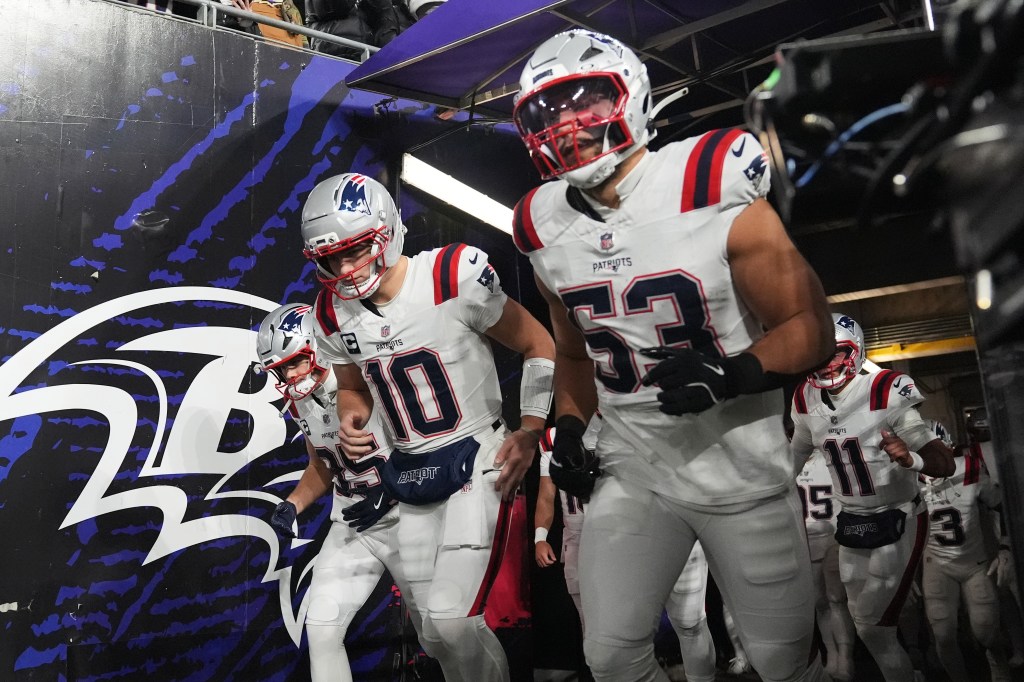
In a few days, the Patriots might struggle to field a 48-man roster against the Jets.
But for now, just a little while longer, they can bask in what they did at Baltimore.
Drake Maye led the first fourth-quarter comeback of his career.
Stefon Diggs flashed a Pro Bowl form by raising his game and, by extension, the entire offense.
The defense, finally, forced a few sorely-needed, long-overdue, perfectly-timed turnovers.
All together, the Patriots stitched together a sloppy version of a throwback win for this franchise: the clutch, gritty kind that overcomes poor officiating, the rugged physicality of an old rival and some adversity of their own making (see: that terrible, horrible, no good, very bad fake punt). The Pats ought to feel inspired by this victory, even if it came at a great cost — eight players were injured— and left some warning signs for the weeks ahead.
Did you forget Maye got pressured on more than 40% of his dropbacks again? And the Patriots’ run defense got pushed around again despite beefing up its personnel? And …
Here’s what else the film revealed about the Pats’ latest win:
Drake Maye
31-of-44 for 380 yards, 2 TDs, INT
Accurate throw percentage: 73.8%
Under pressure: 11-of-18 for 134 yards, INT, 3 sacks
Against the blitz: 9-of-13 for 75 yards, TD, sack
Behind the line: 2-of-2 for 10 yards
0-9 yards downfield: 20-of-23 for 157 yards, TD
10-19 yards downfield: 4-of-9 for 82 yards, INT
20+ yards downfield: 5-of-8 for 131 yards, TD
Notes: More than his accuracy, Maye’s comeback was about timing, poise and decision-making.
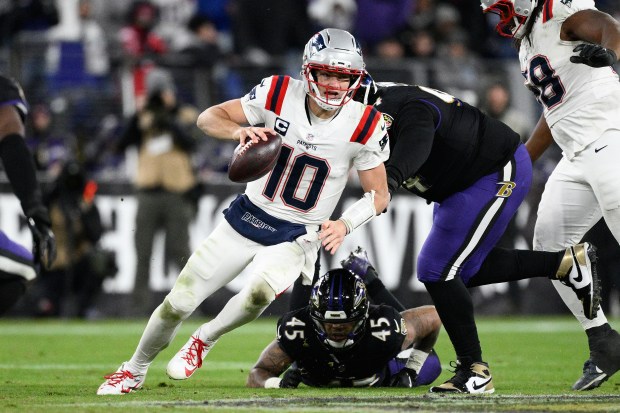 New England Patriots quarterback Drake Maye (10) runs against the Baltimore Ravens during the second half of an NFL game in Baltimore on Sunday. (AP Photo/Nick Wass)
Within the two touchdowns drives he led in the fourth quarter, Maye knew exactly where to go and when to take safe completions, scramble or go long. On the first drive, Maye patiently hit four straight short passes around a scramble, then expertly held a safety with his eyes before launching a 37-yard, pinpoint touchdown to Kyle Williams down the right sideline. Despite taking a season-high 10 hits, he was never all that bothered by the blitz or fooled by the Ravens’ zone disguises.
Backed up at his 11-yard line to start the next series, Maye sought an intermediate crosser immediately recognizing the Ravens had covered Mack Hollins with a safety in man-to-man coverage. Then, he returned to the quick-hitters, including an out route to Stefon Diggs on fourth-and-2; another throw where Maye exploited a safety in man-to-man. Those targets were an improvement from some earlier decisions, including his interception intended for Kayshon Boutte, a long-shot incompletion to Rhamondre Stevenson on third-and-2 and a couple late throws of the middle that, with worse luck, may have been intercepted.
Callahan: Drake Maye made a leap in Baltimore and took the Patriots with him
Maye’s calmness and command kept the Patriots’ afloat in their most critical moments, especially after he’d gotten pummeled in the third quarter. That quarter was Maye at his best, a version that always involves a few picture-perfect deep balls. Maye’s five completions on passes that covered 20-plus air yards finished as a season high.
Before the fourth quarter, however, his defining plays were mistakes: an opening-drive interception and the fumble he lost right before halftime. Both turnovers took points off the board, something the Patriots won’t be able to afford in January. Maye also fumbled a hand-off, but now that play becomes a footnote on an otherwise spectacularly clutch night for the young quarterback.
Critical areas
Turnovers: Patriots 2, Ravens 2
Explosive play rate: Patriots 14.1%, Ravens 7.4%
Success rate: Patriots 50.7%, Ravens 50%
Red-zone efficiency: Patriots 1-3, Ravens 2-3
Defensive pressure rate: Patriots 36%, Ravens 42%
Offense
Game plan
Personnel breakdown: 65.5% of snaps in 11 personnel, 9% of snaps in 12 personnel, 3% of snaps in 13 personnel, 1.5% of snaps in 21F personnel, 1.5% of snaps in 21H personnel, 16% of snaps in 22 personnel, 1.5% of snaps in jumbo personnel.***
Personnel production: 59% success rate in 11 personnel, 33% success rate in 12 personnel, 0% success rate in 13 personnel, 0% success rate in 21F personnel, 0% success rate in 21H personnel, 54% success rate in 22 personnel, 100% in jumbo personnel.
First-down down play-calls: 62% pass (63% success rate), 38% run (33% success rate)
Play-action rate: 18%
In the second half, offensive coordinator Josh McDaniels broke from what had been a layered plan to crack Baltimore’s defense with jumbo personnel packages featuring six offensive linemen. After a slew of injuries and a couple Maye mistakes under pressure, McDaniels shifted to a simpler approach called mostly out of 11 personnel (three receivers, one running back, one tight end). A spread attack allowed Maye to pick on his favorite matchups and stay on-schedule better than they had earlier running into a tough Ravens front.
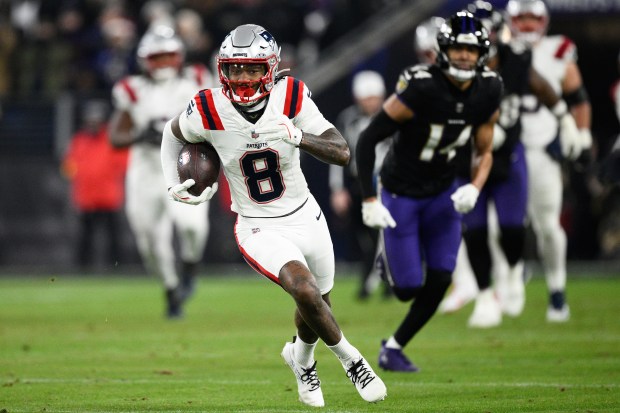 New England Patriots wide receiver Stefon Diggs runs in front of Baltimore Ravens safety Kyle Hamilton (14) during the first half of an NFL game Sunday. (AP Photo/Nick Wass)
But later, McDaniels returned to the same inside run play that busted early and watched Stevenson cut back for a 21-yard, game-winning touchdown. He also used a 22 personnel package (two backs and two tight ends, with one being an extra offensive lineman) to salt the game away on the same run-pass option call the generated two first downs.
The Pats had wanted to create explosive plays via play-action and perimeter runs with rookie TreVeyon Henderson, while punishing the Ravens’ edge defenders for crashing hard on run plays. Through the air, Maye attacked underneath and down the seams, all soft spots in Baltimore’s preferred single-high, zone coverages. Maye finished with nine passes of 20-plus yards.
One play-calling oddity: from 11 personnel, McDaniels called one designed run to 43 passes. Yep. One to 43.
Player stats
Broken tackles: WR Stefon Diggs 4, RB Rhamondre Stevenson 3, RB TreVeyon Henderson
Pressure allowed: LT Vederian Lowe 6 (1 sack, 5 hurries), LG Jared Wilson 4 (QB hit, 3 hurries), RT Morgan Moses 3 (QB hit, 2 hurries), C Garrett Bradbury 2 (2 hurries), RB Rhamondre Stevenson (hurry), OT Thayer Munford Jr. (hurry), Team 3 (hurry)
Run stuffs allowed: Team 2, Wilson
Drops: N/A
Notes
Toughness. This is what stands out most on a rewatch of this tape, from Morgan Moses returning to play to tough out a knee injury, the collective resilience to complete an 11-point comeback and overcome key losses of TreVeyon Henderson and Kayshon Boutte among others.
Stefon Diggs factored heavily into the comeback, specifically by defeating man-to-man coverage, which had been a bugaboo for this receiving corps lately. Diggs won through sharp routes and even breakaway speed. Two of his three catches were deep crossers that went for first downs.
Baltimore did not pay extra attention to Diggs, as the Bills did with occasional double-teams and zone droppers hunting his crossing routes, which may have cost them. Still, Diggs and Mack Hollins both beat the Ravens’ top corners for catches in 1-on-1 matchups.
How about Kyle Williams? As rare as his speed might be, the rookie continues to show his ball tracking is just as valuable for completing those deep passes. He should see a significant jump in playing time for however long Kayshon Boutte (head) is out.
The Patriots tried to unlock passes to their tight ends with delayed releases, a tactic that failed on their opening drive when Maye threw incomplete to Hunter Henry but later worked at the 1-yard line when he hit Henry off play-action for a touchdown.
Maye’s 26-yard throw to Austin Hooper down the right seam in the first half was one of his best of the night, and another example of Maye trusting his receivers to make contested catches. As good as Maye is and has been, not all tight ends and receivers come down with catches like that. Credit to Hooper.
Rhamondre Stevenson had perhaps the most underrated performance of the night, setting up would-be tacklers to either step into blocks or whiff on their attempts to take him down. He played 84% of the offensive snaps and shouldered the load in blitz pickup versus a Ravens defense that made a habit of sending rushers from unexpected places.
Rough night for Vederian Lowe. His six pressures allowed are among the most allowed by a Patriots offensive lineman in a single game the last few seasons. At least most were hurries.
More twists and stunts again affected Jared Wilson, who was the Patriots’ second-worst offensive linemen behind Lowe. The rookie struggled to generate push in the run game, as well.
The uncalled defensive pass interference penalty that cost Boutte a deep catch in the fourth quarter was one of the worst non-calls I’ve ever seen. Ever.
Defense
Game plan
Personnel breakdown: 56% base defense, 28% three-corner nickel package, 5% goal-line, 5% three-safety nickel, 3% dime, 3% dollar.****
Coverage breakdown: 65% zone, 35% man
Blitz rate: 32%
Blitz efficacy: 57% offensive success rate and 7.6 yards per play allowed
The Patriots took parts of their latest game plan against Buffalo, and turned them up a notch.
The defense opened in a goal-line/heavy personnel package on the Ravens’ first play from scrimmage, fielding just three defensive backs with four linebackers and four defensive tackles. That sent a clear message to Baltimore that they intended to solve their run defense with bigger bodies and were unafraid of how the Ravens might hurt them deep. They were half-right.
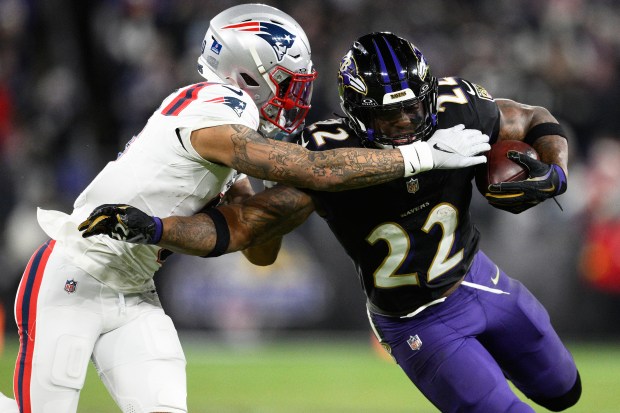 Baltimore Ravens running back Derrick Henry (22) runs against New England Patriots cornerback Christian Gonzalez during the second half of an NFL game Sunday night. (AP Photo/Nick Wass)
Baltimore scored all three of its touchdowns running off-tackle with offensive linemen pulling out in front, a way to generate a numbers advantage against a defense either too slow to reach the edge and/or ill-equipped to set the edge with its corners. The Ravens targeted Christian Gonzalez as a run defender with outside tosses and outside zone variations with crack blocks on the nearest edge defender, which forced him to then jump in as the primary contain player. The Pats never got a great hold on the Ravens’ run game until Henry strangely sat for most of the fourth quarter.
In coverage, defensive play-caller Zak Kuhr majored in single-high defenses, like Cover 1, a man-to-man coverage, and Cover 3, which allowed the Patriots to stack the box. He called a fairly vanilla game, knowing the defense’s most important task was playing simple, fundamental football to contain the run.
One wrinkle: Kuhr did deploy special teams captain Brenden Schooler as a QB spy for three snaps and mixed in some personnel groups with extra defensive backs that helped offset Carlton Davis’ absence late in the game. Schooler has now played five defensive snaps this year.
Player stats
Pressure: DL Cory Durden 2 (2 hurries), OLB Anfernee Jennings (sack), OLB K’Lavon Chaisson (QB hit), LB Jack Gibbens (QB hit), DL Christian Barmore (QB hit), DL Khyiris Tonga (hurry), S Craig Woodson (hurry)
Run stuffs: Team 4
Pass deflections: CB Christian Gonzalez
Missed tackles: LB Jahlani Tavai 2, S Dell Pettus 2, CB Carlton Davis, S Jaylinn Hawkins, Barmore, Chaisson, Gibbens, Jennings
Notes
Survive and advance. Even facing just one half of Lamar Jackson and a mostly unthreatening Tyler Huntley, this defense did just enough against a top-10 rushing attack after putting some of the worst tape of any run defense in the league the past 5-6 weeks. Somehow, a 48% success rate allowed and 5.2 yards per carry allowed, felt like progress given their talent available.
By chasing down Zay Flowers on the Ravens’ final drive and thumping the ball out, K’Lavon Chaisson practiced what Mike Vrabel had preached all week: effort and takeaways. And that is the power of turnover: papering over problems for an otherwise bad defense.
The Patriots had just three turnovers their previous six weeks, a stretch that coincided with some of their worst statistical performances of the year. More takeaways mean less time on the field, so for a unit with a waning pass rush and now below-average run defense, turnovers are the name of the game.
Some contributors who impressed in bigger roles: defensive tackles Cory Durden and Eric Gregory. Others who disappointed: linebackers Jahlani Tavai and Elijah Ponder.
Unsung hero of the game: Anfernee Jennings. Not only did Jennings tally the Patriots’ only sack, he kicked inside to play defensive tackle on a few snaps after the Pats lost rookie Joshua Farmer. Mind you, Jennings is listed at 6-2, 255, roughly 30 pounds lighter than most light defensive tackles.
The lack of a pass rush surfaced immediately when the Patriots had an ideal call versus Jackson: Cover 1 with inside linebacker Jack Gibbens serving as a spy. But instead of corralling Jackson, the Pats let him bounce around in the pocket and zip an 18-yard completion to Flowers.
Gonzalez shadowed Flowers on snaps of man-to-man coverage, including a couple where the Patriots double-teamed him late. Gonzalez allowed three catches in a so-so performance dragged down by a bad first half.
Third safety Dell Pettus played eight snaps; some in three-safety nickel packages, dime and dollar. Pettus’ playing time bears watching as the Patriots run out of front-seven defenders.
The only players to play 100% of defensive snaps Sunday night: Gonzalez, Gibbens and safety Jaylinn Hawkins, who had the team’s first forced fumble. His playmaking (2 interceptions, 1.5 sacks and a forced fumble) has been a pleasant surprise this season.
*Explosive plays are defined as runs of 12-plus yards and passes of 20-plus yards.
**Success rate is an efficiency metric measuring how often an offense stays on schedule. A play is successful when it produces positive EPA (Expected Points Added).
***11 personnel = one running back, one tight end; 12 personnel = one running back, two tight ends; 13 personnel = one back, three tight ends; 21 personnel = two backs, one tight end; 21H = two halfbacks, one tight end; jumbo personnel = two backs, two tight ends, six offensive linemen.
****Base defense = four defensive backs; nickel = five; dime = six, dollar = seven.