

Pete ThamelDec 24, 2025, 07:19 PM
CloseCollege Football Senior Writer for ESPN. Insider for College Gameday.
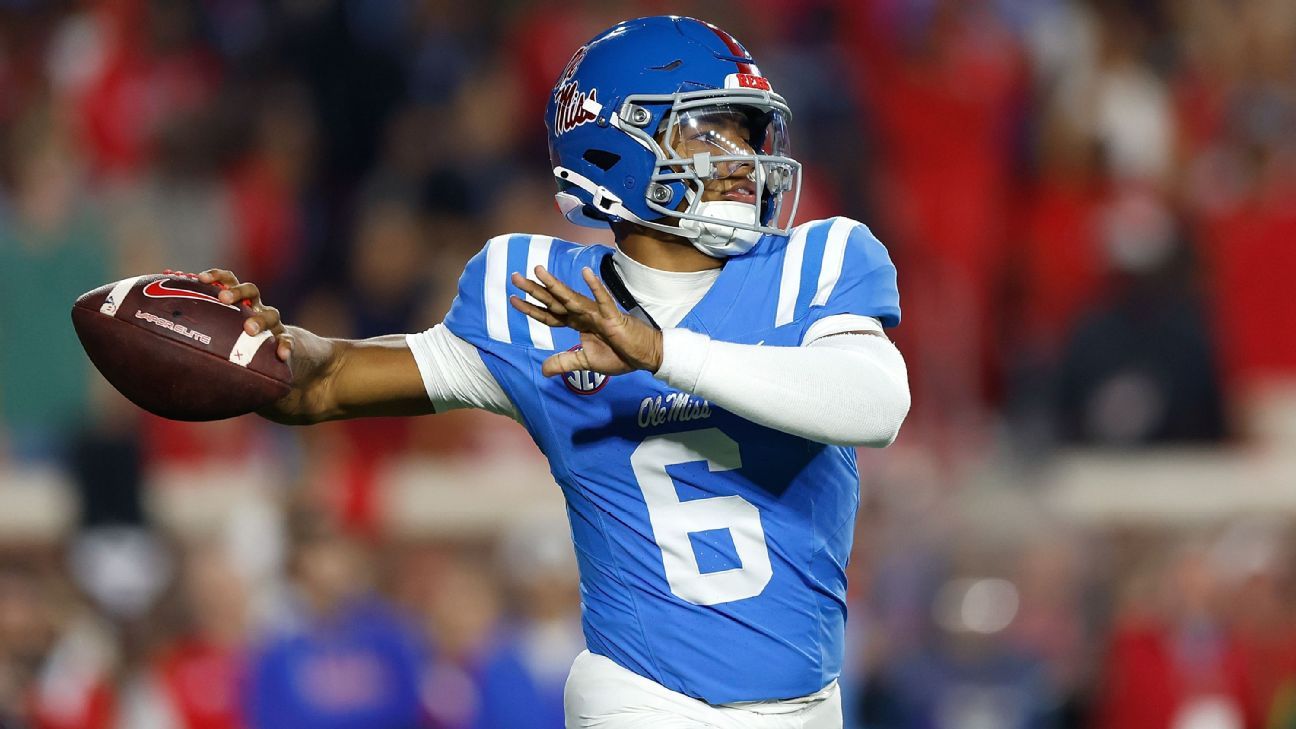
Ole Miss quarterback Trinidad Chambliss‘ rise to stardom after transferring from Division II Ferris State has been one of the defining stories of the 2025 college football season.
In his fifth season of college football — typically the last year of a player’s eligibility — he led the Rebels to the College Football Playoff quarterfinals and finished eighth in voting for the Heisman Trophy.
Now his quest for a potential sixth year looms as one of the off-season’s biggest stories, as he’s attempting to navigate a complex waiver process to secure that sixth year. An extra year would make him one of the most coveted players for college football in 2026 and could set up a compelling decision on where he may ultimately play if he’s granted the waiver.
Editor’s Picks
2 Related
Ole Miss filed a waiver petition for Chambliss to receive a sixth year of eligibility back on Nov. 16, which will ultimately be made by the NCAA Committee on Student-Athlete Reinstatement. There’s been no decision made, although indications early this month were the NCAA needed more information for the year to be granted. There’s no definitive timeline on when a decision would be made.
With no decision and the NCAA transfer portal set to open on Jan. 2, Chambliss enlisted prominent attorney Tom Mars on Dec. 17 to help his case.
Mars sent a 7-page letter to Ole Miss on Dec. 22, which has been forwarded by the school to the NCAA Committee on Student-Athlete Reinstatement. It underscores the unusually high stakes in Chambliss’ case, as he’d be set to make millions of dollars in 2026 as one of the sport’s top returning quarterbacks.
“This matter is not just time sensitive,” Mars wrote in the letter. It goes on to say that Chambliss would “suffer irreparable harm” if he’s not granted the waiver.
Chambliss has thrown for 19 touchdowns and three interceptions, completed 66.6% of his passes and rushed for 506 yards and eight touchdowns this year. In Ole Miss’s first College Football Playoff game against Tulane, he completed 23-of-29 passes for 282 yards.
If he were to get the waiver, Chambliss has said he hasn’t decided where he’d go. Ole Miss will put up a strong charge to keep him, and he’d also likely consider LSU where his former head coach, Lane Kiffin, and offensive coordinator, Charlie Weis, will coach next year.
He told media in Mississippi last week: “I’d have to consider what the best situation is for me. What I feel most comfortable with. Who I trust the most.”
The waiver itself — like many NCAA eligibility issues — is complex. But the general request for the extra year can be distilled to Chambliss asking for a medical redshirt for the 2022 season when he was at Division II Ferris State. (He took a traditional redshirt season his true freshman year there in 2021).
Chambliss played in two games in 2022, accumulating no statistics. And the crux of the waiver request is that he receive a medical redshirt for that season, as he dealt with persistent respiratory issues that ultimately led to surgery to remove his tonsils.
The initial feedback from the NCAA’s case manager, delivered to Ole Miss on Dec. 8, indicated that they were not inclined to give the waiver. They invited the school to submit additional information, as they wanted more contemporaneous medical documentation from 2022.
Mars argues in the letter that that specific data isn’t necessary, as the by-law for Chambliss’ request doesn’t require that.
It’s not uncommon for players to receive a sixth year for a medical redshirt when they’ve already taken a season as a traditional redshirt. In this case, it’s trickier because Chambliss switched schools and levels.
And now Ole Miss and Mars have to prove that Chambliss was “unable to participate in intercollegiate athletics as a result of a life-threatening or incapacitating injury or illness.”
The crux of Mars’ argument in the seven-page letter goes deep into the thicket of NCAA by-laws.
Mars stresses that the waiver by-law Chambliss is seeking — 12.6.1.7.1 – requires “objective evidence.” While a medical hardship waiver, which he’s not applying for, requires “contemporaneous or other appropriate medical documentation.”
“I’m baffled why this waiver wasn’t granted back in November just based on the irrefutable, objective evidence,” Mars told ESPN. Perhaps the NCAA just needed to be reminded what their own Bylaws say.
“The NCAA is attempting to impose a higher burden of proof on a young man who is without any fault, has satisfied all the requirements of the NCAA rules, and who’s been an outstanding representative of college football — both on and off the field.”
Mars’ note includes a statement from the ear, nose and throat specialist who treated Chambliss — otolaryngologist Dr. Anthony Howard — along with 91 pages of medical records that were submitted to the NCAA. They show an appointment from December of 2022, when Chambliss dealt with “enlarged tonsils, chronic tonsillitis and adenoiditis and history of infectious mononucleosis.” There was also a doctor appointment in August, prior to the season, to address these issues.
Dr. Howard concluded that “given the chronicity and documented impact of his symptoms, it is medically reasonable to conclude that chronic tonsillitis and its related complications limited his ability to participate consistently in high-intensity collegiate athletics during the 2022 season. These health issues affected his availability and performance during conditioning, practice, and game preparation. … His chronic tonsillitis represents a medically valid basis for hardship consideration as his condition rendered him incapacitated and unable to participate in the 2022 season.”
While NCAA officials don’t comment on active cases, it appears the lack of real-time documentation from that 2022 season is at the crux of the delay and the committee’s initial hesitation to grant the waiver.
An Ole Miss spokesman said the school is working diligently with all parties to do what it can to aid Chambliss in securing an extra year.
Ole Miss plays Georgia in the Sugar Bowl on the night of Jan. 1. It’s uncertain whether there will be clarity on Chambliss’ future that night, as the transfer portal opens near the time the game ends.