
How could something so undeniably correct turn out to be so indescribably wrong at the same time? Shoot, it’s an impossible question to answer, really; but hey, since we live in the world of impossible-to-find answers (New York Jets land), let’s dive into it, nonetheless.
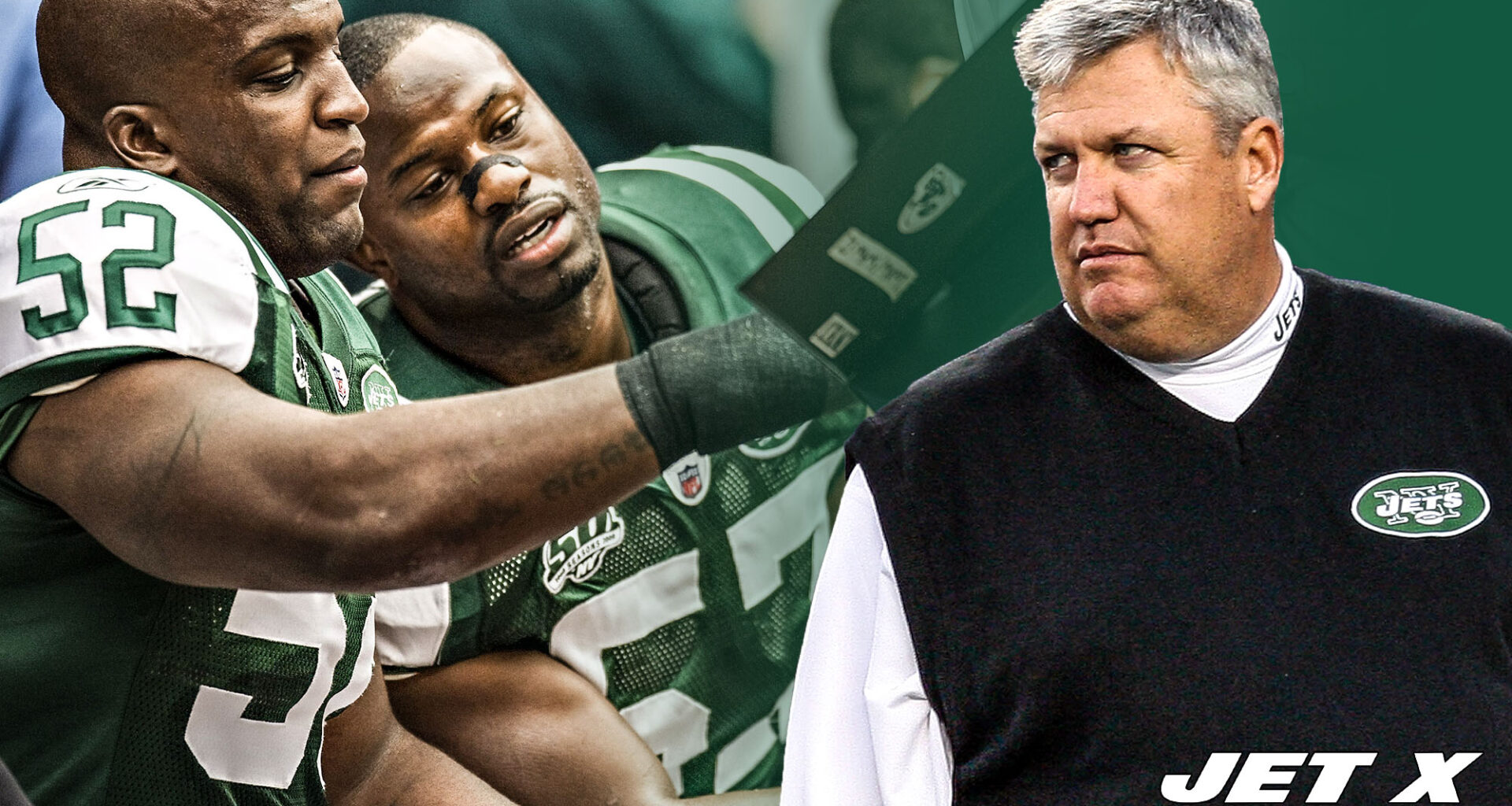
Bart Scott’s recent words on ESPN NY Radio were music to many football fans’ ears. On Tuesday, while working with Jake Asman, Scott discussed some defensive football when asked about the Jets’ current woes.
After discussing how amazing it was that Philip Rivers took his dad-bod off the couch for the Indianapolis Colts—which is just another sign of the burgeoning old-man quarterback era we’re set to soon endure—Scott opined on the state of the NFL.
“The thing that we had—and it’s not Bart Scott, ‘Get off my lawn’—but we had football acumen,” Scott proclaimed when referring to his era of the NFL. “It literally was chess, checkers, because guys were playing at such high levels. Did you see how easy it was for Philip Rivers to smoke them out of their looks?
“He hasn’t paid attention to the San Francisco 49ers (schemes) in how long? This is the first week he’s looked at them.”
Scott, 45, has become a prominent media voice since retiring from the league in 2012. Once Rex Ryan came over from the Baltimore Ravens in 2009 to coach the Jets, he took some players with him, including Bart Scott, his MIKE.
“They’re running the same stuff,” Scott continued. “It’s just elementary. It’s why a guy like Philip Rivers can play, and it’s why Tom Brady said, ‘Hey man, give me a month, and I could come back.’ And he’s serious, dead serious, because the guys today play the game from the shoulders down. The guys I played against (and played with) played the game from the shoulders up.
“You’re getting dumbed-down, reality TV. You’re not getting some beautifully written sitcom.”
When evaluating Scott’s message about how “dumbed-down” the modern game really is, it’s pretty easy to come away with an overarching response …
He’s not wrong.
Firstly, there’s no way I could disagree with him about the “dumbed-down” angle, particularly in relation to the older quarterbacks’ success. After all, I was firmly on the “Aaron Rodgers isn’t washed” bandwagon for a long time, and many examples of the savvy vets getting things done have smacked us in the face all season.
Flacco, Rodgers … how are these old men doing this tonight, some are asking? It ain’t 1998 anymore. The rules = can’t touch the QB without a spotlight and sniper warning from above.
Can’t imagine how long guys like Mahomes and others will play. At least Rodgers and Flacco…
— Robby Sabo (@RobbySabo) October 17, 2025
Moreover, inject anything Bart has to say about the 3-4, odd-front tactics he learned under Rex Ryan, firmly into my veins (something he did discuss, particularly how Chris Harris played more odd fronts in his first game as defensive coordinator).
“Give me three months,” is how Bart responded when Asman gauged his interest in becoming the Jets’ defensive coordinator.
When guided by Asman, via needing three months to learn the modern schemes, the brashness of Bart shone through the screen and screetched soundly through the airwaves:
“No, no, no, we don’t need modern schemes to … this stuff is elementary, bro. This is the dumbest football era.”
Again, he’s not wrong. When evaluating it from a pure objective standpoint, I could and would argue that Bart is on the money in most ways—particularly from a football purity perspective.
Yet, as correct as he may be to most of the living, breathing football world, he is wrong as it relates to building a successful football team in the modern age.
It’s one thing to understand just how dumbed-down the game is today; it’s another to recognize and fully accept why it’s so dramatically foreign to the lifelong eye. That’s the real rub, and it’s precisely this attitude the New York Jets must move away from as an organization.
The reason the sport is dumbed down is the genesis of actual success: The NFL moved in another direction via the rules.
By any and every metric, the late 2000s commenced the party. When Bill Belichick’s cornerbacks continuously mauled Peyton Manning’s receivers in the early to mid-2000s, the noise increased. When the NFL began embracing fantasy football as a significant revenue driver, noise turned into action.
And when the league began feeling more heat than Kenny O’Brien behind his usually porous late-1980s offensive lines—regarding player safety—everything changed.
The late aughts saw the league enforce defensive coverage contact and overall physicality (particularly relating to quarterbacks) in unprecedented ways. In some ways, certain aspects of the game took some time to change their colors.
When Bart and Rex were shocking the world in 2009 and 2010, physicality was still a significant part of the game. Scott would fill and spill like a madman, making it that much easier for David Harris and others to make a play. Nick Mangold and company didn’t just believe in ground-and-pound; they worshiped the altar it stood for (and appropriately so).
In 2011, Eli Manning’s New York Giants won the Super Bowl with the 32nd rushing attack. In 2012, Robert Griffin III and Colin Kaepernick led potent offenses that featured zone-reads and option play—something the traditionalists would have never thought could infiltrate pro football.
Had Buddy Ryan consistently done that with Randall Cunningham, he would have set him up for a Lawrence Taylor-served hospital stay. The sheer physicality and understanding that quarterbacks were “one of the fellas” made it clear that allowing those guys to venture into the real world (defensive EDGE, between the tackles, etc.) wouldn’t end well.
Season by season, the way this sport is played has changed. Today, the top nine all-time passing yards leaders all played, at the very latest, in the 2010 season. Dan Marino, who some thought could never be caught, is now 10th with 61,361 career passing yards.
Matt Ryan ranks ninth. Philip Rivers ranks eighth. Eli Manning ranks 11th. I mean, come on, now. Sights such as these can only force the brain in one direction: The times, they are a-changing.
As much as I live for those old Rex schemes, they simply would not work today—at least not how they were exactly, and not with the same vigor. It’s this realization that must always begin the conversation.
Thanks to the pass-happy ways of the NFL, led by its insane short-passing efficiency, defense as we all knew it has evaporated. Poof, it’s gone. The quicker we can all accept this reality, the better.
These days, defense can no longer dictate the terms of a football game. Period. The offensive play-calling nerds are currently dominating—oftentimes through little genius of their own.
Naturally, there will always be outliers and specific scenarios where all of us, prideful defensive coaches, soak in the moment. By and large, however, defensive football is a lost art, and it’s not due to a lack of trying.
It’s impossible to stop an offense that executes perfectly. Instead of game-planning in a way that features a “give no inch” attitude, it must now revolve around, “What’s best to give up?”
This is why we see the 20-to-20 game take such precedence. The bend-but-do-not-break attitude reigns supreme, with defensive minds preaching red-zone stoutness.
In other words, courtesy of these rules, the only chance an NFL defense has is to abide by a specific set of cookie-cutter principles, such as:
Play off-coverage on third-and-long (heels at the sticks, keep in front, rally on shallow, etc.).
Responsible rush lanes are just as critical as chin-down pass-rush.
Zone-match principles with heavily disguised looks that can even work against motion.
Don’t touch the quarterback.
At one point, Scott mentioned how the NFL’s blitz tactics these days don’t make sense, that they’re mugging the line far too much. Instead, they shouldn’t tip their hand when a second-level backer is coming.
Hey, in principle, I agree. I wish the game were still played that way.
In reality, again, there’s a reason why that’s the case.
The short-passing game rules everything, which means the quarterback’s release time is off the charts low.
The percentage of NFL dropbacks with passes thrown in 2.5 seconds or less skyrocketed from about 56% in 2011 (when Pro Football Focus began tracking it) to over 63% by 2015. By 2018, no starting quarterback had held the ball for 2.6 seconds or longer on 60% of plays, marking a first since tracking began.
Since quarterbacks are releasing the ball much more quickly, the old blitz rules no longer apply. Rolling with the delayed second-level triggers, a Rex favorite, doesn’t have the same impact. No chance.
There just isn’t enough time for the pressure to hit home. (Even Rex began understanding this as his head-coaching career trudged forward, and did so in a negative direction.)
That’s why everything feels dumbed-down and similar across the board—because offenses enjoy an advantage to the point that defenses are only trying to hold on for dear life. Moreover, it’s why employing a skilled offensive play-caller is what moves the needle most in the area of team success.
Part of today’s football struggle places a spotlight on the defensive minds, particularly those of the older-school ilk. The level of their success directly correlates with their stubbornness in the old ways.
It has nothing to do with whether or not they like how things are and everything to do with accepting and running with it.
Although I fully agree with everything Bart Scott had to say about the current state of the NFL and defensive principles in general, it represents the precise attitude the New York Jets organization must recognize and rebuff.
The idea that defensive football can be fixed through old-school principles pretty much sums up why the Jets haven’t made the playoffs since the rule changes led to this “dumbed-down” point in football history.
The New York Jets don’t need any more “old school.” What they need are leaders who grasp the current landscape, and perhaps even some who are hell-bent on innovation—even on the defensive side of the ball.