
The College Football Playoff’s first-round matchups didn’t deliver the television ratings goods in the second year of a 12-team field last weekend.
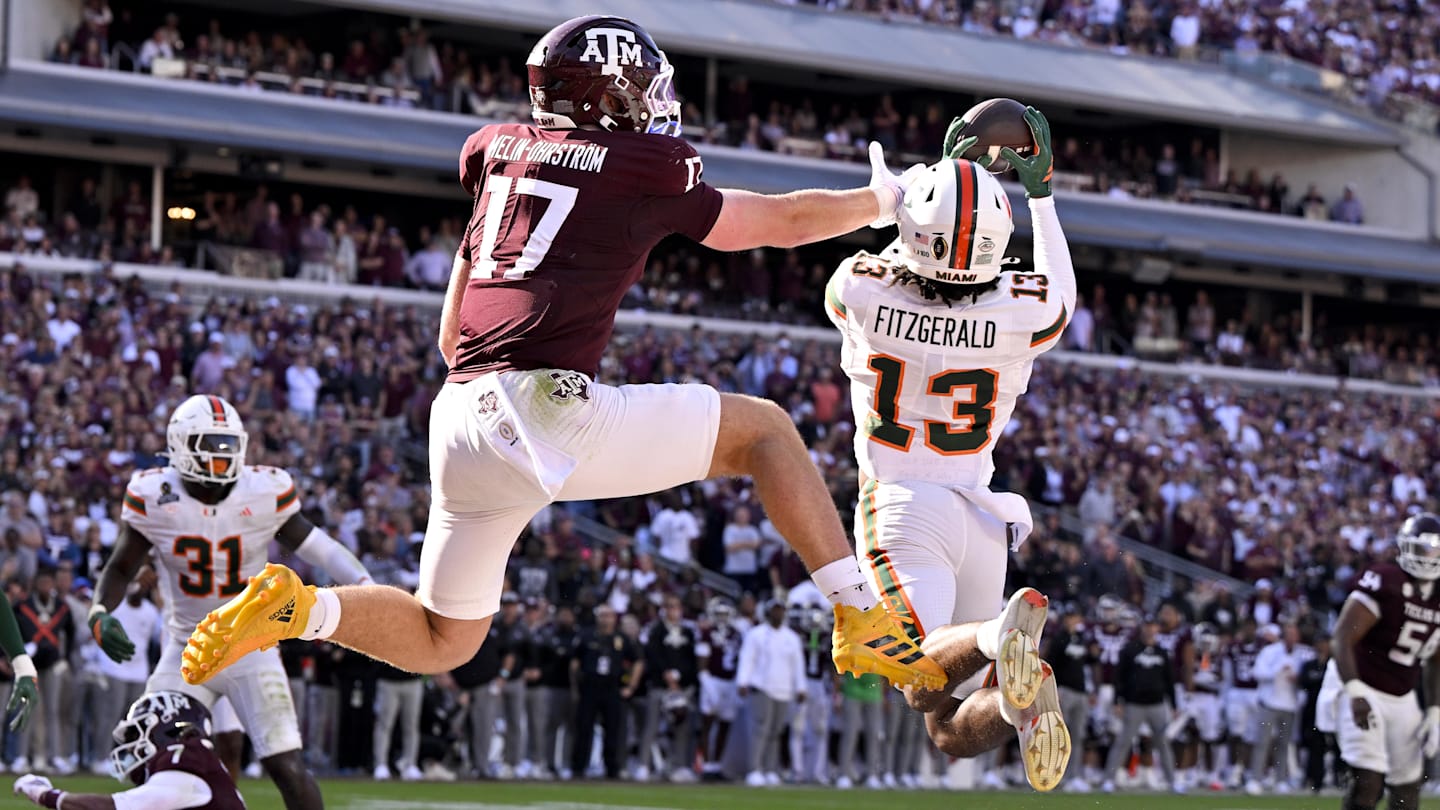
As College Football HQ On SI’s Joe Cox noted, there were several reasons why ratings were down from last year: the NFL hosted a high-stakes NFC North showdown between the Green Bay Packers and Chicago Bears that featured a major comeback and overtime win on the same day, the Notre Dame Fighting Irish didn’t make the field over the Group of 5’s Tulane Green Wave and James Madison Dukes, and the weekend’s closest matchup, the Miami Hurricanes and the TAMU Aggies at Kyle Field, was put on at 11 AM central on Saturday morning.
The Tulane-Ole Miss Rebels and James Madison-Oregon Ducks games, as Cox relayed, also suffered from being on Viacom networks and not the ESPN family of networks like the Miami-TAMU and Alabama Crimson Tide-Oklahoma Sooners games.
“The most obvious issue was that Saturday’s battle of James Madison and Oregon went head-to-head with an NFL game. The Chicago Bears and Green Bay Packers drew nearly five times the viewership of JMU and Oregon,” Cox prefaced before saying, “For that matter, the presence of James Madison probably made a difference. While basketball’s NCAA Tournament draws significant interest in upsets, having a pair of Group of Five teams in the Playoff at the expense of a traditional power like Notre Dame doubtlessly prompted a dip in the ratings.
“The television channels themselves were also likely part of the problem. Both Tulane/Ole Miss and James Madison/Oregon were shown on TNT/TBS/TruTV. Accordingly, the earlier game drew 6.2 million viewers while the latter averaged 4.4 million. While those numbers were down from 8.6 million on those channels for Texas vs. Clemson a year ago, the reduced footpring of those channels versus ABC or ESPN, likely had some impact.
“After all, the early Saturday game of Texas A&M vs. Miami and Friday’s Alabama/Oklahoma battle both drew very nice viewing audiences. Those two games averaged 14.8 and 14.9 million viewers, respectively. That represented about a 10% increase from first-round viewership of Notre Dame vs. Indiana a season ago.
“But then again, the timing of the games might have held significance too. It was very likely, among the three games, that Texas A&M’s game with Miami would likely be more competitive that either of the G5 games. Nonetheless, A&M and Miami drew the earliest TV viewing window, which also likely impacted the final numbers for the weekend.”
CFP facing unnatural arguments forcing it to change
College Football is too obviously business-focused in plain sight.
Why is it a talking point for television ratings to be maximized anyway? Was there an existential panic over the 2023 Final Four having worse ratings with the UConn Huskies, San Diego State Aztecs, Florida Atlantic Owls, and Miami Hurricanes that had the sport’s decision-makers clamoring for changes to March Madness?
Perhaps these rev-share payouts are starting to catch up to these schools. Notre Dame not getting a piece of the CFP pie caused a bigger stir than anyone could’ve imagined, especially for one of the six biggest revenue-producing collegiate sports teams in existence.
Never before have a sport’s collective viewing audience cared so much about millionaire T.V. executives’ pockets.
They’ll be okay. So will College Football for giving the Green Wave and Dukes a chance.