
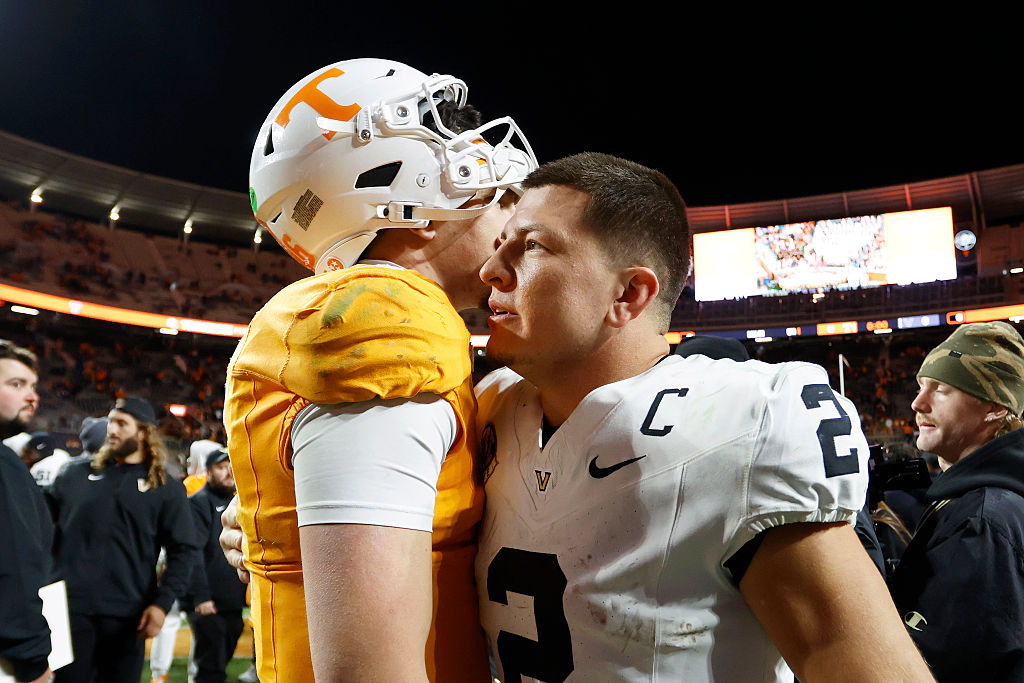
Diego Pavia might be ready to test his abilities in the professional ranks, but he’s not done fighting the NCAA for eligibility for other players who also competed at the JUCO level.
Right now, the NCAA has a perception problem, though that revelation should not come as a surprise. The problem is that, since the organization is tired of fighting eligibility matters in a court room, it is essentially throwing up its hands regarding previous rules that were enforced.
On Friday, Pavia’s attorney, Ryan Downton, filed a memorandum in a Tennessee federal court in which he cited the NCAA’s latest decision that has drawn headlines across college athletics. What were they discussing in their latest filing? Well, that coincides with the NCAA allowing 21-year-old James Nnaji to enroll at Baylor, while also being granted four years of eligibility.
The Big One: College Athletes File Lawsuit Against NCAA To Change The ‘Redshirt Rule’
The problem is that Nnaji was drafted 31st by the Detroit Pistons, while also playing four years of professional basketball in Europe. Even though he never took the court in an actual NBA game, he did participate in the summer league, while at the same time collecting a professional paycheck playing basketball overseas.
“He will be 25 before he runs out of eligibility. Meanwhile, the NCAA argues to this Court that high school seniors are harmed if a 22- or 23-year-old former junior college player plays one more year of college football,” part of the court filing reads.
Sure, we’ve seen numerous players who have participated in basketball overseas before deciding to try their hand at college basketball. But, not a player who had already been drafted by a professional association.
So, why will he receive multiple years of eligibility at Baylor, and players like Tennessee QB Joey Aguilar not be able to play another season because of rules centered around JUCO participation?
Diego Pavia Is Headed For Professional Ball, But Still Helping
Don’t forget, Diego Pavia sued the NCAA in November 2024 for another season of eligibility, where he cited NCAA rules pertaining to how many years athletes have to complete four seasons of competitive play. No matter if the school attended is not at the NCAA level, it still counts towards a players’ clock, which is what this lawsuit is imploring a judge to change.
Right now, athletes get five years to play four years of seasons of ball. This antitrust lawsuit is hoping a judge will rule that athletes would get five years to play five seasons.
In addition to Pavia, there are 26 other plaintiffs, which includes Joey Aguilar. In Friday’s filing, attorney Ryan Downton is asking the judge to rule immediately, which would allow these plaintiffs to participate next season, while the case is continued.
“Plaintiffs asks the Court to judicially extend the waiver issued by the NCAA in response to this Court’s own prior ruling until the conclusion of this case”
Also, Downton decided to have a little fun during the holiday season, using The Night Before Christmas to open their new memorandum.
‘Twas the night before Christmas And all through the NCAA clearinghouse. Not a creature was stirring Not even a mouse,” the filing began. “The stockings were hung by the chimney with care. In hopes that new eligibility soon would be there. Clients were nestled all snug in their beds. While visions of touchdowns danced in their heads. Judges in their robes and me in my cap Were all settled down for a long winter’s nap. When out on the internet there arose such a clatter
“I sprang from my desk to see what was the matter. Away to my phone I flew like a flash. Tore open my email and noticed the cash. When what to my wandering eyes should appear, but…the hypocrisy of the NCAA granting four years of eligibility to a 21-year-old European professional basketball player with four years of professional experience who was drafted by an NBA team two years ago..”
NCAA System Is Now Just A Joke, Making It Up As We Go
While players are receiving eligibility after already competing in the professional ranks, athletes who participated in at least one year of JUCO are taking a hit.
And, it’s not just the ones who played at a lower level that are suffering.
The NCAA’s redshirt rules have also turned into a massive problem. On Friday night, one Power-4 college football coach spoke to OutKick about one of his players being denied a 5th year of eligibility, due to him participating during his freshman year in just 79 snaps.
“How about a kid that’s been in school for 4 years and in his freshman year he played 79 snaps that cost him a red-shirt? And he can’t get a 5th year,” the coach said. “4 for 5 or 5 for 5, it shouldn’t matter. Especially with roster limits. Just go 5 for 5.”
There is currently a lawsuit making its way through the court system that is challenging the NCAA’s stance on redshirt years, led by Vanderbilt linebacker Langston Patterson.
If we are going to give former professional players the opportunity to enroll in college, then the rules need to be changed for all.
Right now, the NCAA is making decisions that won’t lead to sitting in a courtroom, while trying to make up new rules as we go.
The next shoe to drop is a basketball player receiving a better offer to leave the G-League for a return to college ball. Or, a football player being signed to an NFL practice squad, then hoping for a return to the field.
If we allow former MLB players to return to college in order to participate in a different sport, why are we arguing about athletes wanting five years to play five seasons of competitive athletics?