
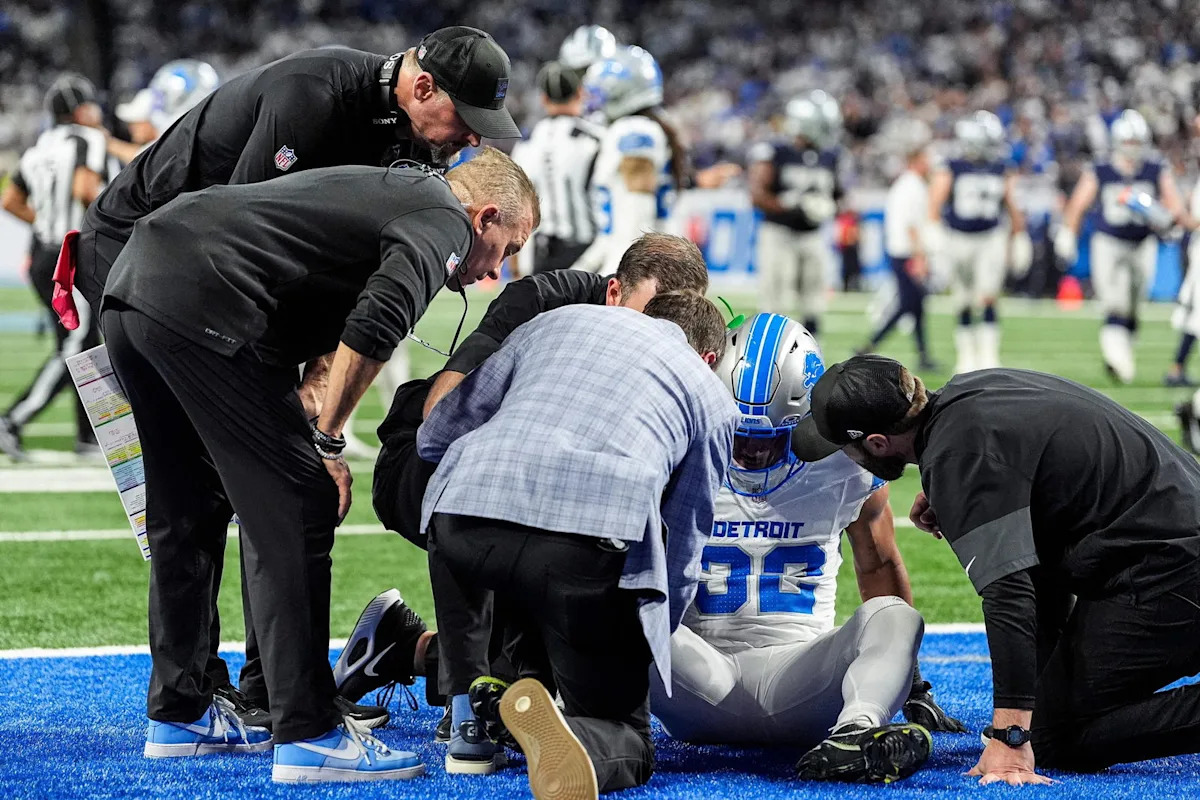
Are Injuries the Root of Detroit’s Problems? A Deep Dive Into a Season Derailed
The Detroit Lions once again find themselves asking a familiar question: How much did injuries shape the outcome of their season? A closer look suggests the answer is—significantly. Detroit finished the year tied for the most players placed on injured reserve (IR) or the physically unable to perform (PUP) list, a staggering number that steadily eroded depth and continuity, particularly on defense.
Advertisement
Offensive Injuries: Mostly Stable, But Not Untouched
For much of the season, Detroit’s offense remained relatively healthy, especially compared to the defensive unit. Still, there were notable disruptions along the way.
Left tackle Taylor Decker missed Weeks 4 and 5 with a shoulder injury, briefly forcing the Lions to reshuffle the offensive line. Starting left guard Christian Mahogany was sidelined from Weeks 10 through 15 with a fractured fibula, while center Graham Glasgow missed two games (Weeks 13 and 15). Despite those absences, the Lions were fortunate to have stability elsewhere. Rookie guard Tate Ratledge played the entire season, as did All-Pro right tackle Penei Sewell.
Advertisement
The skill positions largely avoided long-term injuries. Quarterback Jared Goff did not miss a snap, once again proving his durability. Running backs David Montgomery and Jahmyr Gibbs also played every game, anchoring one of the league’s most productive backfields. Wide receiver Amon-Ra St. Brown technically did not miss a game, though his Thanksgiving scare was concerning—he exited on the Lions’ third offensive play and did not return.
Jameson Williams completed his first full NFL season after injuries and a suspension derailed his first three years. The biggest blow came in Week 10, when tight end Sam LaPorta suffered a back injury that required season-ending surgery. His absence was compounded two weeks later when backup Brock Wright sustained a rare trachea injury, landing him on IR. Veteran return specialist Kalif Raymond also missed two games due to an ankle injury.
Defensive Injuries: A Unit Overwhelmed
If the offense bent, the defense broke.
Advertisement
Detroit’s defensive unit was decimated by injuries from the opening weeks through the final stretch. Defensive end Marcus Davenport was placed on IR with a chest injury, missing nine games. Cornerback DJ Reed suffered a torn hamstring in Week 4, sidelining him for six games, and upon his return, he clearly was not the same player.
Some bright spots remained. Linebacker Jack Campbell and edge rusher Aidan Hutchinson played every game, providing much-needed stability. Linebackers Derrick Barnes and Alex Anzalone also did not miss time. Defensive tackle Alim McNeill, however, missed the first six games while recovering from a torn ACL suffered the previous season.
Even before the season began, the Lions lost cornerback Ennis Rakestraw, a former second-round pick, to a season-ending shoulder injury. Another former second-rounder, Josh Paschal, was unable to fully recover from a lingering back injury while also battling cancer. Malcolm Rodriguez missed the first 10 games while rehabbing a torn ACL.
Advertisement
Rookie corner Terrion Arnold endured a brutal stretch. He played four games before injuring his shoulder in Week 5, missed two games, returned, then suffered a concussion that cost him another two weeks. In Week 13, Arnold reinjured the same shoulder and opted for surgery, ending his season.
Safety Kerby Joseph’s injury timeline was equally frustrating. He initially injured his knee in Week 4, returned in Week 5, then aggravated it in Week 6. Hoping for a short recovery, the Lions delayed placing him on IR, but after a setback following six missed weeks, his season was ultimately shut down.
The final blow came in Week 14 when Brian Branch suffered a torn Achilles—an injury that immediately ended his season and fundamentally altered Detroit’s defense during the most critical stretch.
Advertisement
The Bigger Picture
There is no question injuries played a major role in Detroit’s defensive collapse over the final five weeks. Forced to rely on backups and practice-squad players, the Lions struggled to maintain consistency and execution. For fans, the lingering question remains unavoidable: What could this team have been with a healthy defense?
Instead of answers, Detroit is left with another season defined not just by promise, but by attrition.