
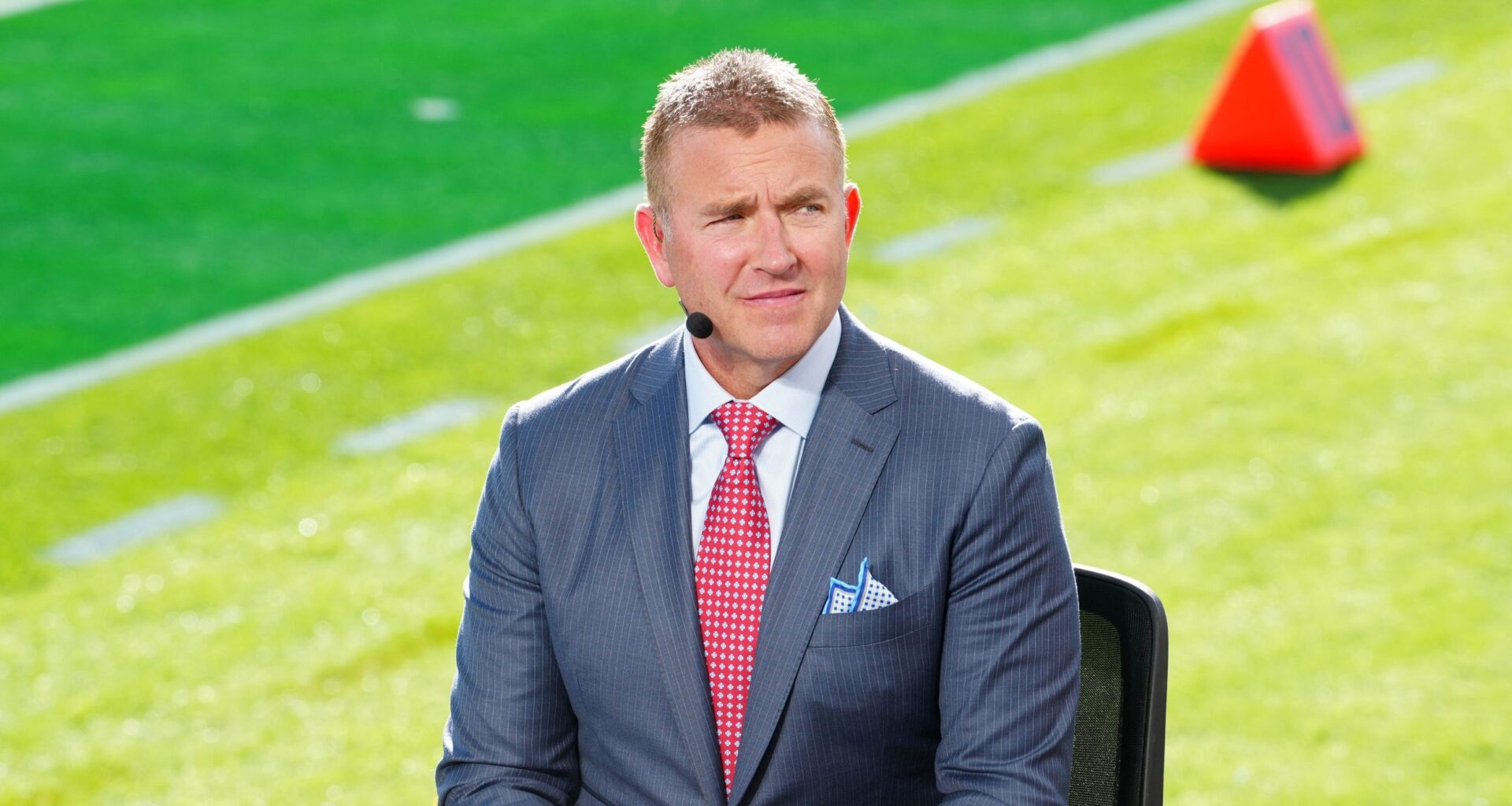
Kirk Herbstreit admitted he once questioned ESPN’s bowl game strategy directly to the network’s face, and it didn’t go over particularly well.
During the most recent episode of his Nonstop with Kirk and Joey podcast, the College GameDay analyst revealed to his co-host, Joey Galloway, that he had previously raised concerns about bowl game oversaturation at an ESPN seminar, arguing that placing 6-6 teams in bowls diminishes what should be a reward for successful seasons.
“I feel like I said this at a seminar one time,” Herbstreit said. “The back of the room — when you and I sit back there — I’ll raise my hand, pull the button down, pull the mic down, and say, ‘Are we creating too many bowl games? Bowl games are supposed to be special. They’re supposed to be a reward for a great year. Do we have to have all these 6-6 teams and like creating these bowl games just because they rate well? I feel like we’re oversaturating the bowl season.’ And that didn’t go over real well when I brought that up at the ESPN seminar.”
Herbstreit’s bringing this issue back to the forefront comes as bowl season has expanded dramatically over the past two decades. College football now has 43 bowl games, meaning 86 teams participate in postseason play. That requires teams to reach just 6-6 to qualify, a threshold Herbstreit clearly thinks is too low.
“It used to be what, 15-18 bowls forever?” Herbstreit said. “And you basically had to be 8-4 to even have a chance to be in. There were a lot of 8-4 teams that didn’t go to bowl games back in the olden days. And now, sh*t, they’re looking for anybody that has a roster to go to a bowl game.”
Ahead of the 2024 playoff, Herbstreit openly questioned whether non-playoff bowl games should exist at all if players don’t want to play in them. This time, though, he acknowledged that he’s been pushing against the same issue internally for years.
“I feel bad because when I turn into a bowl game that actually has good teams that had good seasons, I’m dialed in,” Herbstreit said. “Let’s go. I don’t care if it’s FBS, Group of Five, Power Four, whatever it is. If it’s two teams that have had good years, put them out there and let’s watch them play. So, that was the first part of what started to deteriorate bowl season. And then the second part was, ‘I’m not going to play. What’s the point in playing? It’s an exhibition. Who cares?’ So those two things, I think, have turned the bowl season into why should we even bother?”
Even so, Herbstreit hasn’t tuned out entirely. He pointed to games like Penn State’s Pinstripe Bowl win over Clemson and BYU vs. Georgia Tech in the Pop-Tarts Bowl as proof the concept still works — when both teams show up.
“I’m still a dinosaur. I’m still a guy that if there’s a bowl game on, chances are I’m going to give it every opportunity to chase me away,” Herbstreit continued. “If it’s just bad football or you’re like, ‘Where’s that guy?… What’s the point in watching? This isn’t even the same team that’s playing.’ But there have been a few. Like, the Penn State game was great. The Georgia Tech-BYU game. I couldn’t turn that off. That was an amazing game.”
Those games are the exception, not the rule — and that’s the point Herbstreit keeps circling back to. His issue isn’t with bowl games themselves, but with how diluted they’ve become and how often they feel like obligations rather than rewards.
That’s an uncomfortable truth for a network that profits from volume rather than selectivity. And judging by the reaction he got, it’s one ESPN isn’t eager to revisit.